
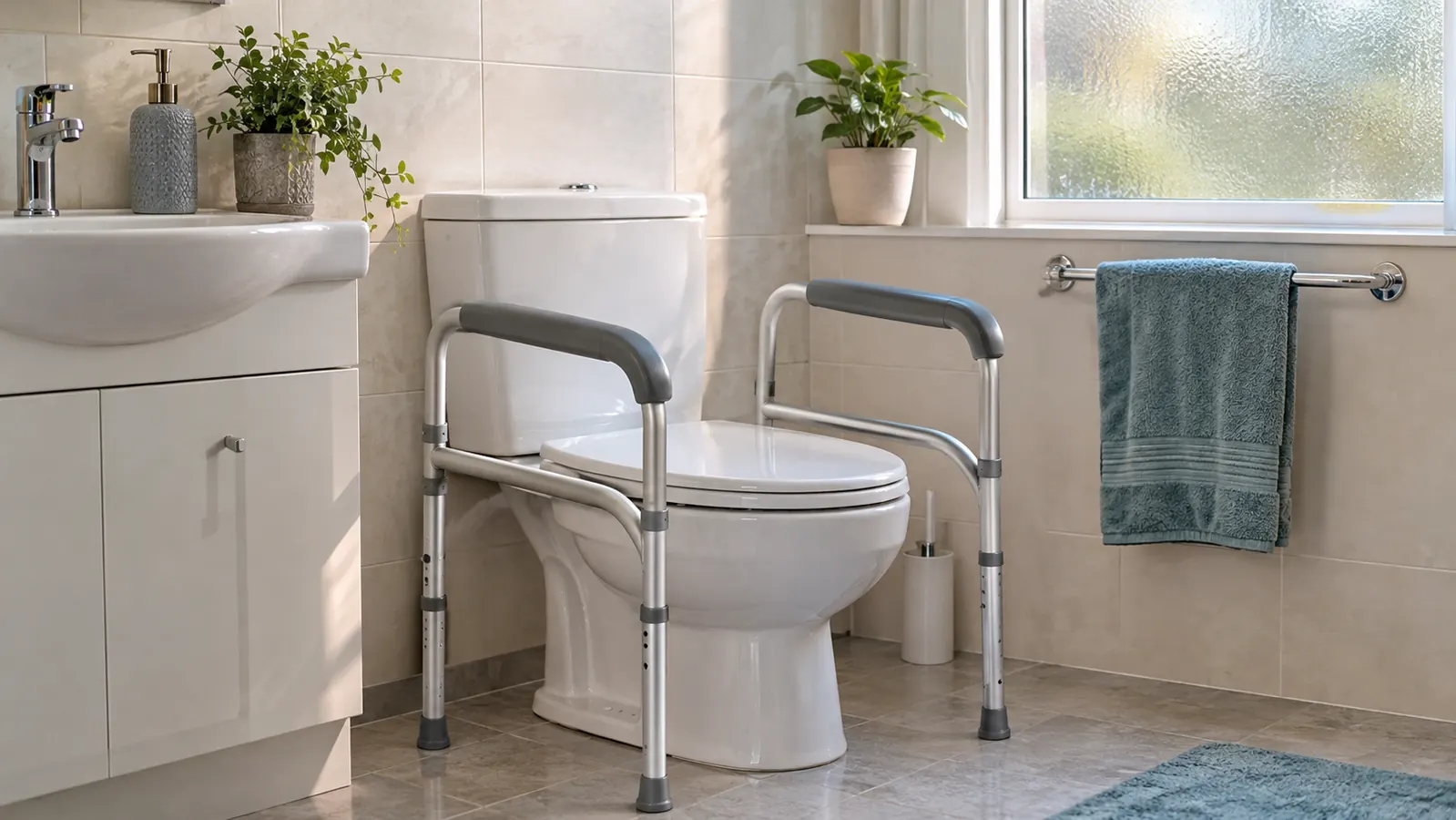
The first time I watched Marge push herself up off the toilet by leaning her weight on the sink edge, I knew that sink was going to give before she did. That was late February 2026, a couple of weeks after my right knee replacement, and I was moving around that bathroom like a man with a new hinge. We had one bathroom in that house then and we still have one, a standard toilet in a standard little room, with no aid of any kind bolted to anything. Marge has arthritis in both knees and her balance has gotten less steady over the last few years. She had been pushing off the sink. I had been using the towel bar, which is not a grab bar and never was, and I could feel it flex under my hand. In March I bought the Medline Toilet Safety Rail and fastened it to the toilet with the seat's own bolts. Eight months later it is still there and still tight. A raised toilet seat is the other thing people bring up when this subject comes around, so here is how the two compare in a real house with one bathroom and two people who both need a hand.
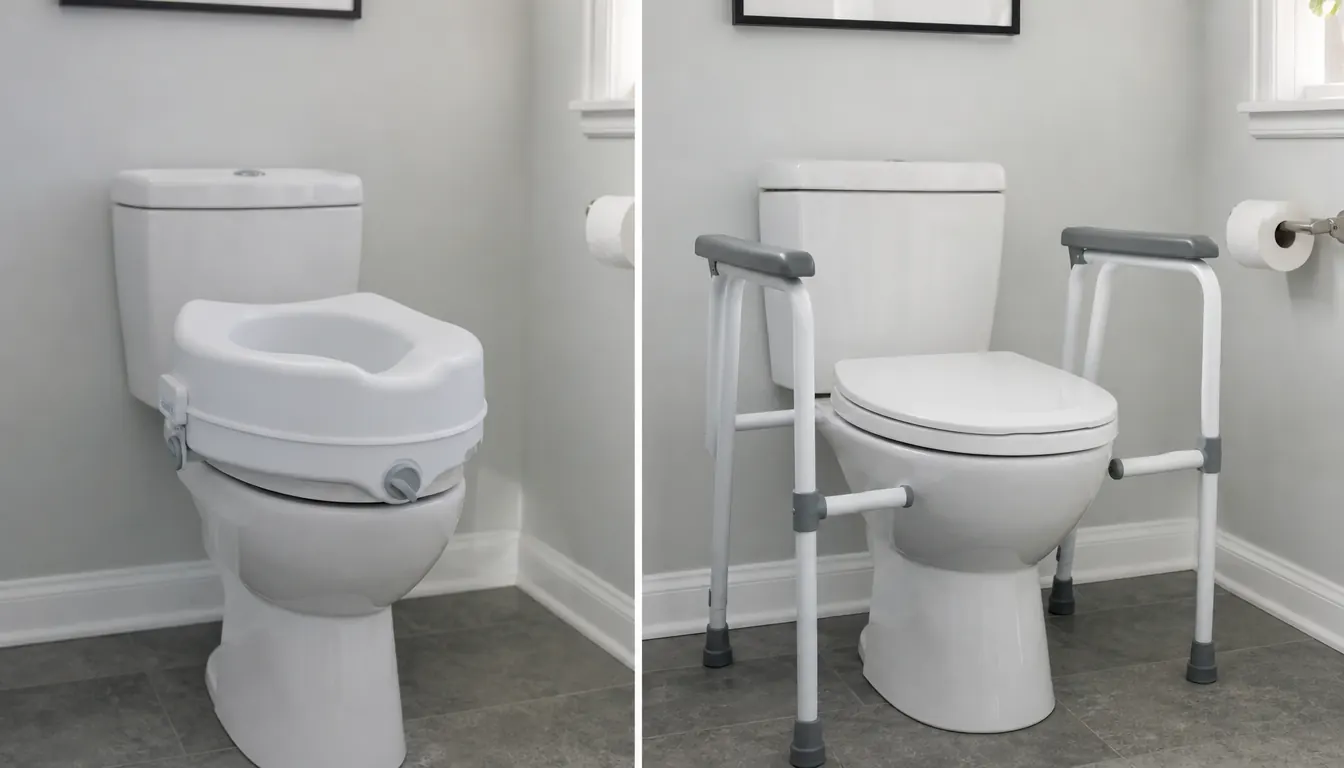
Here is the short answer. If sitting down and standing up at the toilet is the hard part, the Medline rail helps more, because it gives you two arm rests to push from and steady yourself with. A raised toilet seat helps by making the seat higher, which means less bend in your knees and hips. Those are different jobs. One gives you leverage. The other changes the height. For us the leverage mattered more, and I will show you why in a minute. Your situation may be different, and that is worth saying plain before we go any further.
| Medline Toilet Safety Rail | Raised Toilet Seat | |
|---|---|---|
| Main job | Adds arm rests and a steady grip around the existing toilet | Raises the seat height so there is less to bend |
| Installation | Uses the toilet seat bolts; I tightened them with a wrench and check them every couple of months | Lifts onto the bowl or clamps on, depending on the model |
| Arm support | Two arm rests to push up from and hold while seated | No arms; you still need something else to push from |
| Seat height | Does not raise the seat | Raises the seat, which can help if the toilet feels too low |
| Height adjustment | Arms adjust from 27.5 to 31.5 inches | Usually a fixed rise with no arm adjustment |
| Floor space | Legs reach the floor and take up room beside the bowl | Sits on the bowl and stays compact |
| Fit | Fits most toilets; width between arms is 18 to 24 inches | Has to match the bowl shape and the way it mounts |
| Cleaning | Aluminum frame with a scratch-resistant powder coating wipes down | Removable on many models, but seams and brackets can trap grime |
| Travel | Bolted on, so it stays home | Can be lifted off and taken along |
| Best for | Daily sitting and standing with arm support | A simple height boost or a temporary setup |
Where the Medline Toilet Safety Rail Wins
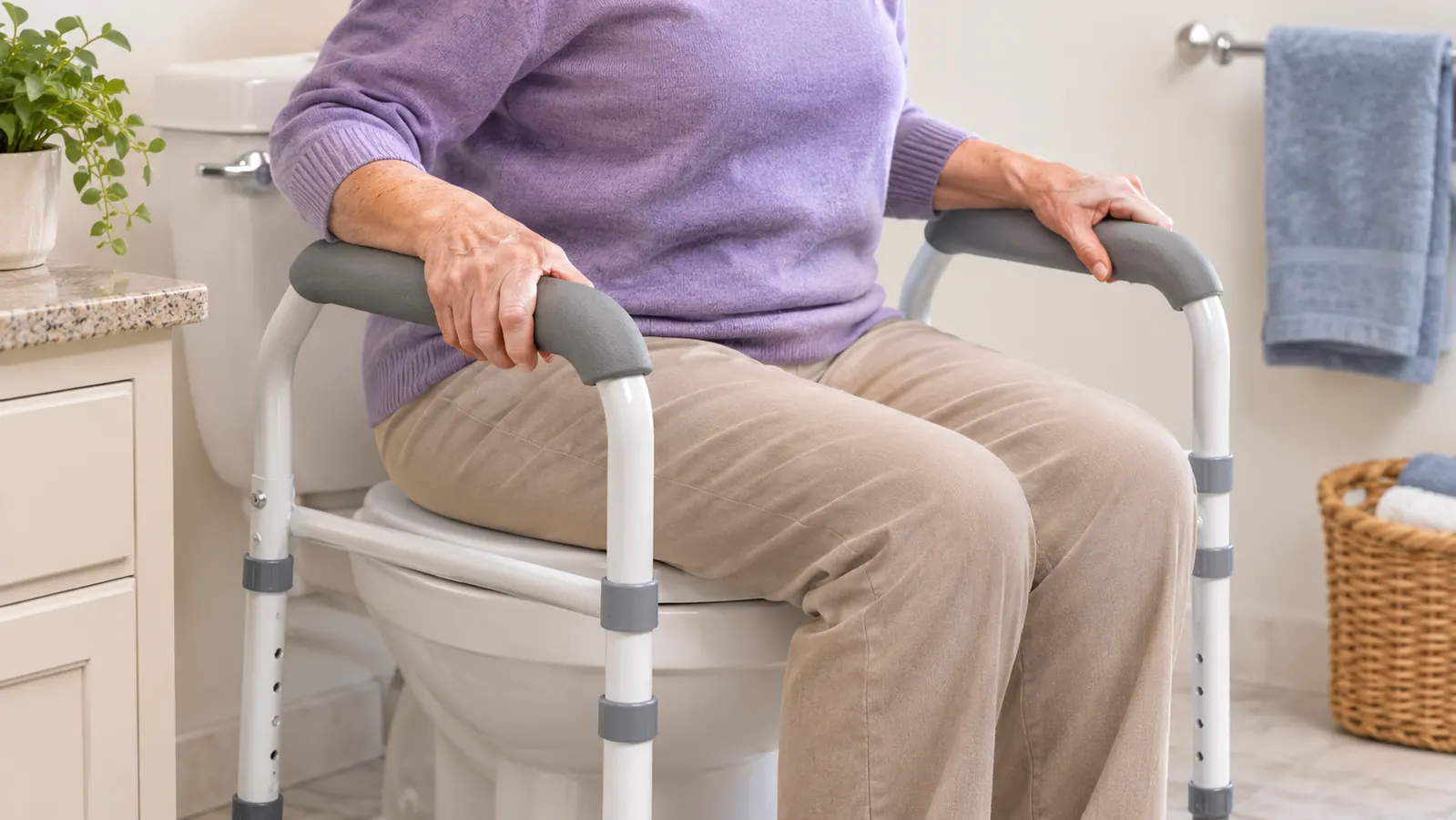
The rail wins on the part that was actually missing in our bathroom, which was something to hold. When Marge sits down she puts her right hand on the far arm rest and her left on the near one, lowers herself slow, and then when she stands she pushes down on both. I do the same thing, more so at night when the knee has stiffened up from sitting in the chair. The rail does not make the toilet taller. It gives you a place to put your hands, and that changes how much work your knees and your back have to do. My physical therapist had me practice standing from a seat with arms and then from one without, back in the spring during my sessions. The difference was plain and it matched what I felt at home. With arms I could push straight down and keep my weight over my feet. Without them I had to lean forward further and catch myself, and that is the part that made me nervous. I am not a physical therapist and I am not going to pretend to be one. What I can tell you is that the hardware gave me a straight push instead of a twist toward the sink.
It also wins on fit and adjustment, and that is where the numbers matter. The frame is aluminum with a scratch-resistant powder coating and it weighs 4.4 pounds. The arms adjust from 27.5 to 31.5 inches, and I set them once the week I installed it, using Marge's reach rather than mine, since she is the shorter one at 5 foot 4. The rail measures 29 inches deep by 19.8 inches wide by 3 inches high, and the width between the arms runs 18 to 24 inches, which fit around our standard bowl without crowding the tank. There is no drilling. It uses the seat bolts, the same two that hold the lid on, and I ran them down with a socket and a ratchet. Every couple of months I put a wrench on them and take up a quarter turn. That is the whole upkeep, and it takes about two minutes. The legs reach the floor. In our bathroom that means the rail takes up a little room on either side of the bowl, and you notice it the first week and then you stop noticing it at all.
Where a Raised Toilet Seat Wins
A raised toilet seat does one thing the rail does not, and that is raise the seat. If your trouble is the drop down and the push up because the toilet sits low, that extra height is the help you want. My physical therapist had me stand from a low seat and from a higher one during the same session this spring, and the higher one was easier on my knee. That is not a medical recommendation, it is what I felt in that room on that day. If the bend itself is your problem, a raised seat may do more for you than a rail, and I would not argue with anybody about that. A friend at church used one after his hip surgery and told me he liked it because there was nothing to install and he could carry it to his daughter's house in the car. Another friend said it made the seat feel perched to him, a little less solid than what he was used to. Both of those are honest reports. It depends on the model and on the bowl.
It also wins on simplicity and on space. A raised seat lifts onto the bowl or clamps to it, depending on the model, and there is no frame standing beside the toilet. In a small bathroom that counts for something. If you travel or visit family, you can take it with you, and the rail we have is bolted on and stays where it is. Ours is a one-bathroom house, and floor space in that room is already spoken for. Pepper, our Lab mix, likes to lie in the doorway where the hall carpet meets the tile, and I have stepped around her in that room more times than I can count. A raised seat keeps the floor clear. The tradeoff is the arm rests. A raised seat changes the height. It does not give you leverage, and leverage is what we needed.
The rail that gave us something to push from
The Medline Toilet Safety Rail attaches with the seat bolts, adjusts from 27.5 to 31.5 inches, and gives you two arm rests at the toilet. That is the job it does in our house every morning.
Amazon See the Medline Rail on Amazon →How I Compared Them
I did not buy a raised toilet seat. We have never owned one, and I am not going to write like I have. I compared the Medline rail that is bolted to our toilet against raised seats I have seen at the physical therapy clinic, at friends' houses, and in the listings themselves. The clinic kept both kinds in the back room where they store the equipment, and I looked them over while I waited more than once. At church, a friend told me he used a raised seat after his hip surgery and liked it because it was simple and he could take it to his daughter's house. Another friend said it made the seat feel less stable to him. That is the range you get with anything. The listings I read through on a Sunday afternoon told me what I already suspected, which is that a raised seat is mostly a height question and a rail is mostly a leverage question, and no listing is going to settle that for you.
The Medline rail is the only one of the two in our bathroom. It is bolted to the toilet and the legs reach the floor. I am not a doctor or a physical therapist. If you are deciding for yourself or for your wife, ask your own physical therapist or doctor about your knees, hips and balance. What I can tell you is what the hardware does and how it held up in daily use.
The Daily Difference in Our Bathroom
Marge uses the rail every morning and on the night trips, and I have watched her do it enough times to know the order. Right hand on the far arm rest, left hand on the near one, sit down slow, then push up on both. Before the rail she used the sink edge. Before that she had tried the towel bar for about a week in February, and it moved when she put weight on it, which scared her enough to stop. The rail does not move. The legs reach the floor and the frame is bolted through the seat bolts. One morning in April I watched her come out of that bathroom at a quarter to six and she said it was the first time in months she had not had to think about it first. That is the kind of thing you cannot put in a spec sheet. I put a wrench on the bolts every couple of months, and they have needed a quarter turn twice since March.
I use it too, and the first month after surgery was the real test. The rail gave me a place to push from without twisting toward the sink, which was the move that hurt. I still use it now, mostly at night when the knee is stiff from sitting. It does not raise the seat, so I still bend as far as the toilet requires, and on a bad morning that bend is the whole problem. If the bend is your problem, a raised seat may be the better first purchase. If the problem is finding something solid to push from, the rail is what helped us. I would rather tell you that plain than sell you a rail you do not need.
The rail does not make the toilet taller. It gives you something solid to push from, and that was the part we were missing.
Who Should Buy Which
Buy the Medline Toilet Safety Rail if you want arm support at the toilet every day, if the bathroom you use most is the one it would go in, and if you are willing to tighten four bolts and put a wrench on them now and then. It fits most toilets, and the arms adjust from 27.5 to 31.5 inches, so it will take a taller person or a shorter one without changing the hardware. It is the right choice for a household like ours, where two people use the same toilet and both of them want something to hold on to. It is also the choice if you have a standard toilet and you do not want to pull the seat and put a different one on. What it will not do is make the seat higher, so if the height is your complaint, read the next paragraph before you order.
Buy a raised toilet seat if the height is the problem, if you need something you can lift off and carry, or if you want the simplest possible setup with nothing to install. It does not give you arms, so if you need leverage as well, plan on a rail or a wall support to go with it, and talk to your physical therapist about what makes sense for your balance. Do not buy both in the same week without measuring. The rail's legs need floor space on either side of the bowl, and a raised seat sits right where the rail's arms are, so the two together can crowd each other and crowd you. In our house the rail did the job and we never went looking for the other one. In yours the height may be the first thing to fix, and there is no shame in that. Ask your doctor or your physical therapist about the fit and about your balance before you spend the money.
The one we kept bolted to the toilet
Eight months in, the Medline Toilet Safety Rail is still the aid we reach for every morning. It fits most toilets, adjusts from 27.5 to 31.5 inches, and gives you two arm rests to push from.
Amazon See the Medline Rail on Amazon →