
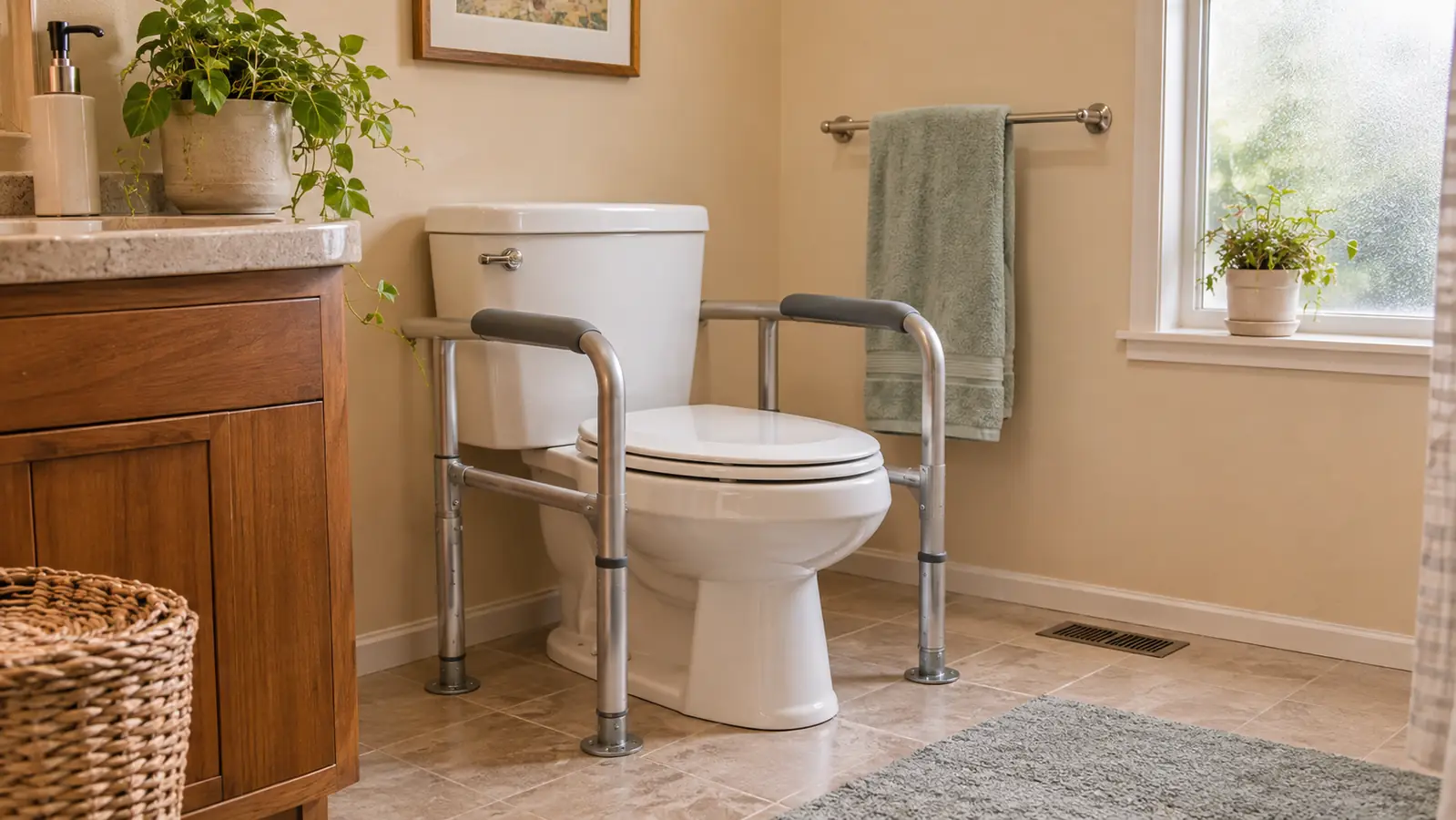
The towel bar in our bathroom is not a grab bar, and I knew that. Knowing a thing and changing your habits are two different animals, though. All winter Marge pushed herself up off the toilet with her hand flat on the sink edge, and I pushed up on that towel bar. In March I set a level against it and watched one of the screws back out of the drywall about a quarter inch. That ended the argument. I ordered the Medline toilet safety rail that Saturday, and it has been bolted to our toilet for about eight months now.
I'm Hal Brennecke. I'm 74, I spent 38 years as an HVAC service technician in other people's houses, and I install everything in ours myself. Marge is 72, she has arthritis in both knees, and her balance has gotten less sure over the last few years. I had my right knee replaced in February 2026. Between the two of us, the six feet of floor in front of that toilet is the most-used square footage in the house. The Medline rail is the one piece of equipment we both use every single day, which is more than I can say for anything else I bought this year.
The Quick Verdict
Bolts to the toilet's own seat bolts, no drilling, and after eight months the arms still do not shift when I lean on them. The trade is two legs on the floor and a wrench on the bolts every couple of months.
Amazon Check Today's Price →The rail my wife and I have both used every morning since March
It mounts on the seat bolts in about twenty minutes, adjusts for two people of different heights, and puts two arms where there used to be one flat sink edge. Check the frame measurements against your own toilet before you order.
Amazon Check Today's Price on Amazon →How I've Used It
The rail attaches with the same two bolts that hold the toilet seat down. You take the seat off, set the rail's brackets over the bolt holes, set the seat back on top of them, and run the bolts through both. No drill, no anchors in tile, no calling anybody. I had it out of the box and bolted down in about twenty minutes, and ten of those were spent hunting for the right socket.
What I did first, and what nearly tripped me up, is worth a minute of your time. Before I ordered anything I pulled the two seat bolts with a socket to see what they were biting into. The porcelain was fine. One bolt came out clean and the other fought me for ten minutes, because somebody had overtightened it years ago and chewed the shoulders. I cleaned the threads up with a wire brush, wiped the whole flange down, and when the box landed on the porch that Saturday afternoon the install went in one sitting with no bad language. If your seat bolts are rusted or stripped, sort that out before the rail shows up, not after. That is the one step that turns a twenty-minute job into a lost afternoon.
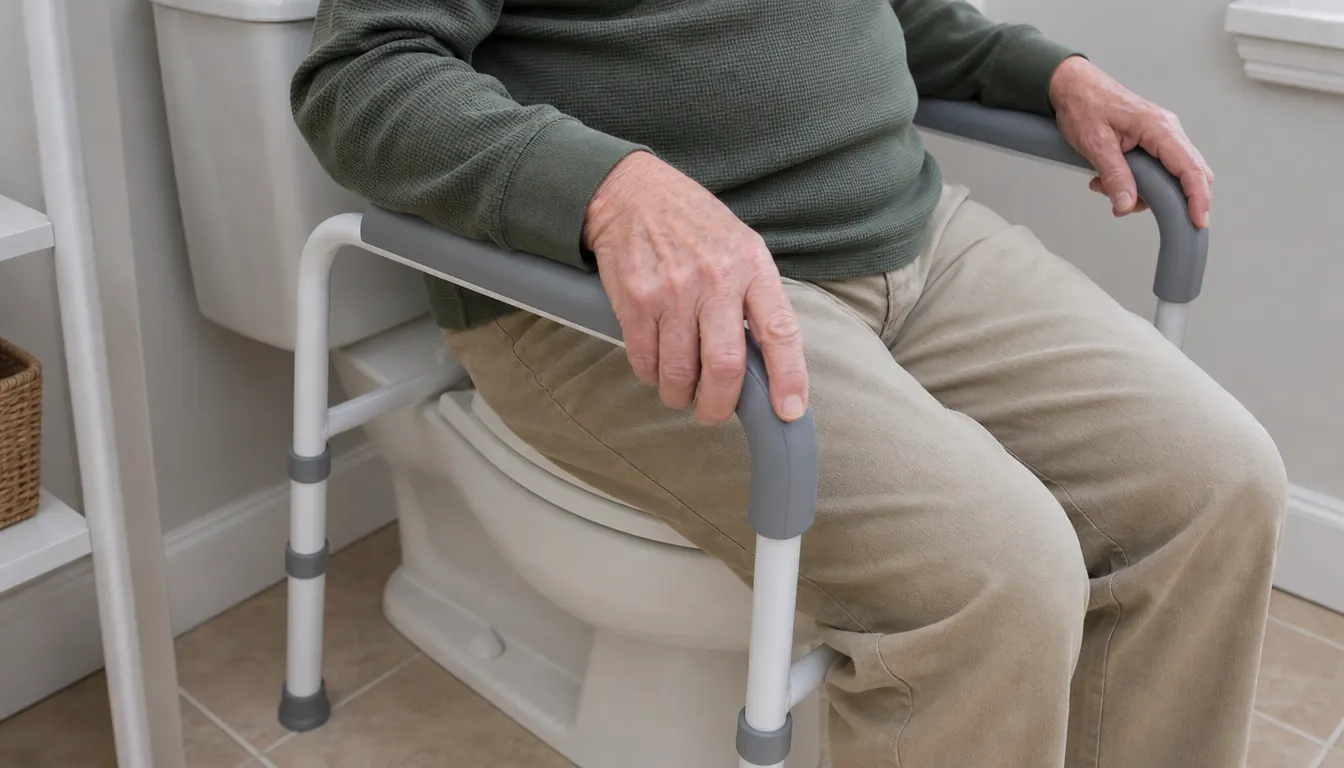
Marge is 5 foot 4 and I'm 5 foot 11, so the arm height that suits her is not the height that suits me. The arms adjust, and I set them once, splitting the difference, then watched her use it for a week before I moved them up one setting. She comes off the seat now with a hand on each arm. I use the right-hand arm, the knee-replacement side, and push up through it. Neither of us has touched the sink edge or that towel bar since March.
The one maintenance item is the bolts. Toilet seat bolts work loose on their own, because people sit down on them a few thousand times a year, and adding a frame you push against speeds that up. I put a wrench on the two bolts about every two months. It takes a minute. If you are the sort of person who will never do that, this is not the product for you, because a rail that rocks is worse than no rail at all.
What Comes in the Box and What It Measures
You get the frame, which is aluminum with a scratch-resistant powder coating, plus the brackets that clamp under the seat and the hardware. It shipped in a box about the size of a golf bag box and everything was in it. The frame weighs about four and a half pounds, so holding it in place with one hand while you start a bolt is not a wrestling match.
Measure your own bathroom before you order and I mean with a tape, not with your eye. Back of the tank to the front of the bowl, wall to whatever sits on the other side, and tile to rim for height. Write those three numbers on the back of a receipt and keep it. Ours came back inside the listed range with room left over, but the number that mattered was none of those three. It was the walkway. I stood in the doorway with the tape and pictured where my feet would land stepping around the legs, and that is the thing a spec sheet cannot tell you. Five minutes with a tape saves a return and a box on the porch.
The footprint is worth measuring before you order. Medline lists the frame at 27.5 to 31.5 inches long, 19 to 22 inches wide, and 27.5 to 31.5 inches high, with 18 to 24 inches between the arms. Ours sits with maybe three inches to spare between the right-hand leg and the wall, which is tight enough that Marge steps around it rather than through it. If your bathroom is the size of a closet, get a tape measure out first.
The seat depth is listed at 16.75 inches and the seat back interior height at 31.5 inches. Those matched our standard-height toilet closely enough that I did not have to shim anything. A comfort-height bowl should still fall inside that range, but I would check the numbers against my own measurements rather than trust a product page, and so should you.
Setting the Height and Getting It Level
The arms adjust in height and the legs reach the floor. That last part is what makes it feel solid. A rail that only clamps at the top can flex when you lean on it. This one has two feet on the tile, so when you push down the load goes into the floor instead of into the toilet.
Here is how I set it for two people. I started with the arms at the low end and had Marge sit down and stand up three times in a row. Too low, she said. She was pulling with her shoulders instead of pushing with her hands, which is the whole thing we were trying to quit doing. I moved them up one setting and had her go again. Better. One more and she said it felt like reaching, so we came back down. The setting we landed on has not moved since March, and I put a pencil mark on the inside of the upright so I would know where it started from if it ever did.
I set the height, then did what I do with every handrail I have ever installed. I put my weight on it. Both hands, leaned forward, pushed down. The frame moved maybe an eighth of an inch before the bolts took up, and then it stopped. I did the same thing a week later and it did not move at all. I check it whenever I am down there with a wrench anyway.
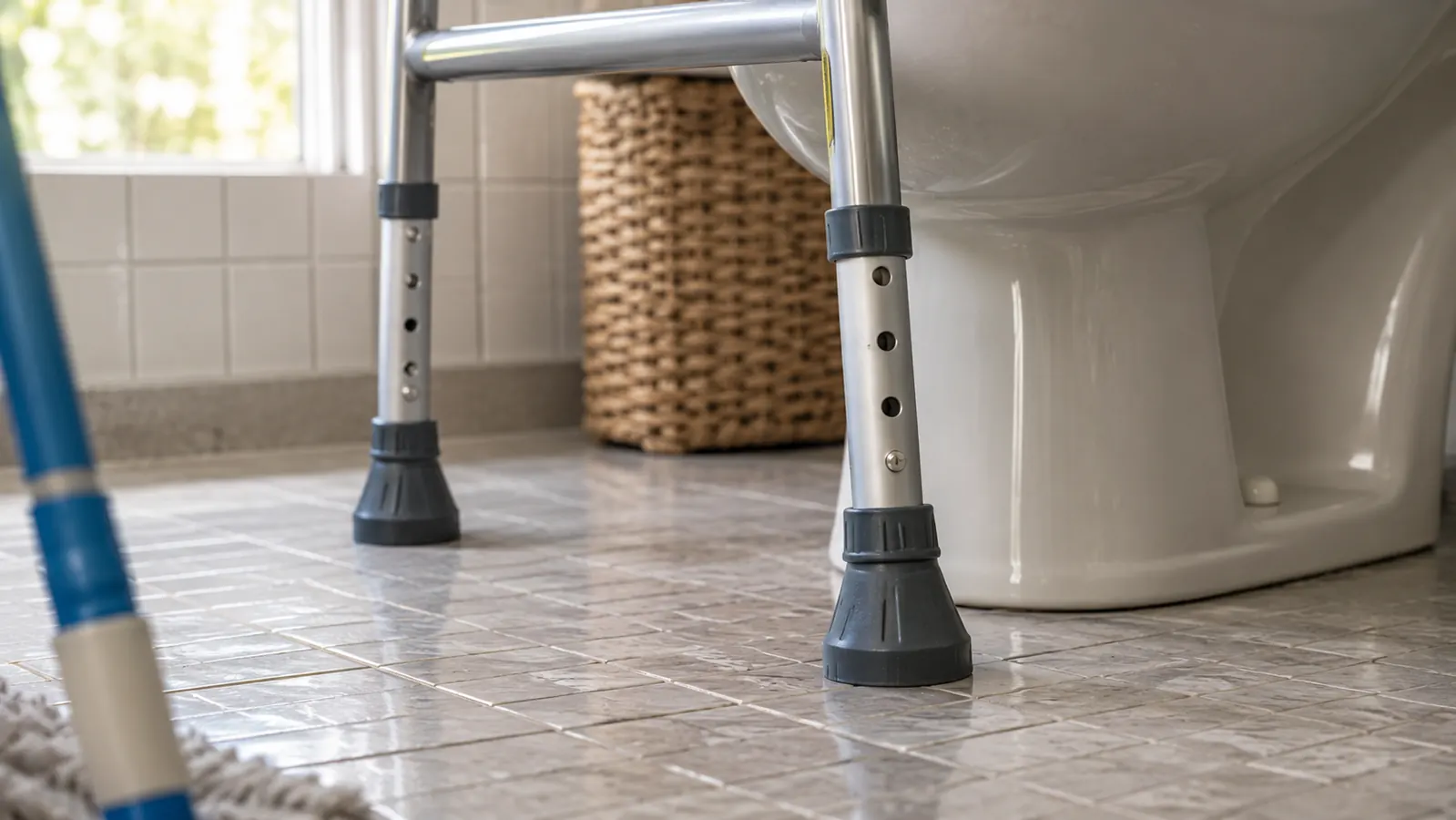
One thing I would tell anybody: get the legs even. If one foot sits on a grout line and the other sits on the tile face, you will feel a rock in the frame and you will blame the rail. I slid a folded piece of cardboard under one foot for a week, decided that was ridiculous, and moved the whole thing two inches to the left so both feet land on flat tile. That solved it.
Pushing off a sink edge, your hand slides. Pushing off a rail, your hand does not. That is a small thing to write down and a large thing to live with.
Eight Months of Daily Use
It is November now and the rail has been in place since March. Nothing on it has broken. The powder coating still looks like it did on day one apart from a couple of water spots I do not bother wiping. The arms do not shift when I push on them. That is the whole review, really. It does the one thing I need it to do and it has done it for eight months without me thinking about it.
One Sunday in July I came in from church with my knee stiff from the pew and the walk across the parking lot, and I did what I do now without deciding to. Hand on the right arm, down slow. Hand on the right arm, up. It was not until I was washing my hands that it registered that the toilet had not crossed my mind at all. That is the point of a thing like this. An aid you have to think about is an aid that is not finished doing its job. This one has gotten quiet, and quiet is what I paid for.
Marge used it first, and she is the one who was pushing off the sink. She has told me more than once that the difference is not the height, it is having two arms instead of one flat edge. Pushing off a sink, your hand slides out from under you. Pushing off a rail, it does not. The towel bar is still on the wall. It holds towels now, which is what it was built for.
For me it is the right-hand arm. After the knee replacement I could not put weight through that leg to stand up for the first couple of months, so I did all of it through my arms and my left leg, and the rail took that without complaint. My physical therapist has me off the rollator for short distances now and I walk the house with a cane, but I still come off that seat through the rail out of habit. The rail stays.
What I'd Change
The legs sit on the floor, and that is both the reason it is stable and the reason I do not love it. Mopping around two feet in a bathroom is a nuisance, and I do it more carefully than I used to, because I do not want to knock the frame and then have to go back and check the bolts.
It is also a permanent-looking thing. Our bathroom now reads like a bathroom in a clinic. Marge does not mind. I do not love it, but I would rather have it than a towel bar pulling out of the drywall with my hand.
Last, the height adjustment has a range and that range has ends. Mine is a standard bowl and I set the arms somewhere in the middle, which means I had room to move in either direction. Somebody with an unusually low or unusually tall bowl might not. Measure before you order and you will not be surprised.
What I Liked
- Bolts to the toilet's own seat bolts, so no drilling and no wall anchors
- Two arms instead of one flat edge to push against, which is what Marge noticed first
- Legs reach the floor, so the frame takes weight instead of flexing
- Aluminum frame with a scratch-resistant powder coating, light enough to hold one-handed during install
- Height adjusts, so a 5 foot 4 person and a 5 foot 11 person can share one rail
Where It Falls Short
- Two legs on the bathroom floor to mop around
- Seat bolts want a wrench on them about every two months
- Takes up floor space, so a very small bathroom gets cramped
- It gives you something to push against, not the strength to push. It does not stand you up by itself
- Looks institutional once it is bolted down
Who This Is For
This is for somebody who needs something solid to push against to sit down and stand up at the toilet, and who has a standard toilet they do not want to replace. It suits two people of different heights sharing one bathroom, which is our situation exactly. It also suits a renter or anybody who does not want holes in the wall, because it uses the seat bolts and comes off the same way it went on.
If balance is the issue rather than strength, talk to your doctor or a physical therapist about what you actually need before you buy anything. I am an HVAC man, not a medical one. I can tell you the frame is solid, the install is simple, and the height range covered our bathroom. I cannot tell you it is the right piece of equipment for your situation.
Who Should Skip It
Skip it if your bathroom is narrow enough that two floor legs would make the room hard to use. Skip it if a raised seat is already doing the job for you, because a raised seat and a rail solve different halves of the same problem and stacking them can leave you sitting higher than you want. And skip it if you need help getting in and out of the tub, because that is a transfer bench job and this rail will not do it.
Most of all, skip it if you will not put a wrench on the two bolts twice a year. A rail that rocks is worse than the sink edge, because you will trust it more than you trusted the sink. The whole value of this thing is that it does not move, and that depends on a minute of maintenance every couple of months.
Still bolted to the same toilet, eight months on
Two arms, no drilling, and a bolt check every couple of months. That is the entire trade, and I would make it again. Check the frame measurements against your own toilet before you order.
Amazon See the Medline Toilet Safety Rail on Amazon →