
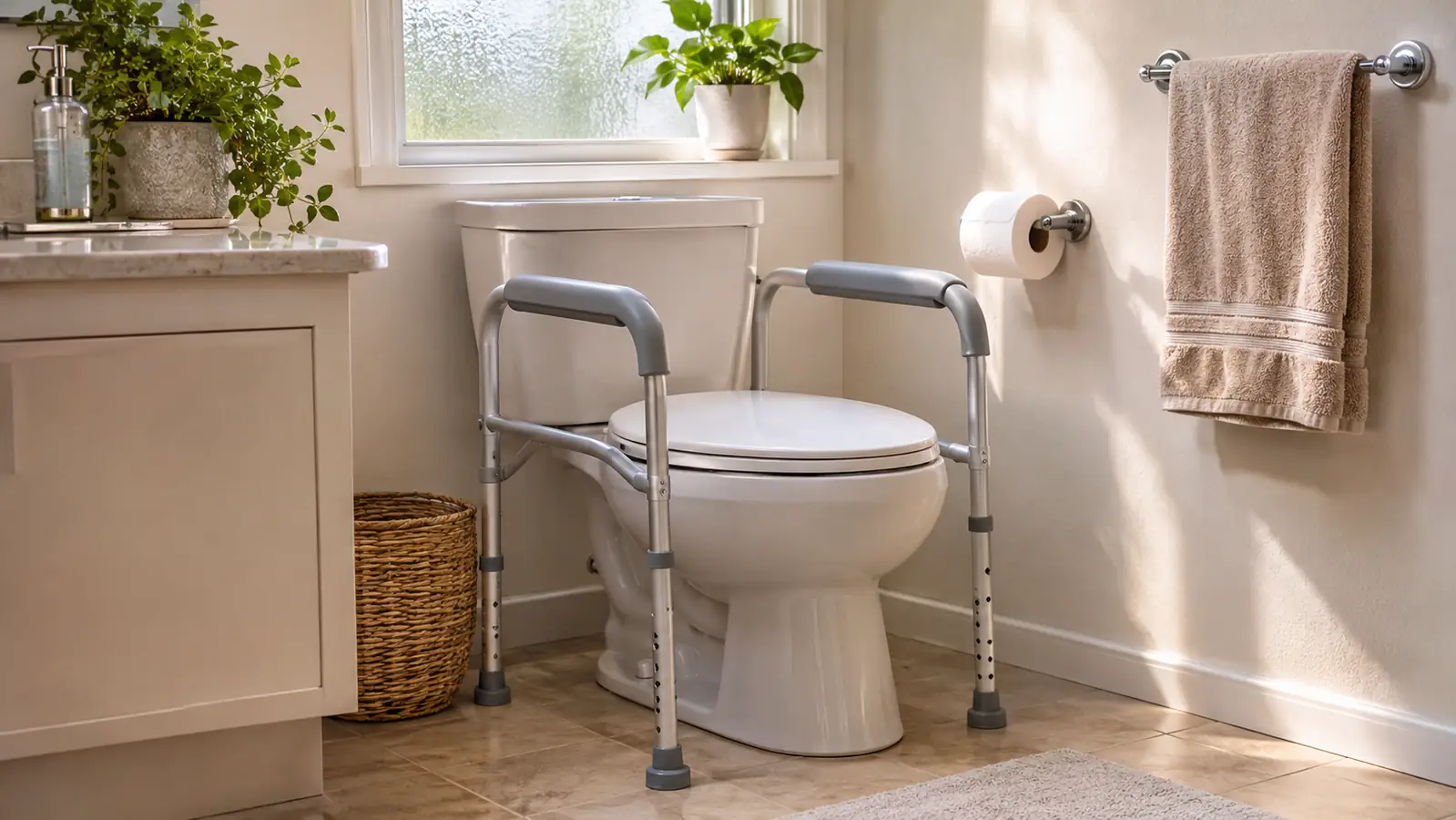
Marge and I have one bathroom. It is a plain little room off the hall with a standard toilet in it, and until this spring the two of us were getting up off that toilet by grabbing whatever happened to be nearby. She used the flat edge of the sink counter. I used the towel bar. That towel bar is screwed into drywall, not into a stud, and I know exactly what a towel bar is not built for, because I spent thirty eight years fixing things in other people's houses for a living.
In March I ordered the Medline toilet safety rail and put it on myself with a wrench. It has been on that toilet about eight months now, and both of us use it every single day. What follows is not a sales pitch. It is ten plain reasons the thing earned its place in a room where I do not keep anything I do not need. If you want the longer account of how we got here, that is the bathroom story piece. This one is just the list.
The rail that replaced a towel bar and a sink edge
Bolts onto the toilet seat bolts. No drilling, no anchors, no tile work. Read the height range and the width range before you order so you know it will fit your room.
Amazon See the Medline rail on Amazon →You push up on something bolted to the toilet, not on the sink edge
The first change was where our hands went. Before, Marge would put her palm flat on the counter and lean, and I would pull on that towel bar, which was a bad habit and I knew it was a bad habit. The arms of the Medline rail sit right about where your hands already want to go, and they are attached to the toilet itself. You are not leaning on the room. You are leaning on the fixture, and the fixture is bolted down. That is a different feeling in your shoulders entirely.
The arms adjust to your reach instead of you adjusting to them
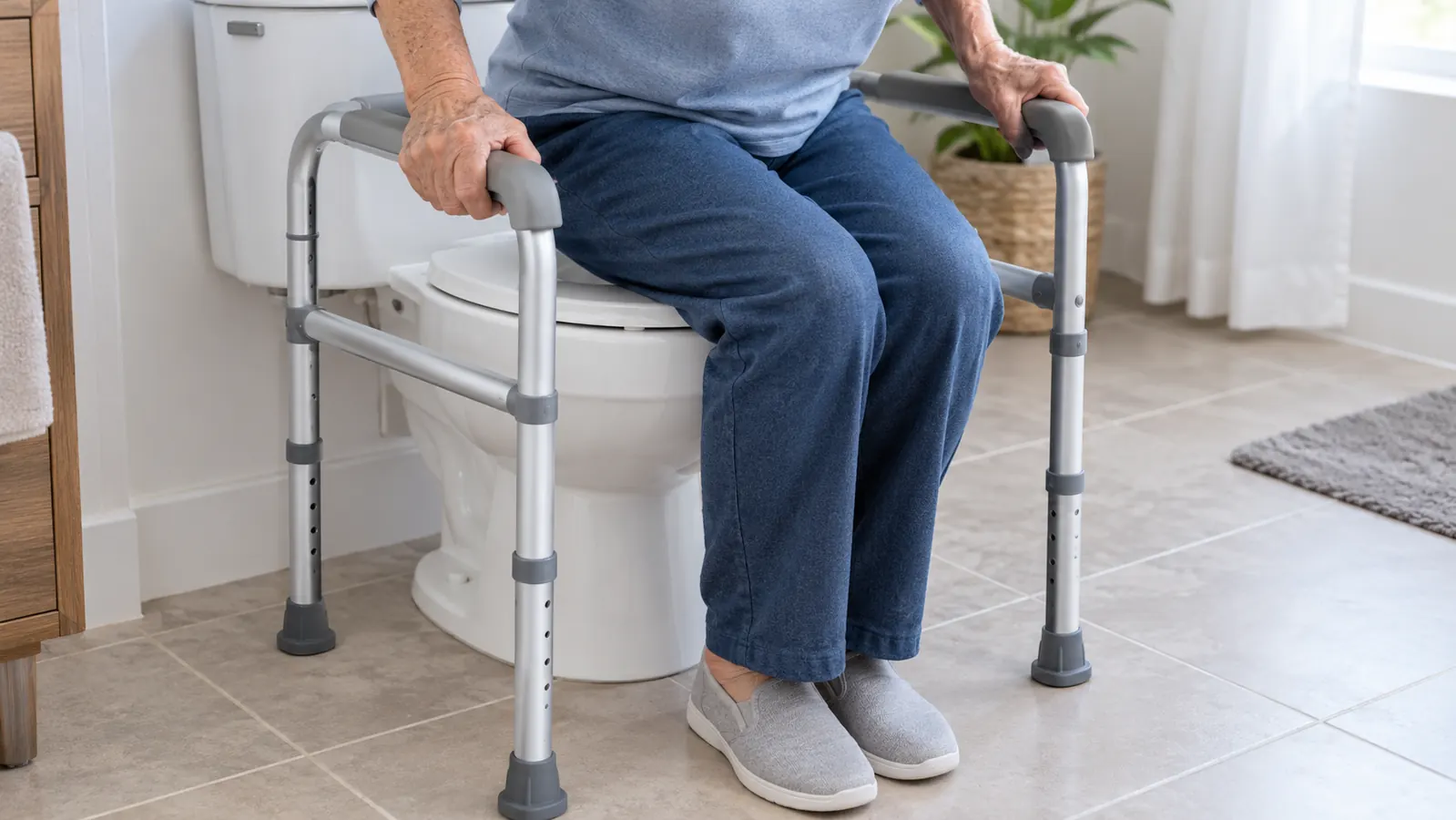
The arms set anywhere from about 27 and a half inches up to 31 and a half inches. I put mine where my hands naturally land when I come up to standing, then had Marge sit down and tell me whether it felt right. Two tries, five minutes with a wrench. Nothing about it is fixed in place forever. If a shoulder gets stiffer or your reach changes, you loosen the bolts and move the arms, and you are not buying anything new to do it.
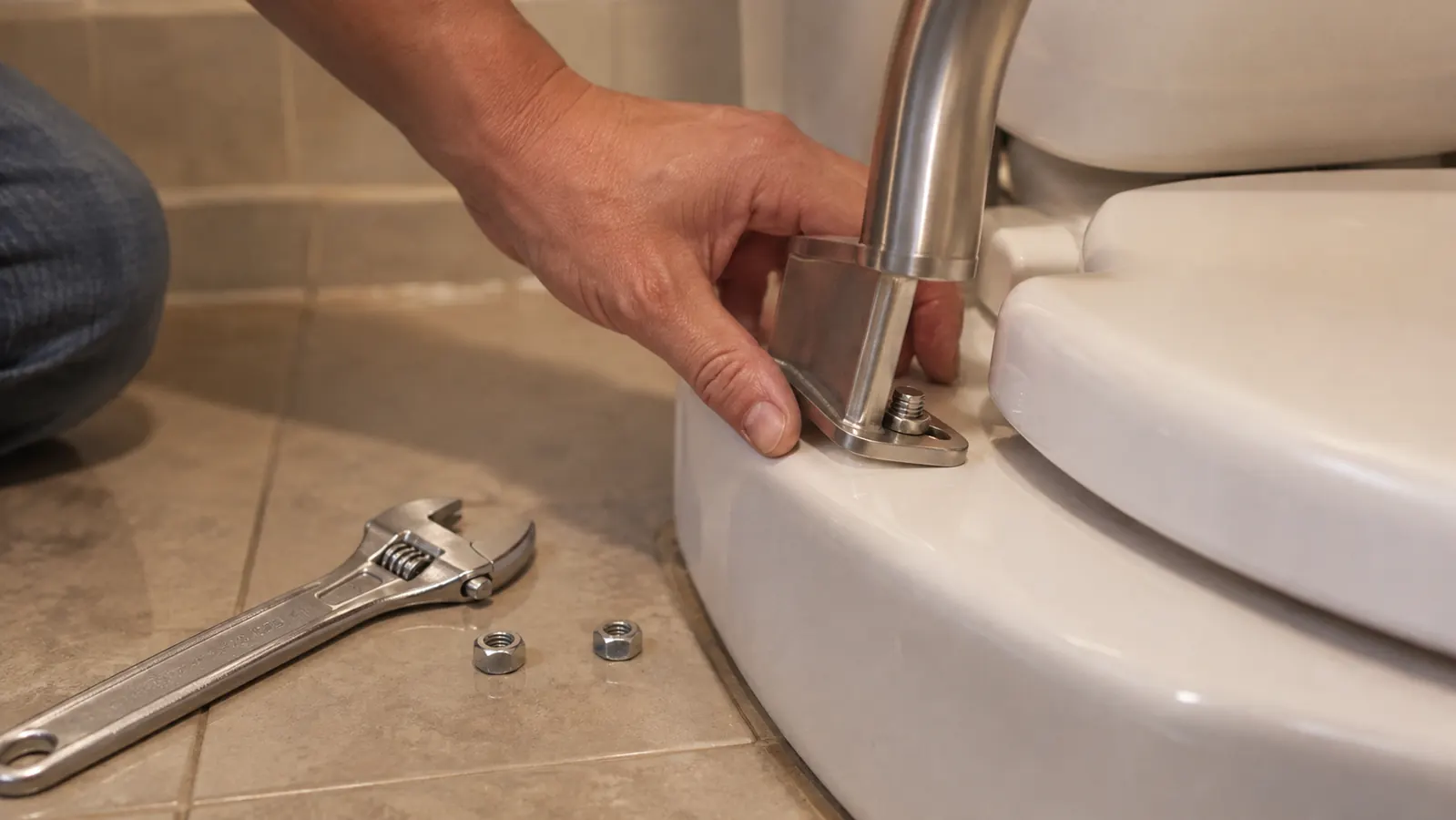
It uses the toilet seat's own bolts, so there is no drilling
This is the part that sold me. You take off the two nuts holding your seat down, set the rail brackets over those same bolts, and put the nuts back on. No holes in the tile, no anchors, no calling a handyman. I had it on before Marge finished her coffee. I am handy, so call it twenty minutes, and most of that was me being careful rather than the job being hard. One adjustable wrench is the whole tool list.
You get a grip on both sides, so you stand up square
The rail is 19 to 22 inches wide, with 18 to 24 inches between the arms, so there is a handhold on each side of you. That matters more than it sounds. Pushing up with one hand twists your lower back and hips. Pushing up level with both hands keeps you square over your feet. Marge noticed it the first week and said so out loud. She said it felt like standing up out of a chair instead of hauling herself off a ledge.
The legs reach the floor, so the load does not go through the seat
There are legs on this rail that come down to the tile, and they carry the weight. That is the difference between a rail that is decoration and one that actually holds you. When I put my hand on the arm and push, the whole frame stays put instead of the seat flexing underneath me. It is an aluminum frame, about four and a half pounds, and it does not budge when I lean on it.
I am not leaning on the room anymore. I am leaning on the fixture, and the fixture is bolted down.
It fits an ordinary small bathroom, which is all we have
Our bathroom is nothing special. One room, one tub-shower, one toilet, not much floor left over. The Medline rail measures 27 and a half to 31 and a half inches long and 19 to 22 inches wide, and it went around our seat without me having to move the wastebasket or the rug. I measured before I ordered because I was expecting a fight, and there was no fight. If your room is genuinely tight, measure first anyway. Ours is small and it still works.
One setting serves both of us, so nobody is readjusting it
I am 5 foot 11. Marge is 5 foot 4. I fully expected to be resetting those arms every time we swapped off, and we have not touched them since the first week. There is enough range in the adjustment that the same height works for the both of us. She grabs closer to the front of the arm, I grab closer to the back. That is the entire difference. Eight months in, the arms have not moved a fraction.
It wipes clean with the same rag you are already using
The frame is aluminum with a powder coating on it, so it resists scratches and it does not stain. Cleaning a bathroom in our house is a spray bottle and a rag, and the rail gets exactly the same treatment as the sink and the tub. I have not had to do anything special to it. No rust working into the joints, nothing gummed up around the bolts. For a piece of hardware that sits in a wet room every day of its life, that is worth saying out loud.
It stays where it is, so there is nothing to remember
A chair would do part of the same job, but a chair has to be pulled over and it slides when you push on it. This rail is simply there, the same way the toilet is there. In eight months my maintenance has been re-tightening the seat bolts about every two months, and that is the whole list. I have not had to move it out of the way for company or stow it anywhere. It is part of the bathroom now, and nobody in this house has to think about it.
It comes back off just as easily, which matters if you rent or move
I put the Medline rail on with the same two bolts the seat came with, and I can take it off the same way in about five minutes. No holes in the tile means that if we ever sell this house, or if a day comes when we do not need it, the toilet goes right back to how it looked before. The frame carries a limited warranty, which I have not had to use. For a piece of hardware that changes how a room works, being reversible is a real comfort.
What I'd Skip
Two things I would skip. I would skip drilling anything into bathroom tile when a bolt-on option like the Medline rail is sitting right there, because tile cracks and then you own a second project. And I would skip any rail that only gives you one side to hold, since pushing off with one hand still turns you as you rise. I also looked hard at a raised toilet seat and passed on it. That changes how high you sit, not what your hands have to hold, and the two of us wanted something to push against more than something to sit higher on. If height is your main trouble, that is a different conversation, and it is one for my physical therapist or our doctor, not for me. I fix furnaces. I do not give medical advice.
Ten reasons, one wrench, twenty minutes
The same Medline rail has been on our toilet since March and both of us still use it daily. Measure your seat width and your floor space first, then decide.
Amazon Check the Medline toilet safety rail on Amazon →