
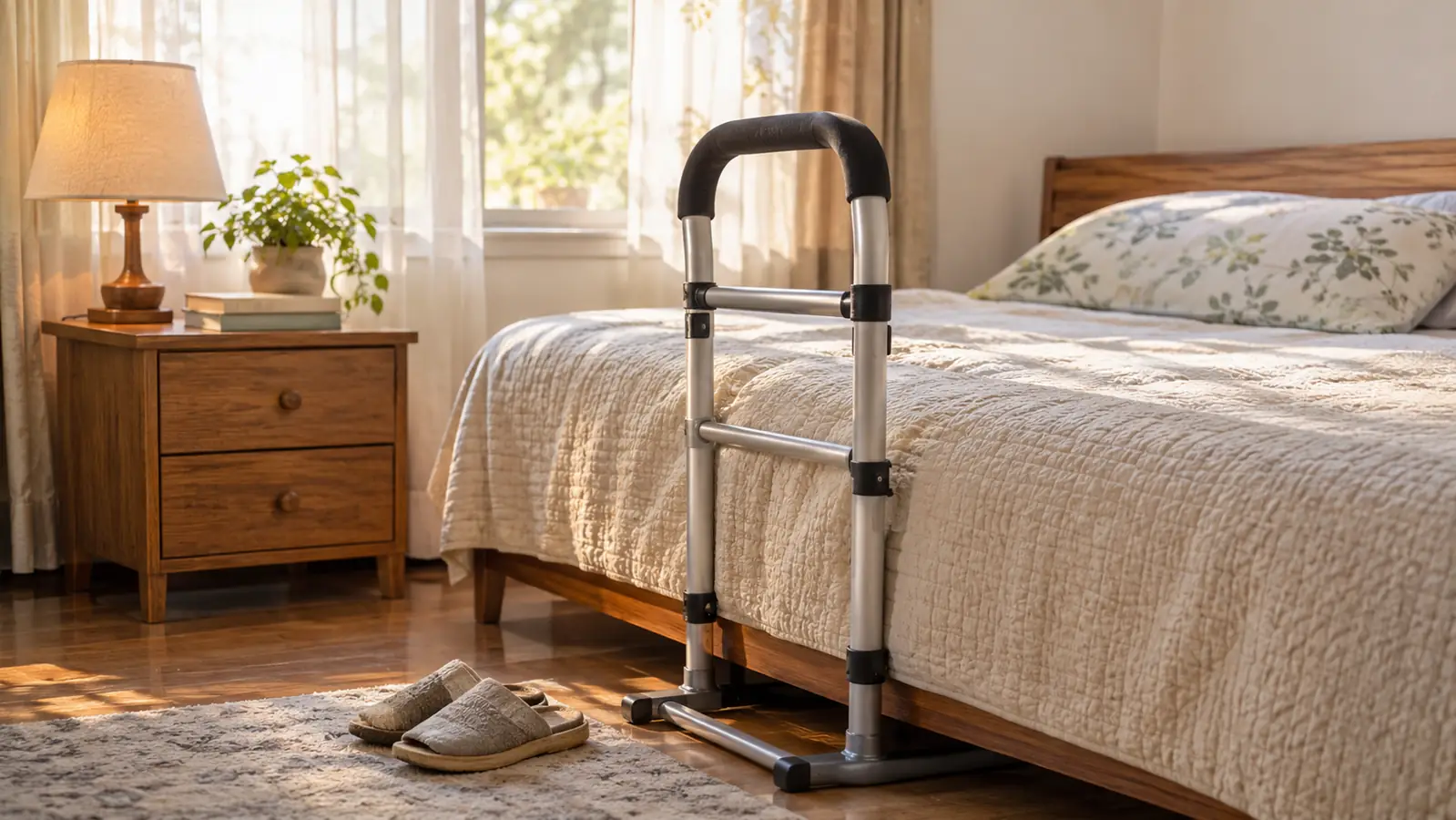
Marge pushed up off the nightstand one too many times, and I finally paid attention. It was a Saturday morning in late May, she was swinging her legs out of bed, and the nightstand tipped maybe half an inch before she caught herself on it. Half an inch is nothing until it is something. I am 74 and she is 72, we have been in this ranch house since 1988, and after 38 years of crawling around other people's houses fixing furnaces I can tell you which furniture in a room is anchored and which furniture is just standing there looking confident. That nightstand was the second kind. Two weeks later there was a Medline bed assist bar on her side of the queen bed, base slid between the mattress and the box spring, strap run around the frame. She has used it every morning since, and on the bathroom trips in the middle of the night. This is the honest version of how that has gone.
I am not a physical therapist and I am not going to write like one. Anything about how much weight to put through a bar, or whether a person should be using one at all, goes to our doctor or to my physical therapist, who has seen more of my right knee than I care to think about since February. What I can tell you is what I bought, how it went together, where it sits in our bedroom, and which beds it will not work on. That last part is where people get burned, and the listing does not lead with it.
The Quick Verdict
A steady handhold for a regular bed with a box spring, together in under fifteen minutes with no drilling. Not for adjustable beds, and the strap wants a look every month or two.
Amazon Check Today's Price →The nightstand was never a handhold. This is.
The Medline bed assist bar slides between the mattress and the box spring and straps to the frame, so the thing Marge pulls on is anchored instead of hopeful. The height adjusts to sit where her hand falls.
Amazon Check Today's Price on Amazon →How I Installed It, and Why It Took Fifteen Minutes
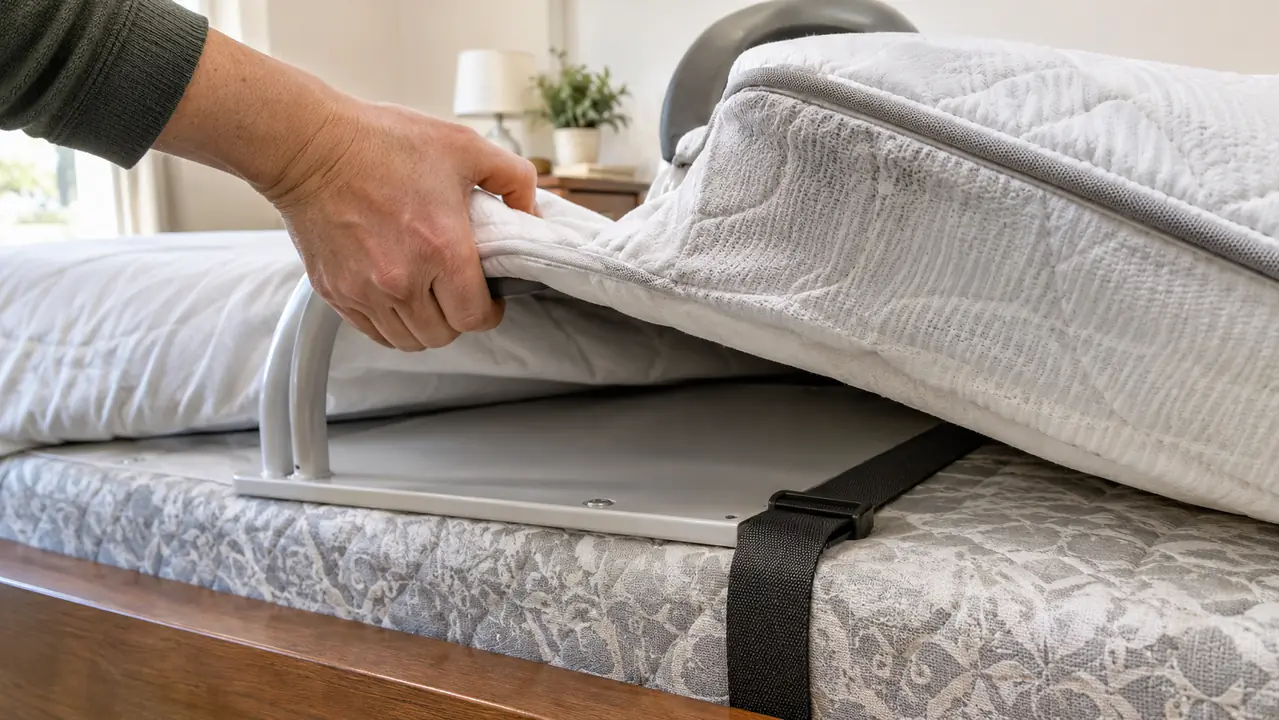
I did not need a drill, and that matters to me, because I have put enough holes in enough walls to know I do not want to be doing it in a bedroom at my age if there is another way. The bar comes in pieces that go together at the height setting, and then the base slides down between the mattress and the box spring. That is the whole trick of it. The mattress holds the base down, and a strap around the bed frame keeps the whole assembly from walking away from you. I put it together on the bedroom floor, lifted the corner of the mattress with my shoulder, slid the base in, and had the strap snug in under a quarter of an hour. Marge sat at the kitchen table with a cup of coffee the entire time, offering commentary.
Two things I would tell you before you start. First, put it where the person actually gets up, not where it looks balanced. Marge sleeps on the side nearest the hall door, and that is where the bar went, close enough to the edge that her hand finds it without her having to look. Second, set the height before you tighten anything down. The bar is height adjustable, and I set it so the handle sits a few inches above the mattress surface, roughly where her hand falls when she is sitting on the edge with her feet on the floor. I had it a touch high on the first try, she told me so after church that Sunday, and I moved it down one setting. We have left it alone since.
The strap is the part I check. I go around the frame with my thumb about once a month, the same way I check the bolts on the toilet rail, and twice now it has had a little slack in it. Not much. Enough that I took it up a turn. Five months in, nothing has loosened on the bar itself, the base has not slid, and the whole thing wipes clean with a damp cloth, which is the only care it asks for. It weighs 6.4 pounds, so if we ever need to move it I can carry it one-handed out to the garage and back.

What the Medline Bar Does Well After Five Months
What it does best is not move. When Marge sits on the edge of the bed and pulls on the handle, the bar takes the pull and the mattress takes the bar. Compare that to the nightstand, which took the pull and tipped. She gets up in the morning without me hearing the furniture complain, and on the night trips she does not have to find her balance in the dark before she has a hand on something solid. The nylon pocket that hangs on the bar turned out to matter more than I expected. Her reading glasses go in it, along with a small flashlight and whatever book she is on. Before that, the glasses lived on the nightstand and got knocked to the floor about once a week, and at 72 nobody wants to be on their hands and knees at two in the morning looking for their glasses.
The second thing it does well is leave the bed alone. No holes in the frame, no brackets screwed to the wall, no new mattress, no changing anything. Our bed is a plain queen on a regular box spring and a standard frame, and that is the arrangement this bar was built for. If we ever replace the mattress, the bar comes out as easily as it went in and goes back the same way. For a couple in their seventies staying put in the house they bought in 1988, that counts. I do not want to install anything in that bedroom that I cannot undo in ten minutes if the situation changes.
The third thing is the grip. It is a bare bar and not a padded handle, and I expected Marge to say something about that. She has not. Her hand fits around it, the height is where she wants it, and it does not have the give that makes some handles feel uncertain when you put real weight on them. If a person has very little grip strength left in their hands, that is a question for my physical therapist and not for me. All I can report is that a 72-year-old woman with arthritis in both knees uses this thing every morning and has stopped mentioning it, which is the highest compliment any object gets in this house.
What I Liked
- Base slides between the mattress and box spring, so nothing gets drilled into the frame or the wall
- Height adjusts so the handle sits where the hand falls when sitting on the edge of the mattress
- Strap around the frame holds it in place, and the bar itself has not loosened in five months of daily use
- Nylon pocket keeps reading glasses, a book and a small flashlight within reach instead of on the floor
- Wipes clean with a damp cloth and weighs 6.4 pounds, light enough for one person to move
Where It Falls Short
- Built for non-articulating beds only. It will not work on an adjustable base
- Needs a box spring or similar layer for the base to slide under
- The strap takes up slack over time and has to be checked every month or two
- Bare handle with no padding, which suits Marge but will not suit every hand
- Reaching into the pocket means leaning over, so it is no help to someone who cannot lean
The nightstand took the pull and tipped. The bar takes the pull and the mattress takes the bar. That is the whole difference.
The Things the Listing Photos Do Not Show You
Here is what I would want somebody to tell me. This bar is for a bed that stays put. The manufacturer's own instructions say non-articulating, and they mean it. If you have an adjustable base, the kind that raises the head, the bar has nothing stable to sit against and the base has nowhere honest to live. Same story with a platform bed where the mattress sits right on the slats, and with any frame where the mattress is loose. Ours is a plain queen on a box spring, and the bar sits in it like it was made for it, because for our bed it was. If your bed raises, folds, or has no box spring, stop reading here and go look at a wall-mounted grab bar instead.
Second thing the photos do not show. The base sits under the mattress and needs weight above it to hold. A heavy queen mattress does that. A thin mattress on a light frame may not, and you would feel the bar shift the first time you pulled on it. You can test this before you trust it. Put it together, slide the base in, strap it down, then lean on the handle with a good share of your weight while somebody else watches the base. If the base lifts, you have your answer, and it is not the answer you wanted. I did that check with Marge watching from the doorway, and the base did not so much as wiggle.
Third, the bar helps the person on that side of the bed. That sounds obvious and it still catches people. If two people share the bed and both need a hand getting up, you need two bars or you need to move the one you have. Marge sleeps nearest the door, and this one lives on her side. On my side I have the bad knee and a cane leaning against the wall, and that is my business. It also only helps at the bed. Getting down the hall in the dark is a separate problem with a separate answer, which in this house is the cane by the door, plus Pepper, who sleeps in the bedroom doorway and does not move for anybody, so we all know where she is.
One small thing that annoyed Marge for about a week and then stopped annoying her. The handle stands above the mattress line, right where the comforter wants to drape, so the quilt slides off it every night and hangs off the side. Her first instinct was to tuck the bedding around the handle, which made the whole thing look fussy, and then she gave up and left the bar bare. Now the comforter sits behind it and nobody thinks about it. If a person is particular about how a made bed looks, that is worth knowing before the box arrives, because the bar is going to be visible from the doorway.
Bed Types This Bar Does Not Suit
Let me put the bed question in one place, because it is the reason I wrote any of this down. It does not suit an adjustable bed. It does not suit a hospital-style bed that already has rails on it. It does not suit a waterbed, where the surface moves and the base has nothing to press against. It does not suit a platform bed with the mattress straight on the slats and no box spring. It does not suit a bunk or a loft. And it is worth measuring the bed height before you order. The listed dimensions are 27.5 by 14 by 43.75 inches, and if your bed sits high with a deep mattress, the handle ends up lower relative to the mattress top than you pictured. Ours is a standard-height queen and it came out right on the first setting I tried.
There is a second kind of bed it does not suit, and that is a bed with someone in it who should not be hauling on anything without being shown how. I mean that plainly. My physical therapist spent real time with me on getting up out of a chair without yanking on the arms, and the same idea applies at the edge of a mattress. A bar is a handhold. It is not a hoist, and it is not a substitute for somebody teaching you how to use your legs again. If the plan is to grab it and drag yourself upright with your whole body, have the therapist out to the house first and let them watch. That is not me being careful with my words. That is me having watched what happens when a person pulls on furniture that was never built for it.
Who This Is For
Who it is for, then. A house like ours. One story, one bed, a plain frame and box spring, and a person who needs something steady to hold when they swing their legs out in the morning. It is for the couple where one of them is up in the night more than the other and neither wants a lamp on at two in the morning. It is for the person whose nightstand has been doing a job it was never built for. And it is for anyone who wants the problem fixed without holes in the bedroom wall or a new bed. Five months in, this Medline bar has done what the listing says it does, and I would buy it again the same afternoon.
The way it fits into a day here, if that helps you picture it. Marge reads in bed with her glasses in the pocket. She swings her legs over, puts her hand on the bar, and stands up without the mattress rolling away from her. In the night she does the same thing in the dark, because the handle is in the same place every time and she does not have to hunt for it. In the morning I make the bed around it and straighten the strap with my thumb on the way past. That is the entire relationship we have with the object. It is not interesting, and after a knee replacement and a wife with two bad knees, not interesting is exactly what I was shopping for.
Who Should Skip It
Who should skip it. Skip it if the bed adjusts. Skip it if there is no box spring. Skip it if the person using it cannot lean forward to reach a handle without help, because then the problem is bigger than a bar and it belongs with our doctor or a therapist. Skip it if you are shopping for something to hold on the walk to the bathroom at night. That is the cane's job here and the bar cannot do it from the bedroom. And skip it if you want a padded grip, because this is a bare bar and it will not turn into anything else. Five months in, bare has been fine for Marge. It would not be fine for everybody, and I would rather tell you that than sell you something.
One handhold, fifteen minutes, no holes in the wall
The Medline bed assist bar is made for non-articulating twin, full and queen beds with a box spring. Check your bed against the listing before you order, then set the height with the person sitting on the edge of the mattress.
Amazon Check Today's Price on Amazon →