
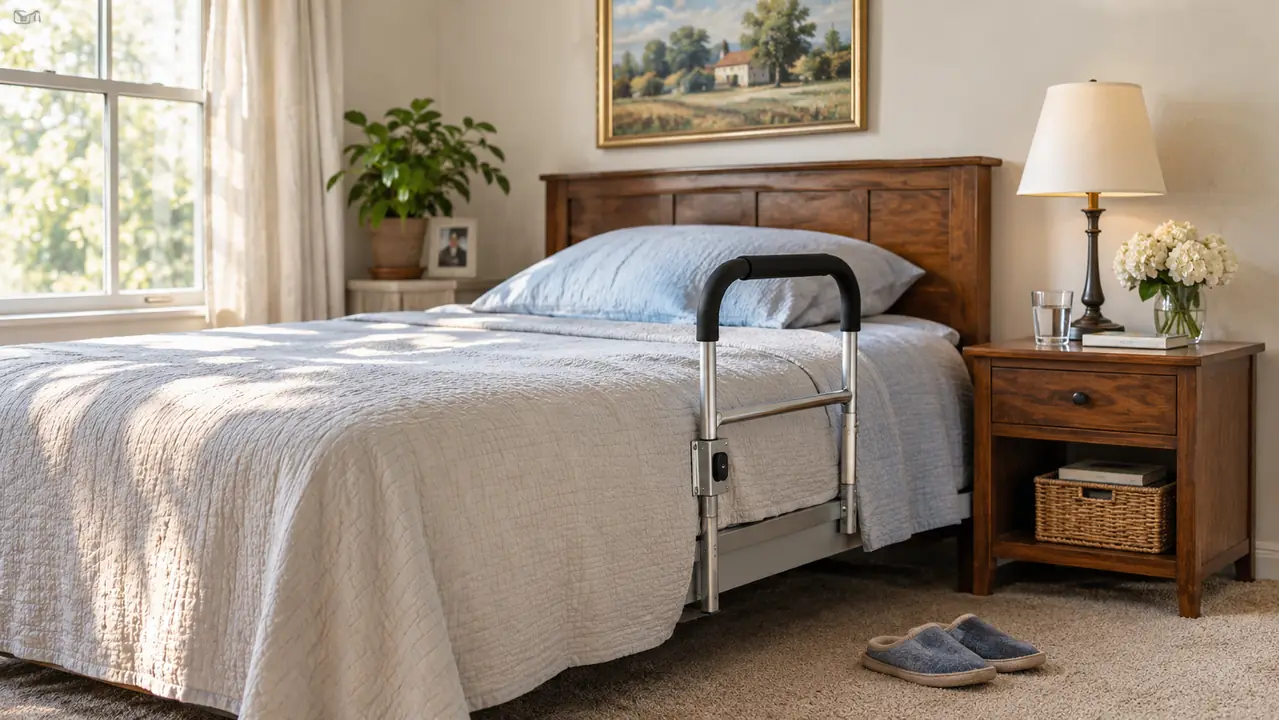
Marge pushed up on the nightstand for about a year. It wobbled, she knew it wobbled, and she did it anyway because there was nothing else within reach. In June I slid the Medline bed assist bar between her mattress and the box spring, strapped the base to the frame, and set the height to her mattress. Five months on it has not moved. A wall-mounted grab bar was the other thing we looked at, and it is a good piece of hardware. It is just a different job.
So here is the short answer. If the problem is standing up from the edge of a bed, the Medline bar is the one that puts a handhold exactly where your hand already goes. If the problem is the walk from the bed to the bathroom door, or you sleep on an adjustable base, a wall-mounted bar earns its holes. Get this wrong and you spend good money on the wrong helper. I have installed a lot of things in other people's houses over 38 years, and the ones that get used are the ones that sit where the person actually reaches.
| Medline Bed Assist Bar | Wall-Mounted Grab Bar | |
|---|---|---|
| Where it mounts | Base slides between the mattress and box spring, strapped to the bed frame. No drilling. | Screwed into the wall, ideally into a stud. |
| Bed types | Non-articulating twin, full, queen and king, per the listing. | Any bed at all, including an adjustable base, because it lives on the wall. |
| Where your hand lands | At the mattress edge, which is the spot you actually push off from. | On the wall, a lean away from where you are sitting. |
| Height | Adjustable to match the mattress. | Fixed once it is anchored. |
| Taking it with you | Lifts out in a minute and rides in the trunk for a trip or a move. | Stays with the house. |
| The walk to the bathroom | Nothing to hold once you are on your feet. | A steady handhold along the wall for the whole walk. |
| Making the bed | The handle is in the way when you tuck a sheet on that side. | Out of the way entirely. |
| Keeping things handy | A nylon pocket holds glasses, a book or a flashlight. | Nothing. |
| Getting it installed | Your hands for the base, then the strap to the frame. | Drill, level and a stud finder, plus a patch and paint if it ever comes out. |
| Best for | Standing up from bed in a bedroom you cannot or would rather not drill into. | A bedside where someone also needs support walking past the bed. |
Where the Medline Bed Assist Bar Wins
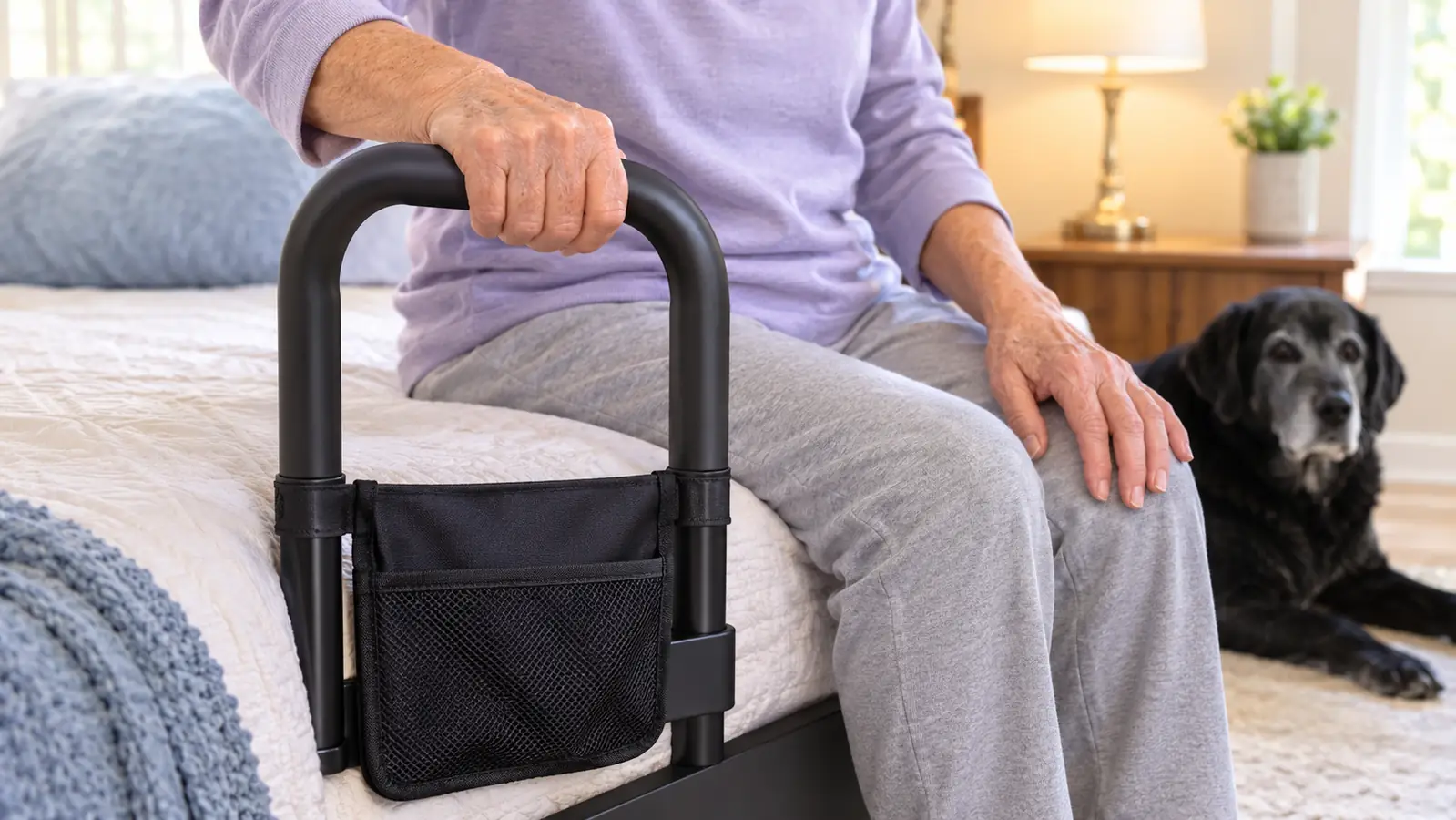
It wins on geometry, and geometry is most of this. When you sit on the edge of a mattress and push up, your weight goes down and forward through your arm. A bar that comes up out of the mattress puts that handhold right beside your hip, an inch from where you already are. A bar on the wall puts it a foot away, behind you and to the side, so you are reaching back and across to find it. I watched Marge do both motions in the air at the kitchen table before we bought anything, and the difference was plain. The Medline bar is the one your hand finds without you looking. I measured it with a tape afterward, because that is how I am. Sitting on the edge of our queen, her hand came down about a foot in from the edge and roughly level with the top of the mattress. The handle lands in that same spot once the height is set, and the base runs about 27 inches under the mattress so there is something to push against. The wall on her side is another 14 inches past that.
It also wins on consequences. Nothing gets drilled. The base is a U-shaped frame that slides under the mattress and the strap ties it to the bed frame, so the whole thing comes out in a minute and leaves no mark. We had it out once already, in August, when I pulled the mattress off to deal with the box spring, and it went back in the same afternoon. That matters more than people think. If Marge's needs change and we move her to the other side of the bed, or we swap the mattress, or we go stay with her sister for a week, the bar goes with us. And there is the height adjustment, which is a small thing until you use it. I set it so the handle sits where her hand falls naturally while she is sitting. A wall bar is set once, forever, by whoever had the drill that day.
Where a Wall-Mounted Grab Bar Wins
It wins on the walk. Our bedroom is off a hallway with hardwood in it, and the bathroom is a dozen steps away. At two in the morning, standing up is only half the trip. A bar on the wall gives you something to hold the whole length of that walk, which the Medline bar cannot do because its job ends at the mattress. My physical therapist was blunt about this when I asked her: a handhold you have to cross the room for is not a handhold. If balance during walking is the bigger worry, the wall bar is the more useful piece, and I would not argue with anyone who put one in the hallway first.
It also wins if the bed moves. An adjustable base goes up and down, and a bar strapped to that frame is going along for the ride or coming loose. A wall bar does not care what the bed does. And I will say the unpopular part: when a wall bar is screwed into a stud, it feels like part of the house. There is no give in it. Some folks want that certainty, and I understand why.
The one that slides under the mattress and comes back out when you move
Height adjusts to your mattress, the nylon pocket keeps glasses and a flashlight where you can find them at 2 a.m., and nothing gets drilled. This is the bar Marge reaches for every morning on her side of the queen bed.
Amazon Check Today's Price on Amazon →How Each One Actually Attaches
The Medline bar took me under ten minutes and I did not open the toolbox. The base slides between the mattress and the box spring, the handle stands up at the edge, and a strap ties the frame to the bed frame so it cannot walk out from under the mattress over time. The listing says to use it with a non-articulating twin, full, queen or king, and ours is a plain queen on a regular box spring and frame, so that is what we have. The whole thing weighs a bit over six pounds and the care is a wipe with a damp cloth.
A wall bar is a different afternoon. You find the studs, or you open the wall and add blocking if there are none where you want the bar, and then you drill. In a house like ours, built in the eighties with plaster over drywall in places, that is a real job, not a five-minute one. Do it wrong, into hollow drywall with the wrong anchors, and you have created the exact thing you were trying to prevent. I have repaired enough of those for other people to know how they end. A fellow from church had one put in last winter by a handyman. Two hours, a can of spackle, and a quart of paint, and he says it is the most solid thing in that room. I believe him. It is a good product when it is done right.
That is the honest trade. The Medline bar asks nothing of your house. The wall bar asks for holes and studs and a level, and in exchange it gives you a fixture that does not depend on a mattress staying put.
Five Months on Marge's Side of the Bed
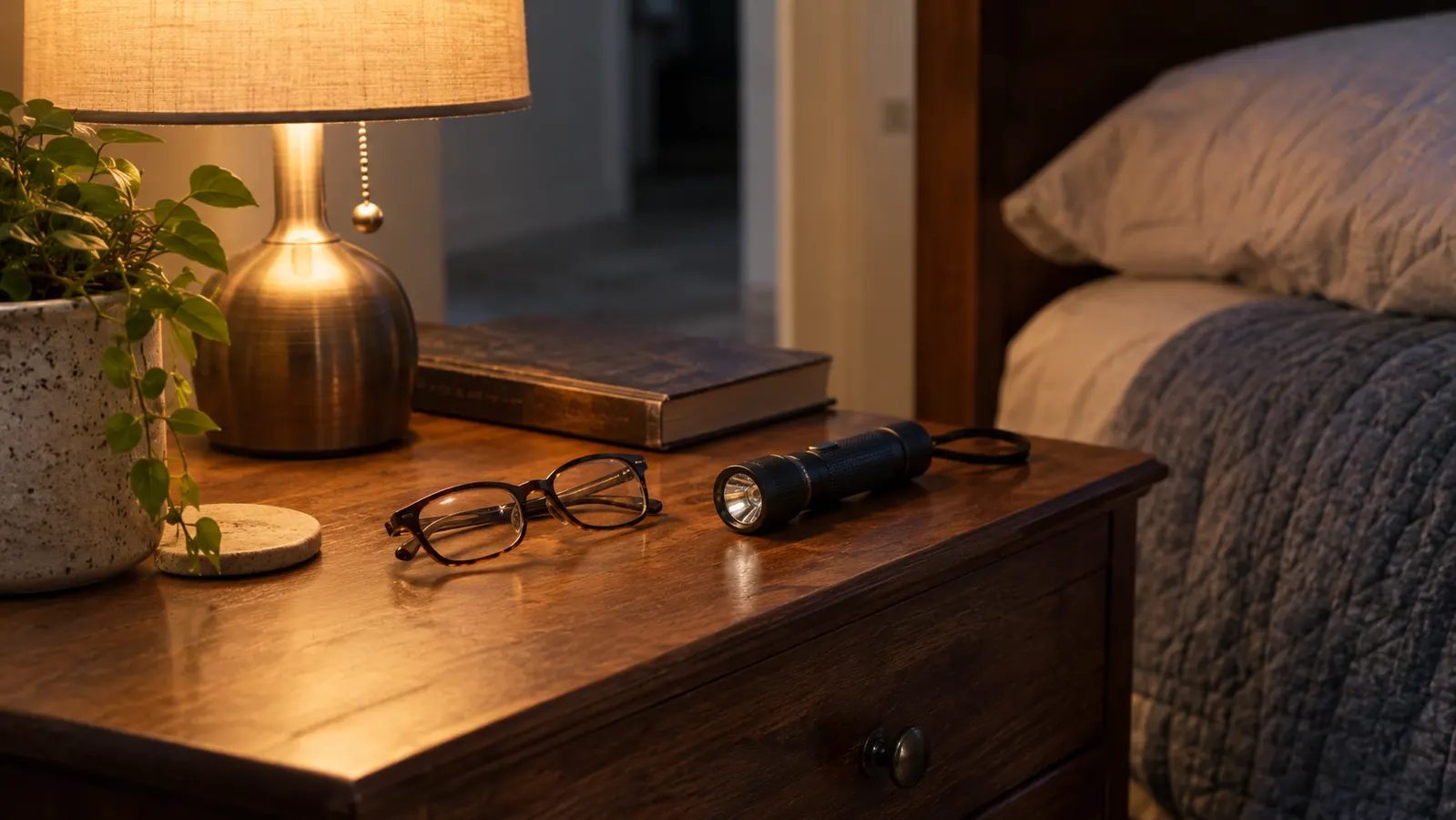
She uses it every morning and on the night trips, which in our house is usually one, sometimes two. The pocket holds her reading glasses and a small flashlight, and that turned out to matter more than I expected, because the lamp is on my side and she was forever feeling around in the dark for her glasses. Now they are a hand's width from her pillow. She has not touched the nightstand to stand up since June. It still wobbles, by the way. We never fixed it. Nothing pushes on it anymore. There was one night in August, around three in the morning, when I was half asleep and heard her hand find the handle with no fumbling at all. That is the sound a handhold is supposed to make.
What I check, maybe once a month, is the strap and the base. I pull the handle toward me and see if the base has crept. It has not. I do it on the first Saturday, when I walk the house doing the rest of the small jobs. The height has not slipped either, and I set it in June with a screwdriver and have not touched it since. If I have one complaint it is that making the bed on her side is fussier now, because the handle is right where I want to tuck the flat sheet. That is a small price and I would pay it again.
Five months, every morning and most nights, and the base has not crept out from under that mattress once.
The Question My Physical Therapist Asked
When I told her what we were considering, she asked me one thing: what is she holding onto now, and where is her hand when she does it. That is the whole comparison in one question. Marge's hand was on the nightstand, at mattress height, beside her hip. So we bought the thing that put a solid handle in the same place. If her hand had been on the wall, or if the trouble had started after she was already up and walking, we would have had a different answer. I asked her at the clinic in late May, on the same visit where she moved me off the rollator for short distances. She had me sit in a clinic chair and stand up four or five times while she watched where my hands went, because I could not describe it worth a nickel. She said the description matters less than the hand. I am not a doctor and I do not play one at the kitchen table. Fit and fall risk are questions for my physical therapist or our doctor, and I asked both.
The other thing she told me, and I pass it along because it applies to either product: a bar is a handhold, not a workout. It does not build strength and it does not fix a medical problem. It gives you something steady while you do the work yourself. Both of these products do that. Neither one does more than that, no matter what the box says.
What I Liked
- No drilling at all, which means no studs, no anchors and no patching later
- Height adjusts to match the mattress so the handle lands where your hand falls
- Nylon pocket keeps glasses, a book or a flashlight within reach at night
- Base stays put between the mattress and box spring and straps to the frame
- Weighs a little over six pounds, lifts out in a minute and travels with you
- Wipe with a damp cloth is the entire care routine
Where It Falls Short
- The handle is in the way when you tuck a sheet on that side of the bed
- Only for non-articulating beds, so an adjustable base is out
- Does nothing for you once you are on your feet and walking
- Marge had to get used to reaching beside her hip instead of forward to the nightstand
If You Rent, or You Would Rather Not Put Holes in the Wall
This comes up at church more than you would think. Folks in a rental are not going to drill into a landlord's wall, and folks in a house they have been in for forty years are often just tired of making work for themselves. The Medline bar is the answer in both cases, and it is also the answer if the bedroom might change, or if a spare bed gets used by whoever is recovering that month. One caution from an old repairman: read the part about non-articulating beds before you buy. If you have an adjustable base, this is not your product and no amount of wanting it to be will change that. The second caution is about your bed itself. This design sits between the mattress and the box spring, so look at what you actually own before you order. Ours is a plain queen on a regular box spring, which is the setup it is made for.
Who Should Buy Which
Buy the Medline bed assist bar if the difficulty is the standing up itself, the first push off the edge of the mattress, and if your hand naturally lands beside your hip when you do it. Buy it if you rent, if you have a plain non-articulating bed, if you might move the bed or travel, or if you want something in place this afternoon without a trip to the hardware store. Buy it if the nightstand is currently doing a job it was never built for, which is exactly where we were in May.
Buy a wall-mounted grab bar if the worry starts after you are upright. If the hallway or the path past the foot of the bed is the shaky part, if the base is adjustable, or if you want one fixture that holds for good and you have the studs or the budget for someone who can find them, put the bar in the wall. Some households need both, and that is not overbuying. It is two different jobs. Just do not buy one and expect it to do the other.
The bar Marge reaches for every morning, five months in
Slides between the mattress and box spring, straps to the bed frame, height set once to your mattress. Nothing drilled, nothing to patch, and it comes back out in a minute if you ever need it to.
Amazon Check Today's Price on Amazon →