

Marge got out of bed the same way for years. Roll to the edge, plant both feet on the carpet, push up with one flat hand on the nightstand. It worked right up until the night the nightstand slid an inch and the lamp rattled. I was across the hall and heard it. That is the kind of sound that gets your attention at my age.
I am Hal Brennecke. I am seventy-four, I spent thirty-eight years as an HVAC service technician, and I am not a doctor or a physical therapist. Anything in here about fall risk, or whether a piece of equipment suits a particular person, goes to my physical therapist or our doctor, not to me. What I can tell you is what I bought, how I put it in, and what five months of daily use looks like in a one-story ranch house in Kettering, Ohio. In June I bought the Medline bed assist bar for Marge's side of the queen bed. It is still there. She uses it every morning and on the trips down the hall at night, and I have not heard the lamp rattle since.
The Quick Verdict
A plain, no-nonsense handhold that does one job. It gets my wife out of bed without leaning on the furniture, and in five months it has not moved.
Amazon Check Today's Price →The piece that ended the wobbling nightstand on Marge's side of the bed
One upright handle, one flat base under the mattress, no wall anchors and no drilling. Check the current listing and the size chart for your bed before you lift the mattress.
Amazon Check Today's Price on Amazon →How I've Used It
I put it in on a Saturday morning in June, before church, and it took me about twenty minutes. The flat base slides between the mattress and the box spring. You lift the mattress, work the base under, set it where you want it, and let the mattress back down on top of it. Then you stand the upright piece up beside the bed and set the height. Marge's side is the side nearest the hall door, so that is where it went, set slightly forward of the pillow so her hand finds it about the same time her feet find the carpet.
The part nobody mentions is the mattress. A queen mattress is not light, and I had to walk it up and hold it against my hip while I slid the base underneath. That is the only step with any muscle in it. If you have a bad shoulder, or you live alone and there is nobody to hold the other end, plan around that. It is not difficult. It is just awkward, and it is worth knowing before you start.
I added one thing of my own, a strap from the bar down around the bed frame, so the base cannot walk out from under the mattress over a year of use. You may not want that. I have spent my working life going back to equipment that shifted because nobody tied it down, and I sleep better with it there. Every few weeks I put my weight on the handle and check that the base has not crept. It has not.
Before I bought it I did what I always do, which is measure. I slid a tape between the mattress and the box spring at the head end of her side and got a gap I could work with, and I checked that the frame rail sat where I thought it did. The base is 14 inches wide and the upright stands 43.75 inches tall, so there was room to set it forward of the pillow and still keep the flat part well under the mattress. If your mattress sits flush with the box spring and will not budge, work a putty knife in first and see how much slack you actually have.
The first morning she used it, I stood in the hallway and watched, which she did not appreciate. She rolled to the edge, put her hand on it, and stood up in one motion. Then she looked at me and said, well. That was the whole test.

What the Medline Bar Is, and How It Fits a Bed
The listing gives the dimensions as 14 inches wide and 43.75 inches tall, with a shipping weight of 6.4 pounds. In the hand it feels like what it is: a light piece with a wide flat foot. I carried it in from the porch with one hand while holding the door with the other. The handle and upright are covered in a nylon material that wipes clean with a damp cloth. That matters more than you would think in a bedroom where somebody sets down a glass of water at night.
The base is U-shaped, which is the part I did not expect and the part that makes it work. Two arms go under the mattress and the upright rises off the closed end, so the weight you put on the handle presses down across a wide flat footprint instead of tipping on a single bar. On a queen it sits well inside the frame. On a twin I would want to measure before committing, because there is less mattress to spread that footprint across, and a narrow bed is where a flat base earns its keep.
There is nothing on this bar that lights up, beeps, or needs charging. It is an upright with a handle and a flat base. I have spent my life around equipment, and the pieces that actually get used every day are the ones that ask nothing of you. This one asks nothing.
Medline lists it for non-articulating beds in twin, full and queen sizes. Ours is a queen on a regular box spring and frame, not an adjustable base, so it fits the description. If you have one of the beds that hinges in the middle, this is not the piece. That is not a knock on it. It is what the listing says, and I would rather tell you now than have you find out with the mattress already off.
Height is adjustable, and that is the whole of the adjustment. Marge is five foot four; I am five foot eleven. We set it for her, high enough that she is not folding forward to reach the handle and low enough that she is not lifting her hand over her head. It took two tries. The first setting was too tall and she had to reach up for it, which defeats the whole idea. Ten minutes and one more adjustment later it was right, and it has not moved since.
The Grip and the Standing Up
Here is what actually changed. Before, Marge pushed up off the nightstand with the heel of her hand. A nightstand is furniture. It has drawers that slide and a lamp sitting on top of it, and it is not built to take a person's weight. Now she rolls to the edge, puts her hand on the bar, and stands. The bar does not move. That is most of the review, really. A handhold is only worth anything if it stays where you put it.
She is not hauling herself up by the arms, and I want to be clear about that. When my physical therapist and I were working on my own knee, he put it the way I will pass along: your arms help, your legs do the work. The bar gives her something honest to push against while her knees straighten. Marge says it is the difference between standing up and heaving herself up, and she can feel the difference across her shoulders by Friday.
Last Tuesday I was in the kitchen starting the coffee when I heard her get up. Feet on carpet, then the floorboard by the door, then nothing out of the ordinary. That is what five months of this looks like. Not a dramatic improvement, just an ordinary morning without a wobble in it. She came out, said good morning, and asked whether I had put the trash out. Life goes on. That is the whole point of a piece like this.
I use it too, some nights. My right knee was replaced in February, and for the first while after surgery I was up three and four times a night. I would come around to her side of the bed and use the bar instead of feeling my way along the wall. That was not the plan when I bought it. It just worked out that way.
The Pocket, and the Trips Down the Hall
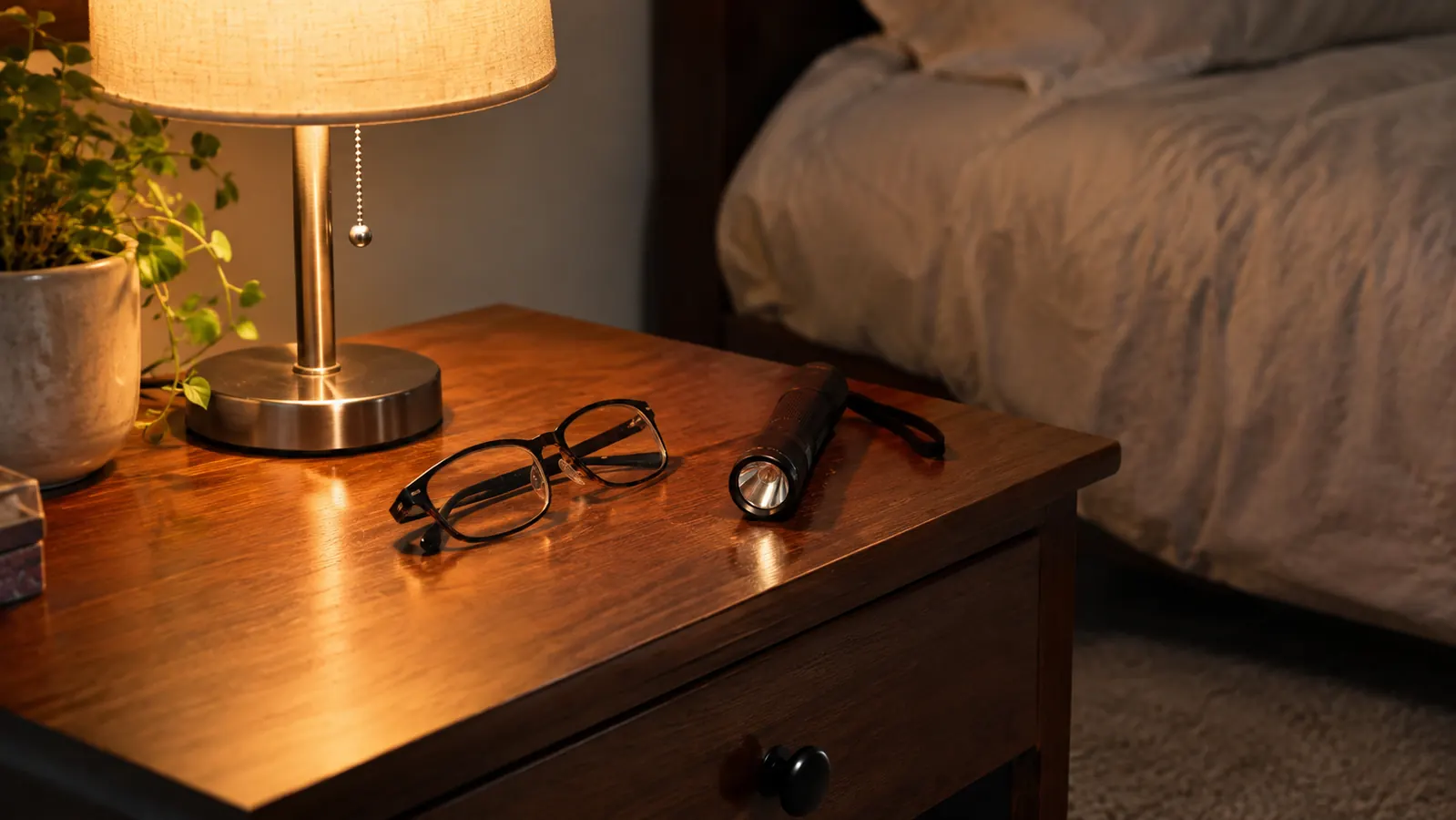
There is a nylon storage pocket that hangs on the bar. Marge keeps her reading glasses in it and a small flashlight. That sounds like a small thing and it is, but the nightstand used to be a pile, and the pile is where her glasses went to die every night. Now they have a place. She can put her hand on the flashlight without turning on the lamp, which means she is not waking me at two in the morning just to go down the hall.
The bathroom is down that hall, past the hardwood, and Pepper, our black Lab mix, likes to lie in doorways. So the trip is not only getting out of bed. It is getting out of bed, finding her footing on carpet, then finding it again on hardwood. The bar handles the first part, which is the part that used to be the shakiest. Pepper has never caused a problem, she is sixty pounds of calm and she does not move, but you still watch where you put your feet at two in the morning.
One note on the pocket. It is a soft bag, not a shelf. Do not put a glass of water in it. Marge tried it once and the whole thing sags. Glasses, flashlight, a paperback, the television remote. That is about the size of it.
Where It Falls Short
It is a handhold at one spot, not a rail running the length of the bed. If Marge has rolled to the middle of the mattress and needs to get up, she still has to get herself to the edge first. For her that is fine. For somebody who cannot turn over or sit up from lying flat without help, one handle at the edge will not cover it, and that is a conversation for a physical therapist rather than for a retired HVAC man.
The base does sit under the mattress, so on a queen there is a slight ridge you can feel if you roll all the way to that side. Marge noticed it the first week and stopped noticing it after that. I noticed it because I am the one who checks things. It is thin, it does not bother her sleep, and I would not let it talk you out of the purchase.
And there is the installation itself. Getting a queen mattress up and holding it while you slide something underneath is a two-hand job at minimum, and easier with two people. If you are doing this alone, take the mattress off the frame first, set the base, and put it back. I did it in twenty minutes with the mattress on. I would not want to do it that way with a sore back.
One more thing, and I will say it plainly. This is equipment, not a training program. It does not strengthen anything and it does not teach anybody to move better. What it does is give her a fixed point for the thirty seconds it takes to stand. If her knees get worse, or if our doctor says she needs more support than a single handle, we will go back and ask. I would rather swap out a piece of equipment than pretend it is doing a job it was never built for.
She rolls to the edge, puts her hand on the bar, and stands. The bar does not move. That is the whole review.
What I Liked
- The height adjusts, so one piece fits a five foot four wife and a five foot eleven husband without buying anything else
- The flat base stays put under the mattress; I check it every few weeks and it has not crept
- The nylon pocket keeps her reading glasses and a small flashlight where she can reach them in the dark
- Wipes clean with a damp cloth, which is all it has ever needed
- 6.4 pounds, and setup took me twenty minutes on a Saturday morning
Where It Falls Short
- Only for non-articulating beds; the listing rules out an adjustable hinged base
- It is one handhold at the edge, not a rail down the side of the bed
- Lifting a queen mattress to slide the base under is awkward, and it is easier with two people
- You can feel a thin ridge under the mattress on that side if you roll that far
Who This Is For
This is for somebody who can get themselves to the edge of the bed but needs something steady to push against once they are there. That is Marge exactly. She does not need to be lifted. She needs a fixed point at hand height that does not slide across the carpet, and five months in, that is what she has.
It also suits a household with a regular box spring and frame, twin, full or queen, where nobody wants holes in the wall. We never had a wall grab bar and I never wanted to put one in. Anchoring into a bedroom wall means finding a stud and hoping you found the right one, and then living with it. This slides in, and it comes back out if we ever move the furniture around. That mattered to me more than I expected it to.
Who Should Skip It
If your bed is an adjustable base that hinges in the middle, the Medline listing says no, and I would take that at face value. If the person getting out of bed needs help turning over or sitting up from flat, one handhold at the edge will not cover it, and my physical therapist would tell you the same thing with more authority than I can put behind it. Talk to your doctor or your therapist about what the actual need is before you spend anything.
And if you want a grab point wherever you happen to land along the bed, this is not that piece. This is one handle, placed where she swings her feet out. It does that one job well. I would not ask it to do more, and I would be skeptical of anybody who told you it could.
The one piece I would buy again for Marge's side of the bed
Five months, every morning, and the nightstand has gone back to being a nightstand. Check the current price and confirm your bed size on the Medline listing before you lift the mattress.
Amazon Check Today's Price on Amazon →