
Marge started pushing up off the nightstand to get out of bed. It worked, mostly, until the morning the whole thing shifted an inch and she caught herself with her other hand. That nightstand is a hundred and something pounds of particle board and it is not built to be leaned on. I have spent thirty-eight years fixing things in other people's houses, and I know a bad handhold when I see one. What she needed was something bolted to the bed itself, low enough to reach without twisting, high enough that she was not bending over to grab it.
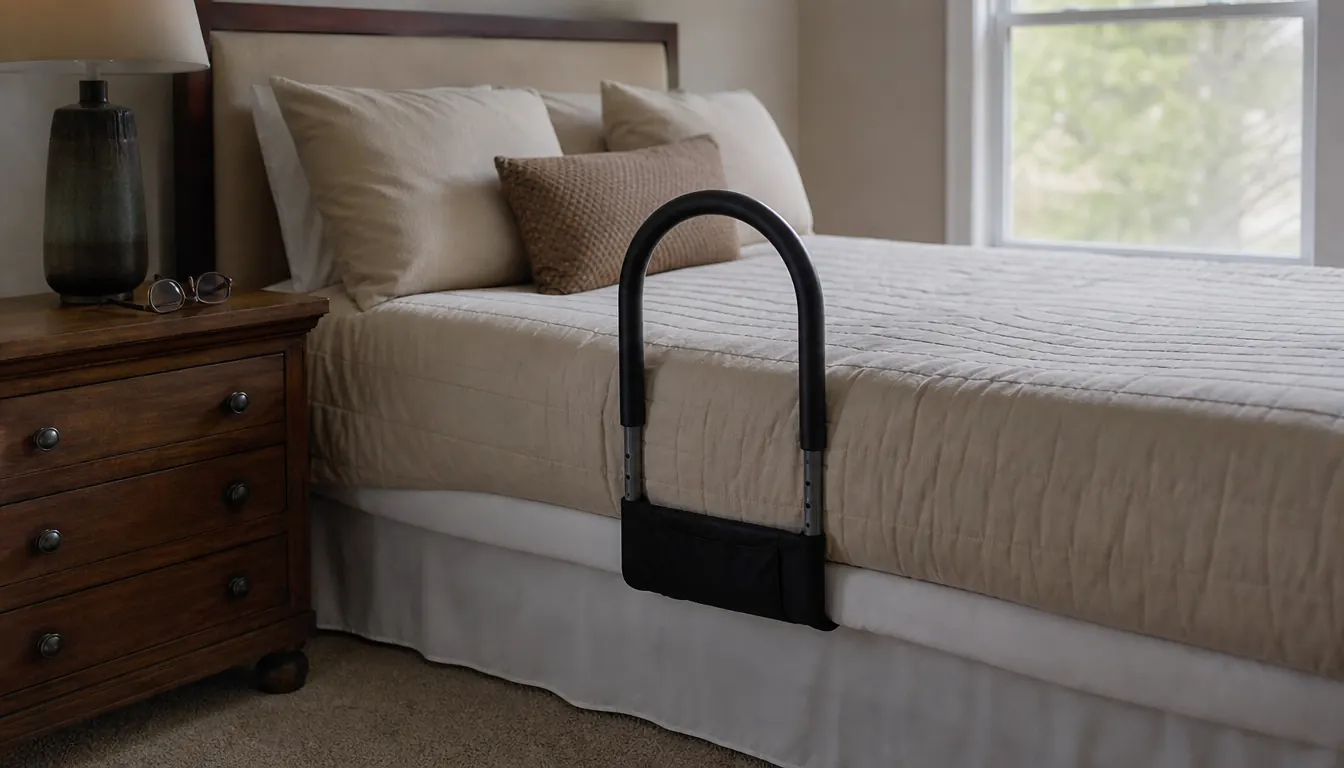
We bought the Medline bed assist bar in June. It is a U-shaped bar with a flat arm that slides between the mattress and the box spring, a strap that ties it off to the bed frame, and a nylon pocket on the side. Six and a half pounds. No drilling. I had it out of the box and standing upright in about ten minutes, and then I spent another twenty getting the height right, which is the part most people rush. Here is the whole job, in the order I did it, and the checks I made before I let Marge put her weight on it.
The bar that replaced a wobbling nightstand
The Medline bed assist bar slides between the mattress and box spring and straps to the frame. No tools beyond what is in the box, no holes in the bed.
Amazon See today's price on Amazon →Before You Start: Three Things to Check
The Medline bar is meant for non-articulating beds, which means a regular mattress and box spring on a frame, not the kind that folds up at the head. Ours is a plain queen on a box spring. If you have an adjustable bed, stop here and ask the seller before you order, because the flat arm needs a mattress and box spring to clamp down on and a folding bed will not give it that.
Second, plan which side. On our bed Marge sleeps nearest the hall door, so the bar went on her side, where she can swing her legs out and stand without walking around the foot of the bed at two in the morning. Third, clear the floor. I pulled the nightstand out about a foot so I had room to kneel, and I moved the dog bed because Pepper likes to lie exactly where I need to be. She is nine and calm and she will not move for a man with a wrench, so I moved it for her.

The Install, Step by Step
Step 1: Unbox and Lay Out the Parts
The bar comes in two pieces that join with a couple of bolts, plus the strap and the pocket. Lay everything on the bed and count it against the sheet in the box before you start, because it is a nuisance to get halfway and find you are short a washer. The nylon pocket came already attached on ours; if yours is loose, put it on now while the frame is light and you can turn it over in your hands.
I bolted the upright to the flat base arm on the bedroom floor, not on the bed. Hand tight first, all the bolts, then snug them down. Hand tight and then a quarter turn is plenty on this kind of tubing. There is no need to bear down on it, and if you do you will crack the finish or strip the bolt head and then you have a real problem.
Step 2: Slide the Flat Arm Between Mattress and Box Spring
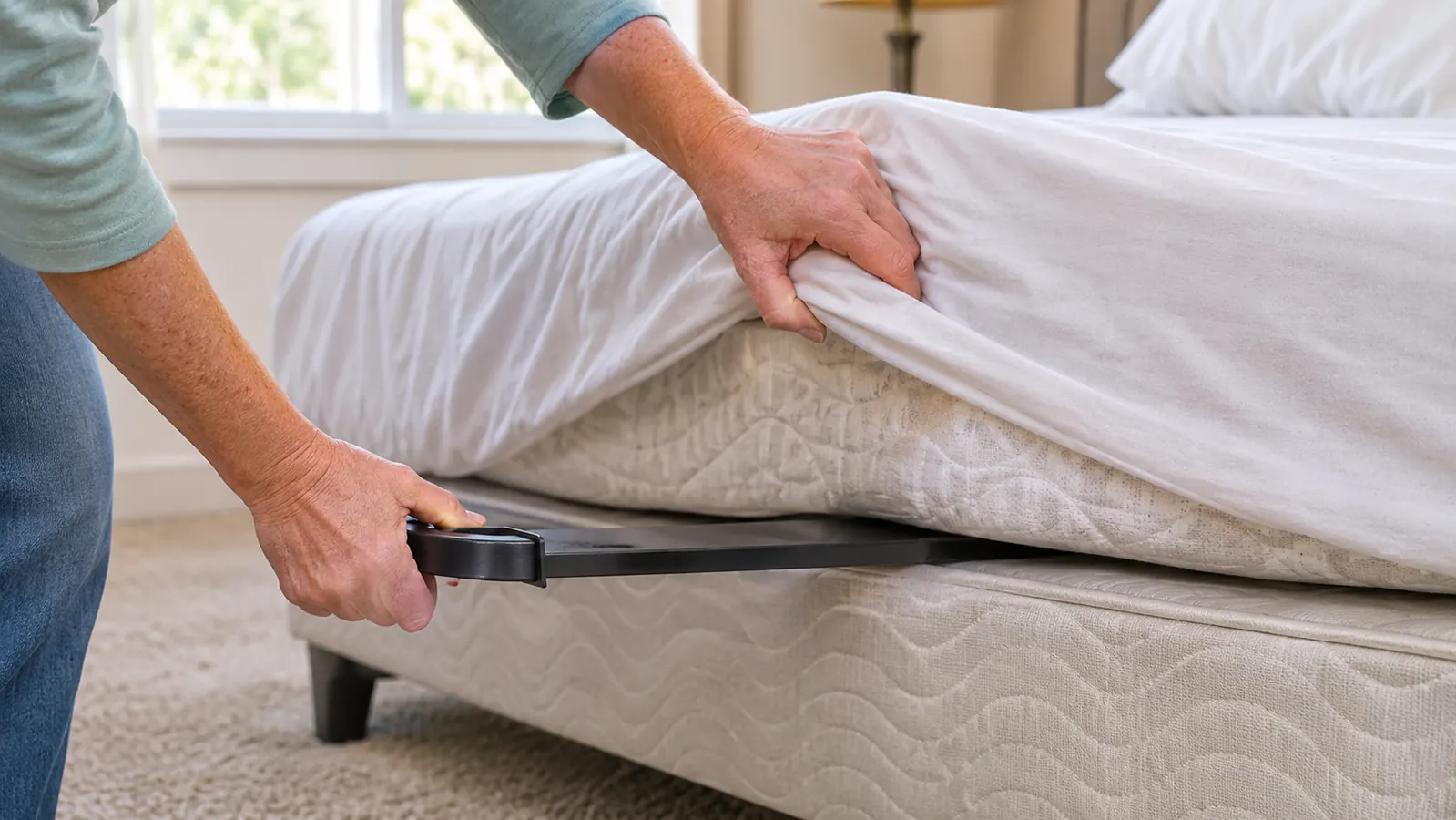
Lift the corner of the mattress at the head of the bed on the side you picked and slide the flat arm in, going in from the edge toward the middle of the bed. Get it in a good ten to twelve inches so there is real surface area under the mattress pressing down on it, not just the tip. The upright part, the U-shaped handle, stands up at the edge of the mattress where a person's hand would naturally land when they sit up.
Push the mattress back down and give the handle a shake. Mine rocked a little at this stage, and that is normal, because the strap is not on yet. Do not panic and do not start shimming things. Move to the next step.
Step 3: Strap It to the Bed Frame
This is the step that turns a lever into a handhold. The strap runs from the bar down and around the bed frame, and you cinch it until the bar stops wanting to tip toward you when you pull on it. Take the slack out first, then pull it firm. You are not trying to compress the mattress. You are trying to stop the bar from rotating forward, and the strap is what does that.
On our frame I had to reach under the box spring to find a rail to wrap around. A flashlight helps and so does a second set of hands, though I managed it alone by propping the mattress with my shoulder. Once it is cinched, grab the handle and pull it toward you the way a person would when standing up. It should feel like a stubborn drawer handle, not like a loose fence post. If it shifts, get back down there and take up more strap.
Step 4: Set the Height for Your Mattress
Here is the measurement worth doing properly. Sit on the edge of the bed the way you would when getting up, feet flat on the floor, and notice where your hand falls when you reach for the bar without leaning over or reaching up. The Medline bar is height adjustable, so you can slide the upright to match. What you want is a grab that lands somewhere between your lap and your chest while you are sitting, so that you are pressing down and slightly forward rather than hauling yourself up by the arm.
I set Marge's and then had her sit and try it, and we moved it twice before it was right. She is five foot four and the mattress sits fairly high on the box spring, so her first grab had her reaching. We came down a notch, she tried again, and that was the one. Do not skip the sit-and-try. The right height is not a number off a chart, it is the height where the person using it does not have to think about the reach.
Tighten the height adjustment once you land on it. Then sit and stand three or four times in a row and check that nothing has slipped. If you have any question about whether the height is right for the person's shoulders or how they should be pushing off, that is a physical therapist question, not a handyman question. My physical therapist is the one who told me to think about pressing down rather than pulling, and it was good advice.
Step 5: Load the Pocket and Run the Final Checks
The pocket on the side holds a book, a remote, reading glasses. On Marge's side it holds her glasses and a small flashlight, which she wanted for the walk to the bathroom. Keep it light. A pocket stuffed with a hardback and a water bottle is weight hanging off a bar that is supposed to be steady.
Then walk around the bed and put your hand on it a few different ways: pull it toward you, push it away, push down on it hard, and give the upright a sideways nudge. Everything should feel like one solid piece with the bed. I also lay down on Marge's side and got up the way she would, which felt foolish and told me more than the shake test did. Last, check that the strap is not pinching the box spring cover and that the flat arm has not worked its way out toward the edge. Then leave it alone for a few days and check the strap again after the first week of real use, because everything settles.
Grab the handle and pull it toward you the way a person would when standing up. It should feel like a stubborn drawer handle, not like a loose fence post.
What Else Helps
Two things made the bar work better at our house, and neither of them cost anything. The first is a lamp within reach on the nightstand, so Marge is not swinging her legs out in the dark and feeling for a handle she cannot see. The second is a clear path. Pepper likes to lie in the doorway between the bedroom and the hall, and a sixty pound dog on carpet at two in the morning is a hazard all by itself, so we started closing the bedroom door at night. She has opinions about it. She has adjusted.
I also went around the room and looked at what else Marge might grab if the bar were not there. The nightstand, which wobbles. The edge of the dresser. A lamp cord. That is the real reason I bothered with a proper install instead of leaning something against the bed. When a person is unsteady, they will grab whatever is nearest, and it is worth making sure the nearest thing is the thing that is actually attached to something.
What I'd Skip
I looked at a wall-mounted grab bar for the bedroom before we bought this and decided against it. That is a job for a stud finder and a hole in the drywall, and if you miss the stud you have a bar that pulls out of the wall the one time somebody really leans on it. The Medline bar clamps to the bed instead, and it goes with you if the bed ever moves. If you want to know how the two compare, that is a longer conversation, but for our bedroom the bed-mounted version was the right call.
I would also skip any temptation to mount it at the foot of the bed or at an angle. It goes at the head, on the side the person sleeps on, flat and level. And skip the urge to crank the bolts down hard. Snug is snug.
Who This Is For
This is for someone who has started pushing off a nightstand, a headboard, or the mattress itself to get out of bed, and for the person who watches them do it and winces. It suits a regular bed with a mattress and box spring. It is a good fit if the person is getting up several times a night, because the bar is right there in the dark without a light on, and if the bed is on the small side of the room where there is no good place for a walker to live.
Marge has been using ours every morning and on her night trips since June, about five months now, and I have not had to touch the strap since the first week. That is the whole endorsement. It is not a medical device and it did not fix anything. It gave her something steady to hold, and it took the nightstand out of the job.
Who Should Skip It
Skip it if your bed is adjustable and folds at the head, because the flat arm needs a fixed mattress and box spring to clamp against. Skip it if the frame is a platform bed with the mattress sitting straight on slats and no box spring, since there is nothing for the arm to slide between and you would be looking at a different style of bar. And skip it if the person's balance has changed recently or they have had a fall. In that case talk to your doctor or a physical therapist first, because the right answer might be something else entirely, and a bar at the wrong height for the wrong person is not better than nothing.
One more thing, and then I will get out of your way. Whatever you buy, install it yourself, slowly, with the person who is going to use it standing right there. Have them sit, reach, and stand before you put the wrench away. The install takes twenty minutes and the height takes ten more, and that half hour is the difference between a bar that helps and a bar that is just in the way.
Twenty minutes now, or another morning on a wobbling nightstand
The Medline bed assist bar is height adjustable, straps to the frame, and holds a pocket for glasses and a flashlight. Check the height with the person who will use it before you tighten the last bolt.
Amazon Check today's price on Amazon →