
Marge is 5 feet 4 and 72 years old, and for most of the last decade she got into our tub the same way she has since we bought this house in 1988. Right hand on the towel bar. Left hand flat on the tile. Right leg over the wall, then a pause while she decided whether the left leg was going to cooperate. I watched that pause for the better part of two years before I said a word about it, which is about my speed. I am not a man who talks about feelings in the middle of a Tuesday morning, but I can order a piece of equipment.
The Drive Medical tub transfer bench was the third aid I bought for her, after the rollator in January and the toilet rail in March. Seven months in, it is the one that changed our mornings the most. It is also the one I got wrong the first time, because I ordered before I measured anything and the outside legs landed on our bathroom floor like a table with one short leg. I am Hal Brennecke, 74, retired after 38 years as an HVAC service technician, and I want to be plain about the limits of what I know. I am not a doctor and not a physical therapist. Anything here about balance, fit or fall risk came out of my physical therapist's mouth or our doctor's, not mine.
So here is what this piece is. What the bench measures, how it went together in our one bathroom in Kettering, what I would do differently, and the parts of owning one that the listing does not print. There is a version of this review that tells you it is wonderful and stops there. That version would leave out the towel on the seat, the bath mat, the handheld shower head I had to install, and the fact that Marge still stands up with her own legs every single morning.
The Quick Verdict
A plain, well built bench that solves one problem completely. Buy it only after you measure the tub wall, the floor space and the seat depth, and plan on a handheld shower head in the same weekend.
Amazon Check Today's Price →Measure the Tub First, Then Order the Bench
Seat height, seat depth and floor clearance decide whether this works in your bathroom. The listing gives you the numbers. A tape measure gives you the truth.
Amazon Check Today's Price on Amazon →How I've Used It: Seven Months in One Small Bathroom
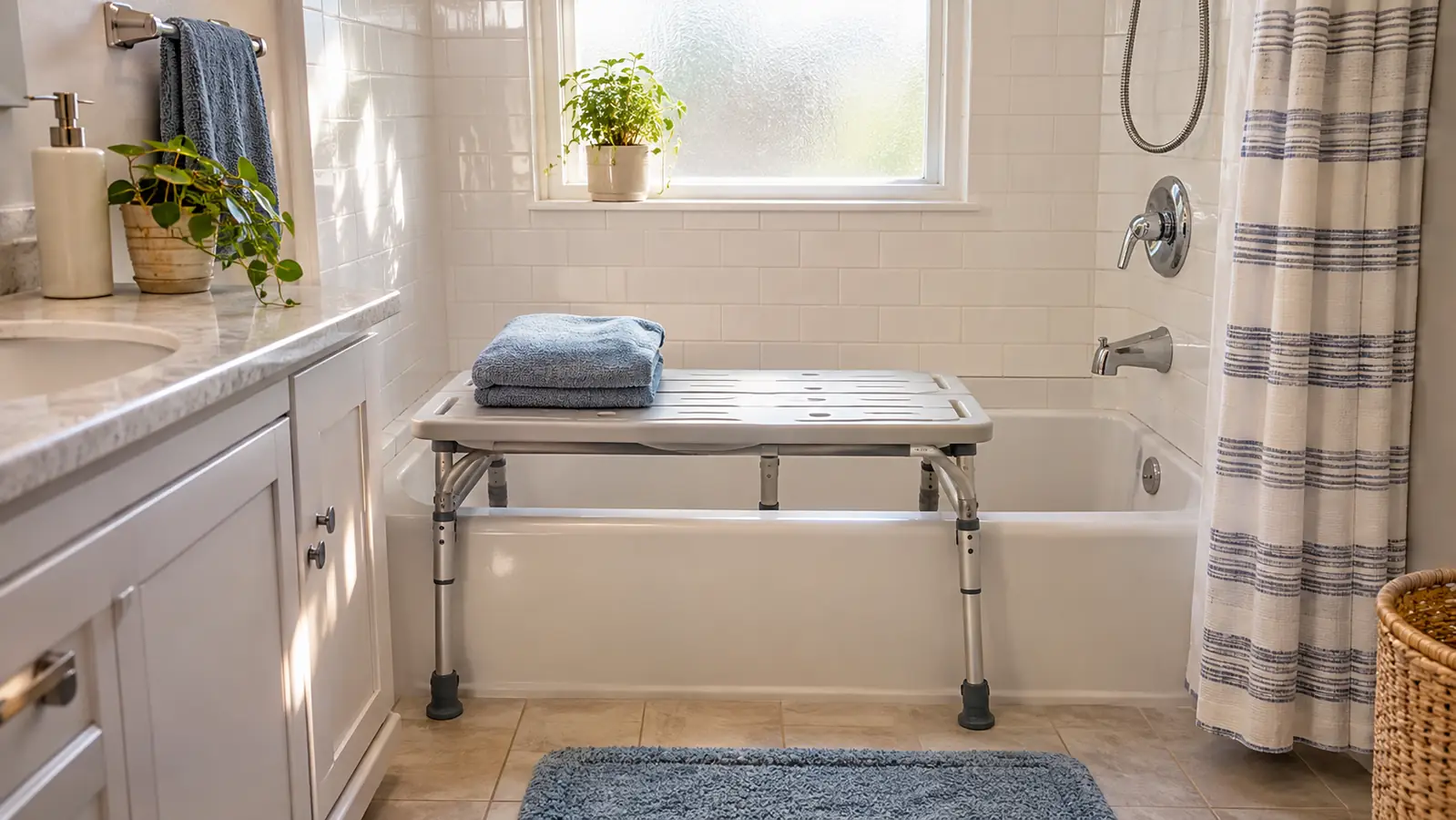
We bought it in April 2026. Ours sits in the same spot today that it sat the first Saturday I put it there, because I set it in the tub, sat on it myself, and never found a reason to move it. Two legs on the bathroom floor, two legs down in the tub. Between baths it stays right where it is, the seat standing over the tub like a small bridge nobody crosses. Marge uses it every single time she bathes, which for her is four or five mornings a week. Seven months at that rate is somewhere north of a hundred and thirty baths, and I have not had to tighten a single thing on it.
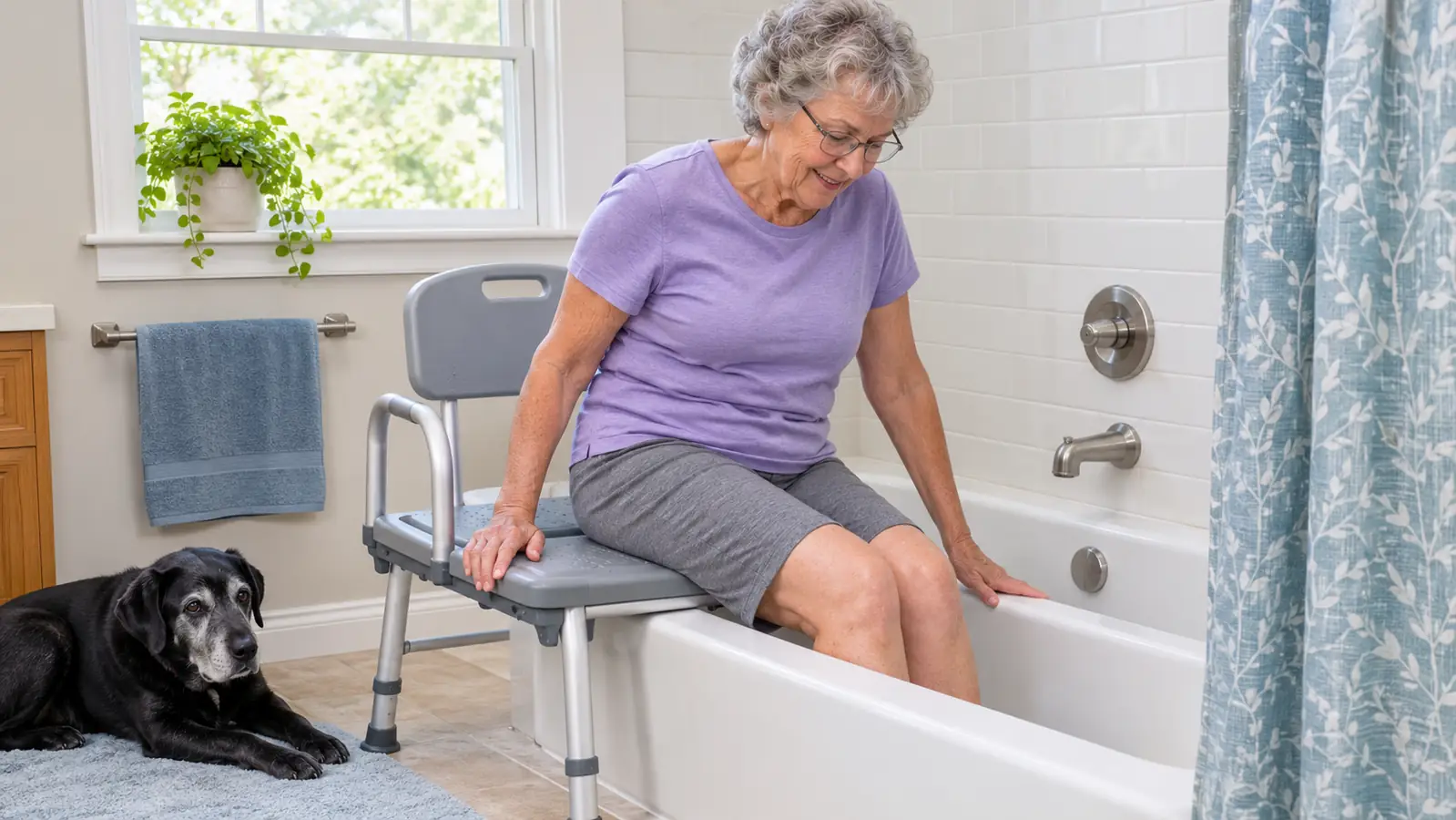
What changed is the sequence, not the speed. Before, it was hand on the towel bar, hand on the tile, leg over, pause. Now she sits down on the outside half with both feet still on the bath mat, scoots back, and swings both legs over the wall at once while her hands stay flat on the tub wall. Out works the same way in reverse. No leg lifted over the wall, no pause, no towel bar. The whole business takes her about as long as it did before, which surprised me. It is not faster. It is just not that moment anymore, and that moment was the one I minded.
I check the legs once a month. Not because anything has loosened, but because I am the kind of man who checks a thing whether it needs it or not. The push buttons on the leg tubes are still firm, there is no rust anywhere on the aluminum frame, and the plastic seat has not cracked or gone chalky after seven months of wet mornings. I scrub the seat once a week with the same brush I use on the tub and that is the whole of the maintenance.
What a Transfer Bench Actually Does, and What It Does Not
A transfer bench is a bridge. The seat spans the tub wall so a person can sit down outside the tub, swing or slide their legs over, and end up seated inside the tub without ever lifting a foot over the wall. Ours sits with two legs on the floor and two legs down in the tub. That is the whole idea, and it has not changed since somebody smarter than me thought of it.
What that buys you is the moment that used to bother me most, the one where a person stands on one leg with a hand on a towel bar. Our towel bar is a towel bar. It is not a grab bar, it was never anchored for a person's weight, and I knew that every single time I watched her use it. Now the wall does the steadying and the seat takes the weight.
What the bench does not do matters just as much. It does not raise or lower you. It does not turn you into place. It does not help you stand back up, and it does not stop you from slipping. Marge still stands using her own legs and a hand on the tub wall. Whether she should be doing that at all is a question for our doctor, and the right seat height for her came from my physical therapist, who is the one who told me to set it just above the wall. If you want a seat that does more than this, you are looking at different equipment and a different conversation with a professional.
What to Measure Before You Order
I ordered the first bench blind, off the listing, on a Thursday night. It arrived, I set it in the tub, and the outside legs sat on our floor at an angle that had me crawling around with a flashlight and a four foot level, convinced the floor was out of level. The floor was fine. The legs were not matched. The return took a week and the second delivery took another, so the whole thing cost me a fortnight and a Saturday morning. Do these four measurements first and you can skip all of that. I did them on a notepad on the bathroom counter with a pencil, and I still have the page.
Tub wall height, measured from the bathroom floor to the top of the tub wall. Ours is about 15 inches on a standard 60 inch tub and shower combination. The legs on this Drive Medical bench adjust through a seat height range of roughly 17.5 to 22.5 inches, and the goal is a seat that sits just above the wall. Not level with it, and not a foot above it. If your tub is set into a raised platform, or your floor is tile over an old tile, check that the range reaches before you buy. Mine reached with two notches to spare.
Floor space in front of the tub. The bench is 17.5 inches deep and 23 inches wide, and you need room for that plus your own feet when you stand up afterward. Our bathroom is small enough that the bench lives in the tub between baths rather than being shuffled in and out of a closet, and I would not want to be lifting it in and out twice a day. Seat depth is the measurement that caught me out. The seat is 15.5 inches deep, which is generous for a taller bather and a lot for Marge at 5 feet 4. She does not sit all the way back. She perches forward, which works fine, but if you are buying for someone very short, know that a deep seat puts pressure behind the knees and they will scooch forward anyway. That is not a defect. It is geometry.
Last one is tub type. A shower curtain is fine. Sliding glass doors are the problem, because the inside legs sit exactly where the sliding panel needs to travel, and the bench does not fit around a track. We have a curtain and I am grateful for it every morning. Write these four numbers down before you order anything, from this maker or any other: wall height, floor space, seat depth, and what is hanging over your tub.
The bench is a bridge, not a lift. It gets her from standing outside the tub to sitting inside it, and everything after that is still her own legs.
How I Set Ours Up
I set the leg height with the bench upside down on an old towel in the hallway, one leg at a time, counting the holes so all four matched. Then I carried it in, set it in the tub, and sat on it myself at 195 pounds and rocked it good. It did not budge. If yours rocks, one leg is off by a notch, and that is a five minute fix worth doing before anybody else uses it. That is the whole assembly. There is nothing to screw together and nothing to drill.
The same weekend I put in a handheld shower head. That was the only extra item we bought for this setup, and I would call it required rather than optional. A fixed shower head six feet up is no use to a person sitting at 17 inches, and a person seated should not be twisting around and reaching back for anything. Mine went on the existing arm with a diverter, the hose clips to a bracket I set at shoulder height when she is seated, and I used the stud finder before I put two screws in the wall. If you are not comfortable with that, ask somebody who is, because a bracket pulling out of drywall mid-shampoo is exactly the kind of thing we are trying to avoid.
We moved the shampoo, the soap and a plastic cup down to the ledge at seat height. That sounds like a small thing until you watch somebody reach up and back for a bottle while seated on a wet surface. The first week, Marge used the bench with me standing in the doorway. That was my physical therapist's idea, not mine, and it was the right call. By the second week she was doing it alone and telling me to go find something else to fix.

The Things Nobody Tells You
The bathroom floor gets wet. She sits down on the outside half with wet legs, water runs off, and it lands right where she is going to stand up again. We put a bath mat down and that solved it, but nobody puts that in a listing because it is not a feature, it is a consequence. Budget for the mat, and buy one with a rubber back, not the fluffy kind that slides.
The plastic seat is hard and it is cold in January, so she keeps a folded hand towel on it, and that towel then stays damp and goes in the wash every other day. The seat also holds a film of soap no matter how well she rinses. I scrub it once a week with the same brush I use on the tub. Ten pounds of bench is light enough for me to lift out with one hand when I want to bleach the tub, which I do about once a month.
You will be tempted to keep using the towel bar. It is right there at the height your hand wants, and it is anchored into drywall with the brackets that came in the package. I have said out loud in our bathroom more than once that it is not a grab bar, and if a person needs something permanent to hold onto, that is a conversation with your doctor and a real grab bar set into studs. The bench does not make the towel bar any stronger than it was.
And the big one, the one I would want somebody to tell me straight across a table: the bench does not stand her up. The seat height helps, the wall helps, her own legs do the rest. If standing is the hard part of the morning, this bench on its own will not fix it, and I would talk to a physical therapist about what goes alongside it before spending money on anything else. What the Drive Medical bench fixed was the getting in and the getting out. That was the piece I could actually do something about.
What I Liked
- Legs adjust so the seat sits just above a standard tub wall, roughly 17.5 to 22.5 inches
- Aluminum frame and plastic seat, so there is nothing on it to rust in a wet bathroom
- 10 pounds, light enough for one person to lift out of the tub for cleaning
- 15.5 inch seat depth gives real thigh support for a taller bather
- Limited lifetime warranty, which tells you what the maker expects of it
- Two legs inside the tub and two on the floor means no stepping over the wall at all
- No tools, no drilling, no assembly. It is out of the box and in the tub in five minutes
Where It Falls Short
- Eats floor space in a small bathroom and lives in the tub between baths
- Hard plastic seat, cold in winter, needs a towel on it and a weekly scrub
- Does not help you stand up or turn, so it is no substitute for leg strength
- Poor match for sliding glass tub doors
- Water drips onto the floor when the bather swings their legs back out
- The 15.5 inch seat depth pushes a shorter person forward on the seat
- The adjustable legs are the whole fit mechanism, so a mismatched notch is on you to catch
Who This Is For
This is for a household with a standard tub and shower combination, a shower curtain rather than sliding doors, and somebody who can stand and pivot on their own legs with a hand on a wall. That is the honest bar. If a person can stand up from a chair, swing their legs, and hold themselves steady for the few seconds it takes to sit down, this bench removes the one part of bathing that required lifting a foot over a wall.
It is also for the spouse or the adult child doing the buying, which in our house was me. It is a piece of equipment you can order, measure for, install and check, and those are things I know how to do. If that is you, and your only real question is whether it fits your bathroom, measure the four numbers above and you will have your answer in ten minutes.
Who Should Skip It
Skip it if your tub has sliding glass doors, because the inside legs sit in the track and you will fight the door every single time. Skip it if the tub is set high on a platform beyond the top of the leg range, or if your bathroom floor is so tight that a 17.5 by 23 inch footprint in front of the tub leaves nowhere for feet. And skip it if the person you are buying for cannot stand and pivot at all. That is not a bench problem, that is a conversation with a doctor or a physical therapist about what the right equipment actually is, and I would have that conversation before spending a nickel.
One more. If you already have a walk-in shower with a seat built into it, you do not need this. I would say the same about anyone whose only trouble is at the toilet, because that is a different piece of equipment and, in our house, it was the toilet rail that did that job. Buy the thing that matches the problem you actually have, not the one that matches the aisle you are standing in.
If Your Tub Wall Measures Under About 15 Inches, This Is the Bench
Adjustable legs, two inside the tub and two on the floor, and no stepping over the wall. Bring your measurements to the listing and check them against the seat height range before you order.
Amazon Check Today's Price on Amazon →