
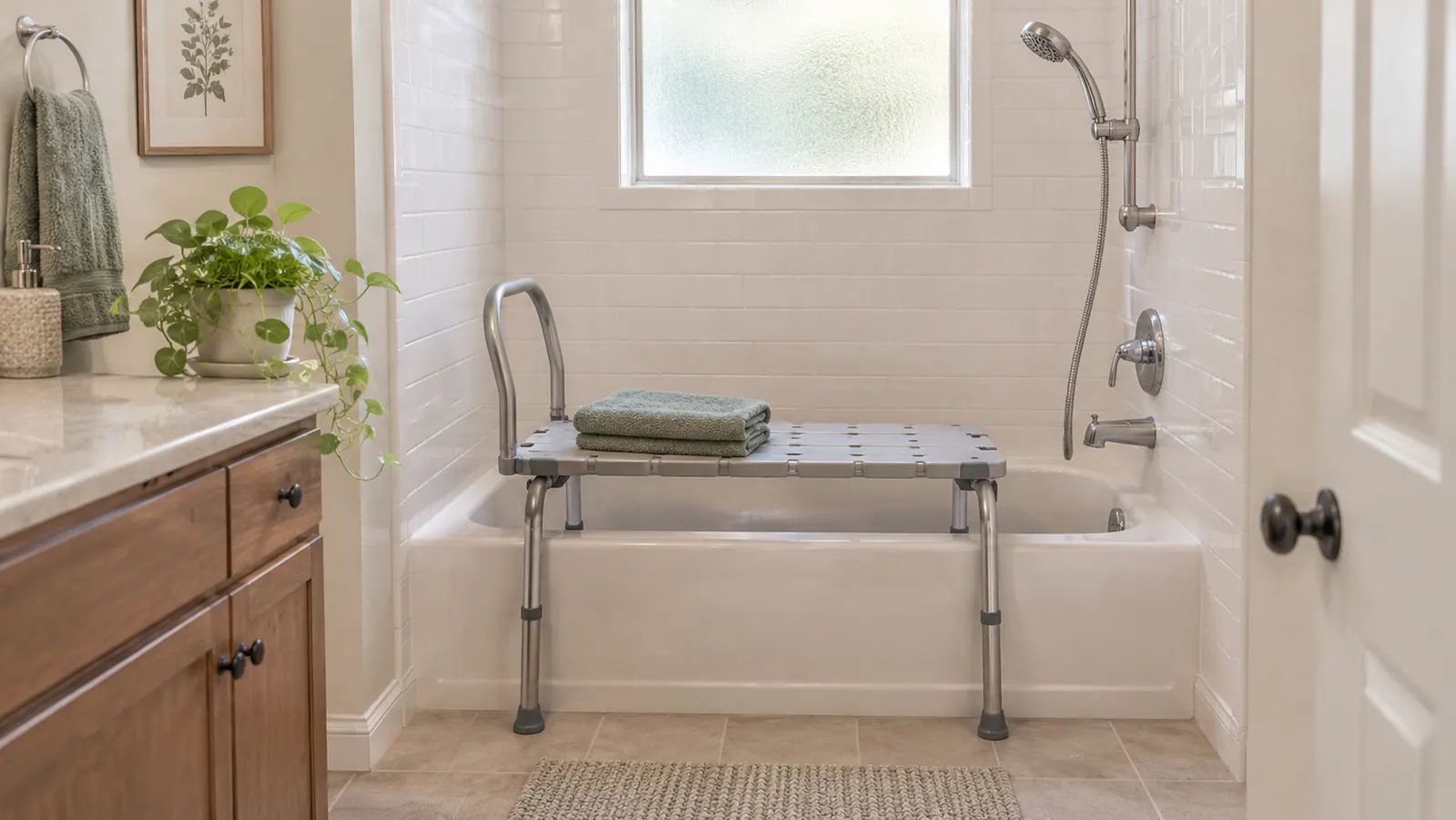
My wife Marge is 72 and has arthritis in both knees. For years she got into our tub the same way: right hand on the towel bar, left foot over the wall, and a short prayer that the second foot would land where she meant it to. The towel bar is not a grab bar. I have been a service technician for 38 years, and I know a fixture that was never built to hold a person's weight when I see one. We just did not have a better answer until April 2026, when we bought the Drive Medical Tub Transfer Bench.
I am Hal Brennecke, 74, retired HVAC. We live in a one-story ranch in Kettering, Ohio, with one bathroom and a standard 60-inch tub-shower combo. I installed the bench myself. Marge has used it every time she bathes since, which is about seven months now. This is not a clinical report. It is what I noticed in our house, with my own tools and my wife's knees.
The Quick Verdict
It does the one job we needed: lets Marge sit outside the tub and slide across without stepping over the wall. Stable, adjustable, and simple to keep clean. It takes up floor space and will not replace a grab bar, so measure your bathroom before you order.
Amazon Check Today's Price →If stepping over the tub wall is the part you dread, start here
Two legs sit inside the tub, two on the floor. Marge sits on the outside edge and slides across. I set the seat height once, and it has not moved since April.
Amazon Check Today's Price on Amazon →How I've Used It
The Drive Medical bench is Marge's, not mine. I put it together and set the height, and I sat on it in the empty tub once to check that the seat was level before she ever used it. After that, it became part of her morning routine. She keeps a washcloth on the seat, a bottle of body wash on the tub ledge, and the handheld shower head in its bracket. The bench stays put. We do not fold it or move it between baths.
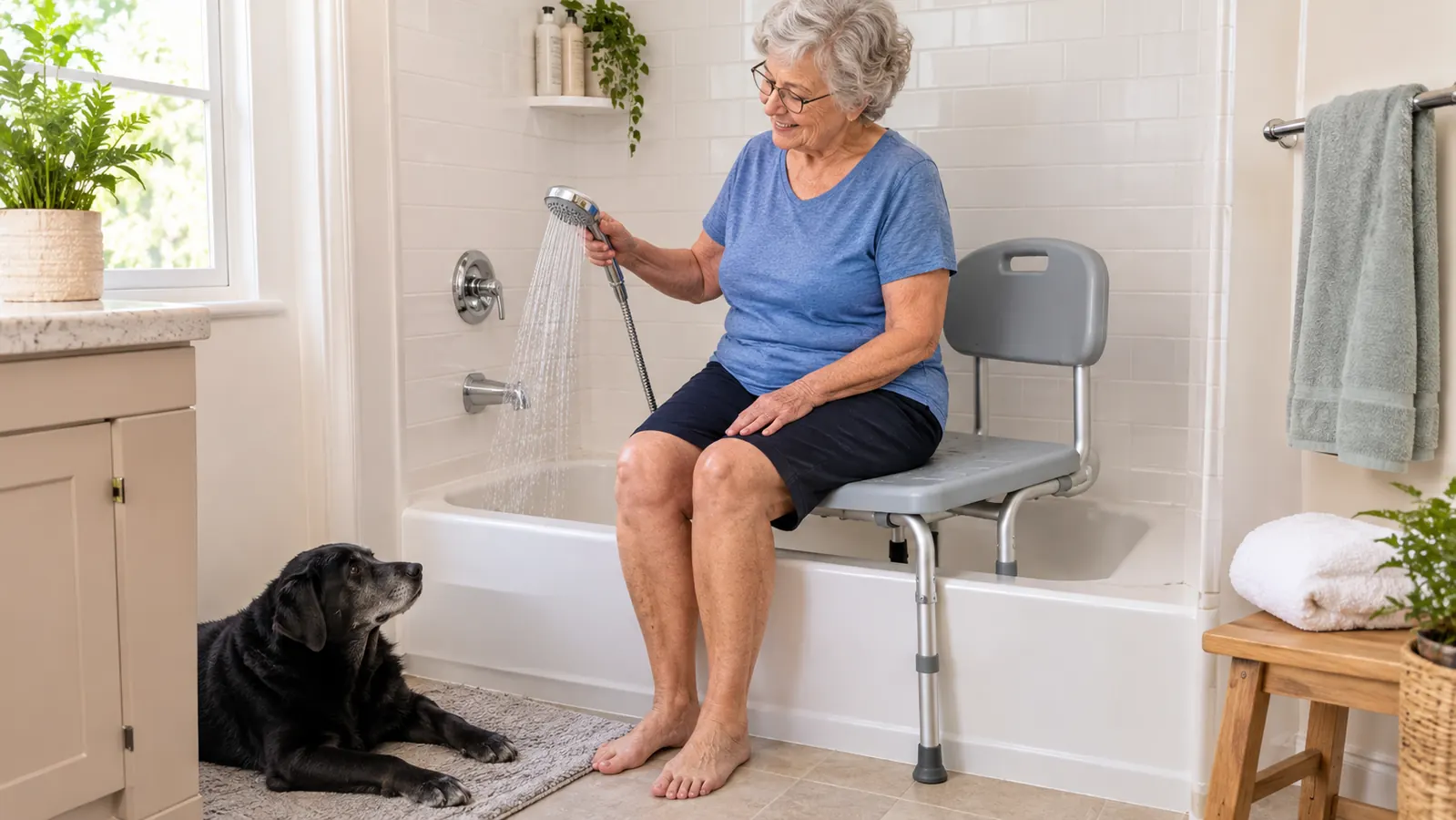
Before April, her routine was a reach and a step. She would put her hand on the towel bar, lift one leg over the tub wall, and bring the other one over while the first foot was already on a wet floor. I did not like it. She did not like it. The bench changed the order of operations. She sits down on the outside half, lifts her legs over one at a time, and slides to the inside half. When she is done, she slides back and stands up on the bathroom floor, not on the tub floor.
The first week was an adjustment. She had to learn to put her hand on the bench, not the towel bar. She had to trust that the seat would hold her. I checked the leg height twice that week because I am that kind of person. By the second week, she was not thinking about it anymore. That is the highest compliment I can give a piece of equipment.
What the Bench Does in a Standard Tub
A transfer bench is a simple idea. It is a seat that spans the tub wall. Two legs stand inside the tub, two stand on the bathroom floor. You sit on the outside end, swing your legs over the wall, and slide across the seat until you are over the tub. You never stand on the tub floor to get in, and you never step over the wall to get out.
The Drive Medical bench is built around that idea. The frame is aluminum and the seat is plastic, per the listing. The seat surface is listed at 15.5 inches deep, and the frame at 23 inches wide. The legs adjust from 17.5 to 22.5 inches. I set ours near the low end so the seat sits just above the tub wall. Marge is 5 feet 4, and on the outside end her feet rest flat on the bathroom floor. That gives her a short slide, not a climb.
The listing also says the bench carries a limited lifetime warranty from Drive Medical. I have not had to use it. What I can tell you is that the frame does not flex when Marge sits down, and the legs do not walk out of place. I check the leg adjusters once a month, the same day I check the smoke detectors. That is a two-minute job.
One thing I want to be clear about: the bench is not a grab bar and it is not a railing. It is a place to sit. If you need to pull yourself up by your arms, that is a different conversation, and it is one for your doctor or physical therapist. The bench does its job by letting you sit instead of step. That is a narrow job, and it does it well.
Setting It Up in Our One Bathroom
Our bathroom is a standard hall bath with a tub-shower combo, a toilet, and a vanity. The bench takes up the floor space in front of the tub. That is the tradeoff. It is not a piece you can tuck into a closet between uses, at least not in our house. We leave it in place. The bathroom door still opens, and Pepper, our 9-year-old Lab mix, can still lie in the doorway, which she does most mornings.
I set the leg height with the bench upside down on a towel, one leg at a time, using the paper that came with it. I wanted the seat just above the tub wall, level front to back and side to side. Then I flipped it over, set it in the tub, and sat on it myself before Marge did. I am 5 feet 11 and about 195 pounds. The bench held steady. I am not going to quote a weight limit because I do not want anyone to treat a number as a promise. The listing has its own figure, and you should read it.
The same weekend, I installed a handheld shower head. That was the only extra thing we bought for this setup. It was not part of the bench, but it matters. With a fixed shower head, Marge would have had to stand up to rinse. With the handheld, she can sit and move the water where she needs it. If you are setting up a bench, put a handheld on your list. It is the difference between a bench that works and a bench that half works.
I did not drill into the tub or the tile. I set the bench in place and checked the legs. That was important to me because I did not want to put holes in a 1988 bathroom that has had enough excitement for one lifetime. The only thing I tightened was the leg adjusters, and I have tightened them once a month since.
Seven Months of Steady Use
Marge bathes or showers most mornings. That is about seven months of steady use, and the bench has not loosened up, cracked, or developed a wobble. The plastic seat has a few water spots that I wipe with a vinegar solution once a week. The aluminum frame still looks like it did in April. I check the leg adjusters on the first of each month, the same day I check the smoke detectors.
The biggest change is not in the bench. It is in the routine. Marge no longer starts her morning by measuring the distance from the towel bar to the tub wall. She sits, slides, washes, slides back, and stands. It takes her about the same time it used to take, maybe a minute longer. That minute is the best minute I have spent on a home improvement in years.
I have had to adjust the height once, in July, after Marge said the seat felt a little high. I lowered the outside legs by one setting and checked the seat with a level. That is the one thing to watch: the bench has to be level. If one leg is off, the seat will rock, and a rocking seat is worse than no seat. I used a torpedo level on the seat the first time, and now I just eyeball it. If you are not handy, have someone check it with a level.
The bench has also made the bathroom easier for me to clean. I can lift the bench out of the tub with one hand, set it on a towel, and scrub the tub floor. The whole thing is listed at 10 pounds. I would not call it featherweight, but I can move it. Then I set it back and check that the legs are seated. That is the whole maintenance routine.
The Tradeoffs I Noticed
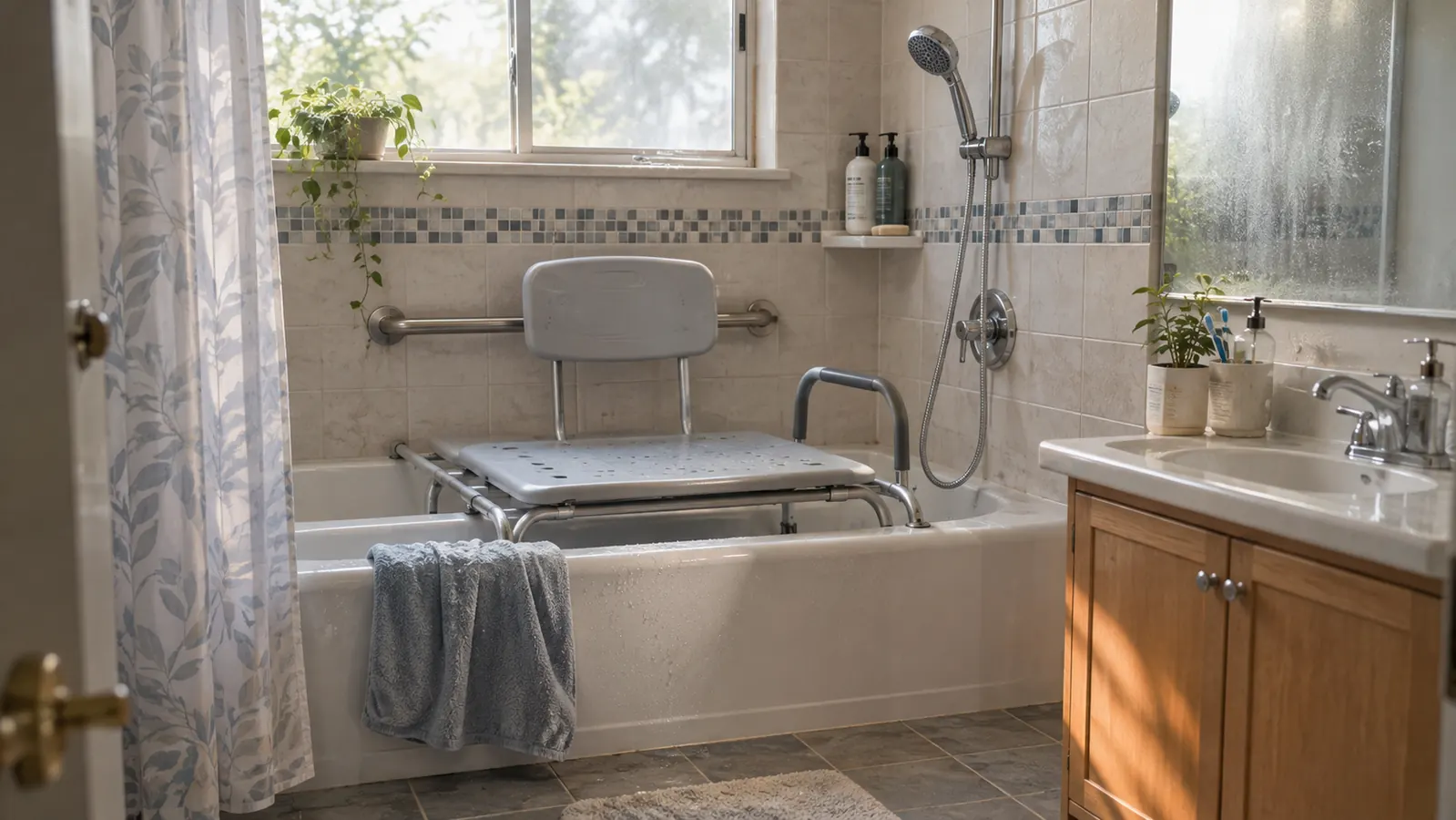
The bench is not a small object. It occupies the floor in front of the tub, and it stays there. If your bathroom is tight, measure the floor space before you order. Our bathroom is not big, and the bench leaves enough room to stand at the sink. A smaller bathroom might not be so lucky. This is the main reason I would not recommend it blindly.
It also does not help with the toilet or the bed. We have separate aids for those, and I am glad we do. A transfer bench is a one-job tool. If you are looking for something that will also help you stand up from the toilet, this is not it. That is not a flaw. It is just the job.
The seat is plastic, per the listing, and it can feel cool on a winter morning. Marge keeps a folded towel on it, which solves that. I would rather wipe a plastic seat than scrub a cushion. The bench also does not make the tub floor any less slippery. It just keeps Marge from standing on it to get in. If you are going to sit on the bench and stand up inside the tub, you still need a mat or whatever your physical therapist recommends. We do not do that. Marge sits, slides, and stands on the bathroom floor. That is the sequence that works for us.
What I Liked
- Height adjusts from 17.5 to 22.5 inches, so it fits a standard tub wall without a custom setup.
- Seat is 15.5 inches deep and the frame is 23 inches wide, which gave Marge room to slide.
- Aluminum frame and plastic seat are easy to wipe down.
- Light enough for me to lift out of the tub alone for cleaning.
- No drilling into tile or tub.
- Limited lifetime warranty from Drive Medical.
Where It Falls Short
- Takes up floor space in front of the tub and stays there.
- Only helps with the tub, not the toilet, bed, or sink.
- Plastic seat feels cool in winter.
- You have to check the leg adjusters and keep the seat level.
- Does not replace a grab bar or a therapist's advice.
I set the seat just above the tub wall in April, and Marge has not stepped over that wall since.
Who This Is For
This is for someone who has a standard tub-shower combo and wants to stop stepping over the tub wall. That is the whole case. If you can sit down on the outside edge, lift your legs over one at a time, and slide across, the bench gives you a way to bathe without standing on a wet tub floor. It is also for the spouse or caregiver who sets it up and checks the height. I am that person in our house.
It is a good fit if you have a knee or hip that does not like the step, or if your balance is not what it was. Marge has arthritis in both knees and her balance has gotten less steady. The bench lets her sit instead of balance. If you are not sure whether you can slide safely, ask your doctor or physical therapist before you buy. I am not a medical person. I am a retired HVAC technician with a level and a wrench.
Who Should Skip It
Skip it if you have a walk-in shower with no tub wall. The bench is built to span a tub wall. Without a wall, you do not need the span, and a different seat makes more sense. Skip it if your bathroom floor is so tight that the bench would block the door or the vanity. Measure first. I mean with a tape, not with your eye.
Skip it if you need more support than a seat gives. If you cannot sit unsupported, or if you need help moving from a seated position to standing, this is not the piece to solve that. That is a conversation for your physical therapist or doctor. The bench is a seat, not a lift. It does one job, and it does it well, but it will not do a job it was not built for.
Seven months in, this is the bathroom aid I would buy again first
The Drive Medical bench ended the towel-bar reach in our house. I set the height, checked it with a level, and Marge has used it every morning since April. If your tub has a wall and your knees do not like it, this is the place to start.
Amazon Check Today's Price on Amazon →