
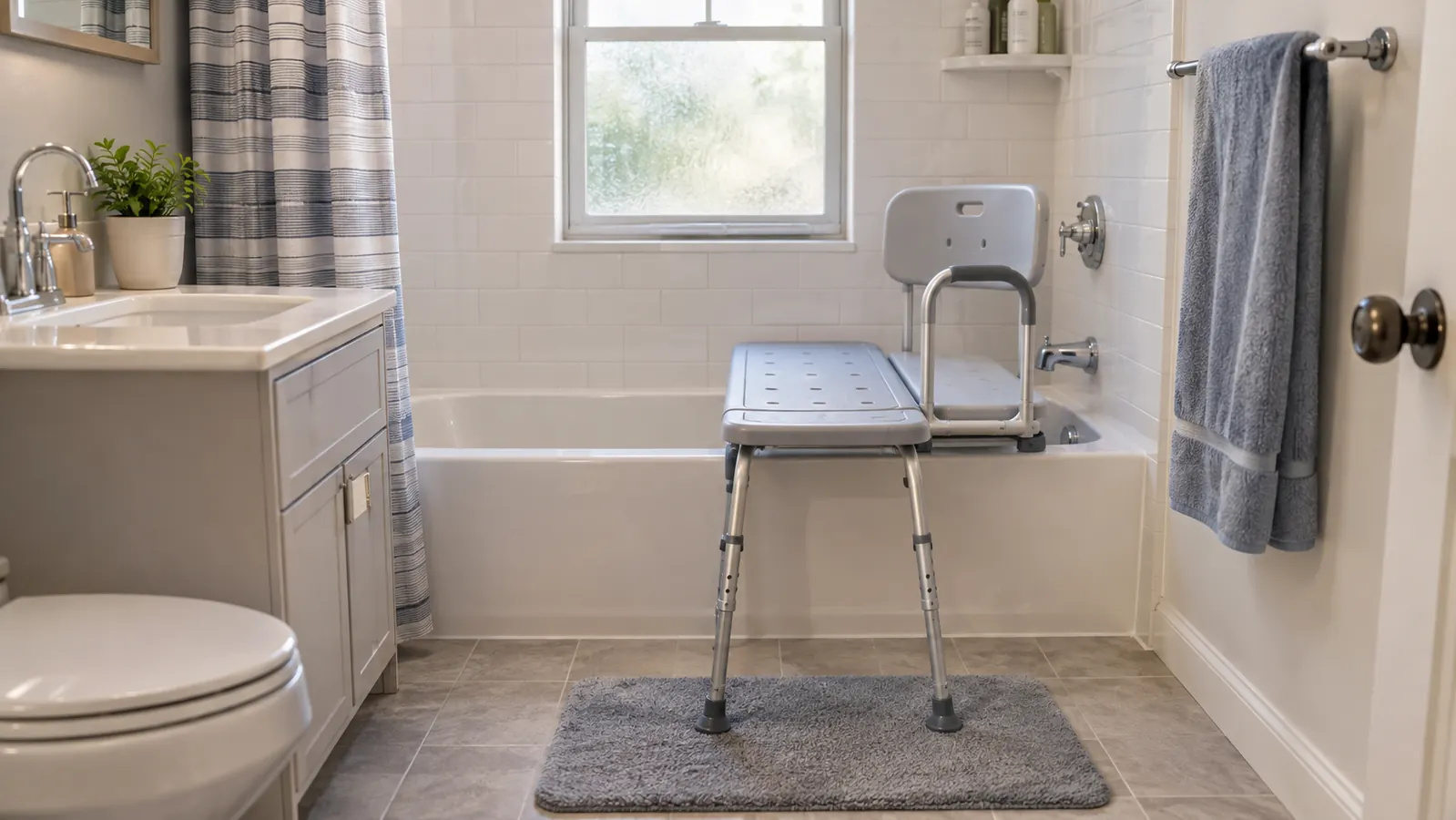
Short answer, because that is what I would want if we were standing in the church parking lot: if the trouble is getting over the tub wall, buy the transfer bench. If the trouble is only staying steady once you are already standing in the tub, a standard shower chair will do the job and take up less of your bathroom floor. The bench in our tub is the Drive Medical Tub Transfer Bench, and if it broke tomorrow I would order the same one again.
Here is our situation, so you can decide how much of it matches yours. One bathroom in a ranch house we bought in 1988, with a standard 60-inch tub and shower combo. Marge is 72 and has arthritis in both knees, and her balance has gotten less steady over the last few years. Until April of 2026 she stepped over that tub wall holding the towel bar, which is not a grab bar, and I knew better than that every single time she did it. We bought the Drive Medical bench that month. I set the leg height so the seat sits just above the tub wall, she sits down outside the tub, and she slides across. She has used it every time she bathes since, and I have not had to adjust it once.
| Drive Medical Tub Transfer Bench | Standard shower chair | |
|---|---|---|
| Getting over the tub wall | You sit down outside the tub and slide across. No stepping over the rim. | You still step over the wall, then sit down inside the tub. |
| Seat height | Adjustable legs, seat from 17.5 inches up to 22.5 inches | Typically fixed and set low to stay stable inside the tub |
| Where the legs stand | Two legs inside the tub, two on the dry bathroom floor | All four inside the tub, on a floor that slopes toward the drain |
| Transferring from a walker or from the doorway | Built for a sit and slide from outside the tub | You have to be standing and steady inside the tub before you sit |
| Seat size | 15.5-inch seat depth, 23 inches wide, so there is room to sit down squarely | Sized to fit between the tub walls, which usually means a smaller seat |
| Warranty | Limited lifetime warranty from Drive Medical | Varies by listing, so read the one you are actually buying |
| Floor space | Two legs live on your bathroom floor all the time | Stays inside the tub and lifts out when you want the tub back |
| Sharing the tub with someone who showers standing | The outside legs are in the way of a standing shower | Comes out with one hand |
| Best for | Someone who cannot safely step over the tub wall | Someone steady on their feet who only needs a place to sit |
Where the Drive Medical Bench Wins
The whole reason this thing exists is one move: you sit down on dry floor and you slide. That is the difference between a bench and a chair, and it is not a small difference. With the bench, Marge's feet never leave the bathroom floor until she is already seated. The seat is 15.5 inches deep and 23 inches wide, so there is room to sit down squarely and then bring one leg across, then the other. Nobody is balancing on one foot on a wet tub floor while they lower themselves down. The frame is aluminum and the seat is plastic, and the whole thing weighs 10 pounds, which means I can swing it out of the tub with one hand when I want to scrub the tub out on a Saturday.
Seat height is the second thing it does better. The legs adjust, and Drive Medical lists the range as 17.5 inches up to 22.5 inches. Our tub wall comes to a hair under 17 inches, so I set the bench so the seat clears it by about an inch. That matters for two reasons. A seat that sits slightly above the wall means she slides across level, not up and over. And it means she can get her feet under her to stand afterward instead of pushing herself up off the tub rim, which is exactly the kind of push our doctor told her to stop doing. If your tub wall is taller than most, you still have room inside that range.
The third advantage I did not think about until I had it set up on the bath mat. Two legs stand inside the tub and two stand on the bathroom floor. Tub floors slope toward the drain, that is just how they are built, so anything that stands entirely inside the tub is standing on a wet slope. The back of this bench is on the same dry, level floor as the rest of the house, and the frame is braced across the tub wall between the two surfaces. I checked the leg height twice the first week and have not touched it since. Drive Medical lists a limited lifetime warranty on it, which for a piece of bathroom equipment is more than I expected to see.
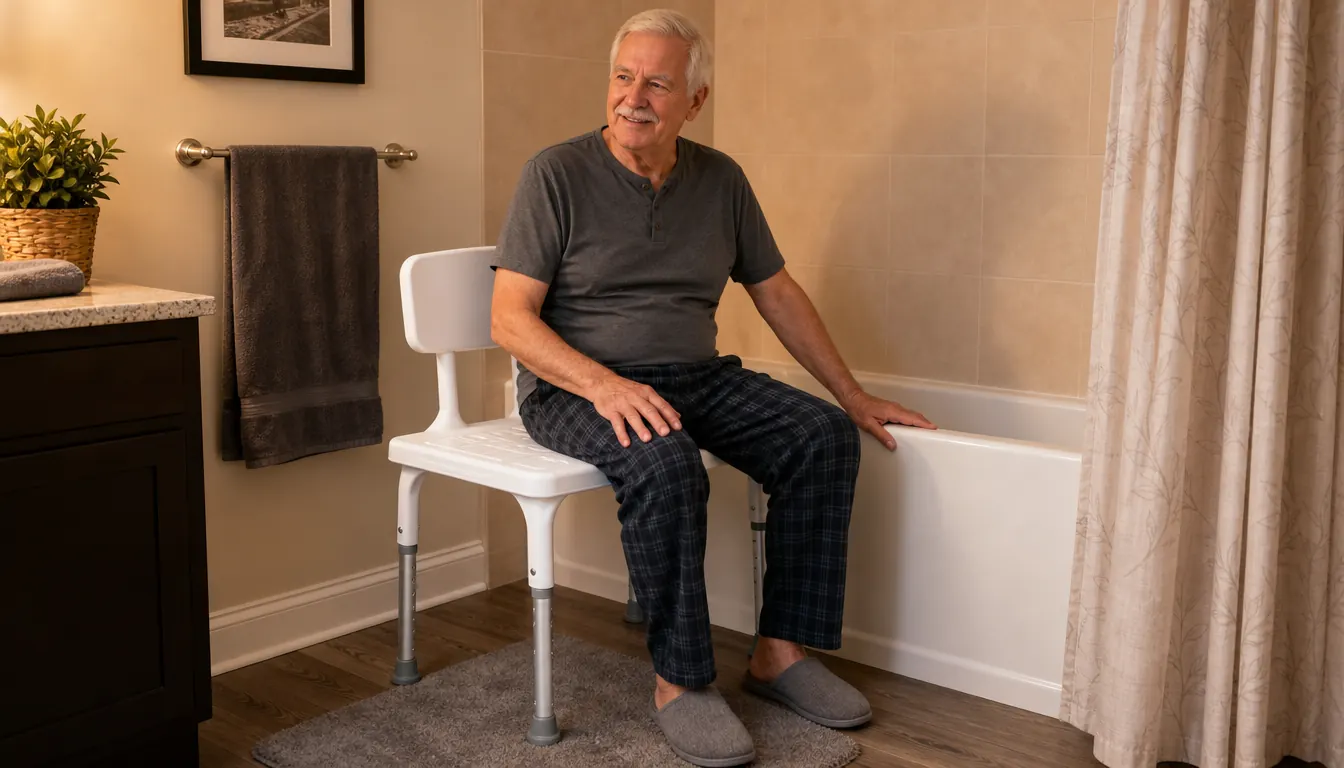
Where a Standard Shower Chair Wins
A shower chair is a four-legged seat that lives entirely inside the tub, and for a lot of bathrooms it is the better fit. Our bathroom is small. The bench spans the tub wall, so two of its legs are always out on the bathroom floor, right where you step when you come through the door. In a big bathroom that is nothing. In a hall bath the size of a closet, you walk around it forty times a day and you notice every one of them. A shower chair lifts out, leans against the wall, and the floor is yours again. If you have a bath mat, a scale and a laundry basket in there already, that difference is real.
The other place a shower chair wins is the shared bathroom. I still shower standing up. With the bench in the tub I am stepping over those outside legs and standing next to the seat the whole time. It works, but it is clutter in a room that was already tight. A chair that comes out with one hand would be simpler for the person who does not need it. And if the person who needs the help is only unsteady on their feet and can step over the wall without thinking about it, a chair covers everything they actually need. A friend at church uses one for exactly that reason, and the restroom off the therapy gym at the clinic I went to had one too. Nobody there was sliding anywhere. They just needed a place to sit down.
Two legs stand inside the tub and two stand on the bathroom floor, so the back of this bench is on the same dry, level floor as the rest of the house.
If the tub wall is the hard part, this is the piece that solves it
The Drive Medical transfer bench spans the tub wall so you sit down outside the tub and slide across. The legs adjust from 17.5 to 22.5 inches, so you can set the seat just above your own tub wall.
Amazon Check Today's Price on Amazon →What to Measure Before You Order
Three measurements and you will know which one you are buying. First, the height of your tub wall from the bathroom floor. Second, the floor space outside the tub, from the tub apron to the nearest wall or vanity, because the bench puts legs out there and a person still has to stand in that space to sit down. Third, the inside length of your tub, since the seat end needs somewhere to go. I wrote all three on the back of a church bulletin and took it to the computer, which is how I do most things. The bench is 17.5 inches deep and 23 inches wide on the floor side, so if the clear floor outside your tub is tighter than about two feet, you are going to feel it every morning.
Setting the legs is the one job that takes a few minutes and then never again. I set ours so the seat sits about an inch above the tub wall. Set it level with the wall, or below it, and you are sliding up and over, which is the whole thing we were trying to avoid. The rule my physical therapist gave me, and it is a good one, is that the person should be able to sit down with both feet flat on the floor and then lift each leg across without leaning back. Try that with a kitchen chair and a tape measure before you order. If the seat has to be higher than the range allows for the transfer to work, this bench is not your answer, and that is a conversation for your doctor rather than a shopping cart.
What I Liked
- You sit down outside the tub and slide across, so no step over the rim
- Legs adjust from 17.5 to 22.5 inches, which covers most tub walls
- Two legs on dry, level floor instead of all four on a wet tub floor
- Aluminum frame, 10 pounds, so one person can move it
- Limited lifetime warranty
Where It Falls Short
- Two legs live on your bathroom floor and stay in the walking path
- In the way for anyone who showers standing up
- Takes up real space in a small bathroom
- You will want a handheld shower head to rinse while seated
The Part Nobody Mentions: The Shower Head
Nobody told us this and I would have figured it out faster if they had. The weekend I set the bench up, I also swapped the fixed shower head for a handheld one on a hose. That was the only extra thing we bought for it, and it took about twenty minutes with a wrench and a roll of thread tape. Sitting down to bathe changes where the water comes from. With a fixed head up on the wall, the spray lands on the back of your head or your shoulder and rinsing off is a yoga exercise. With a handheld, she rinses where she wants, when she wants. If you are comparing a bench with a chair, add a handheld to the budget either way, because both of them put you in a seated position.
What the Bench Does Not Do
It is not a grab bar and it does not turn your bathroom into a safe room. Our towel bar is still a towel bar, and it is still not built to hold a person's weight, so nobody in this house pulls on it. If you need something to hold on to while you stand, that is a different conversation with a different product, and worth having with your physical therapist. The bench also does not help you at the toilet or at the side of the bed. Those are their own jobs with their own pieces of equipment. One tool, one job, that is how I was taught to work on furnaces and it holds up in a bathroom too.
And it does not remove the need to be careful. Marge still plants both feet before she stands. She still uses the seat every single time rather than deciding she feels fine today and stepping over the wall. That is the thing about equipment like this: it only works when it is the habit, not the backup plan. The first month she used it because I had just spent an afternoon setting it up. Seven months in, she uses it because sliding across is easier than stepping over, and that is the only endorsement I know how to give.
Who Should Buy Which
Buy the Drive Medical Tub Transfer Bench if the tub wall is the obstacle. That means the person cannot step over the rim without holding something that was not built to be held, or cannot get a foot up and over while staying steady, or has to sit down to bathe every single time. That was us, and the bench was the right call. It also makes sense if the transfer happens from a walker or from a doorway, because the seat outside the tub is where that transfer ends. The two legs on the dry floor and the adjustable height are the parts doing the actual work, not the seat.
Buy a standard shower chair instead if the person steps over the tub wall fine and the only problem is standing in the shower. It costs less floor space, it comes out of the way when the tub belongs to somebody else, and it does a simple job simply. If you are the one doing the caregiving and the bather can still get themselves over that wall with a hand on your arm, a chair is more honest about what is actually needed. Where neither one is the answer is the person who cannot put weight on a leg at all, or who has been told by a doctor to stay off it. That is a question for our doctor and my physical therapist, not for a listing on Amazon.
Seven months in the tub and I have not had to touch the leg height once
Two legs in the tub, two on the dry floor, seat set just above the wall so you sit outside and slide across. That is the whole idea, and it is the reason this one is still in our bathroom.
Amazon Check Today's Price on Amazon →