
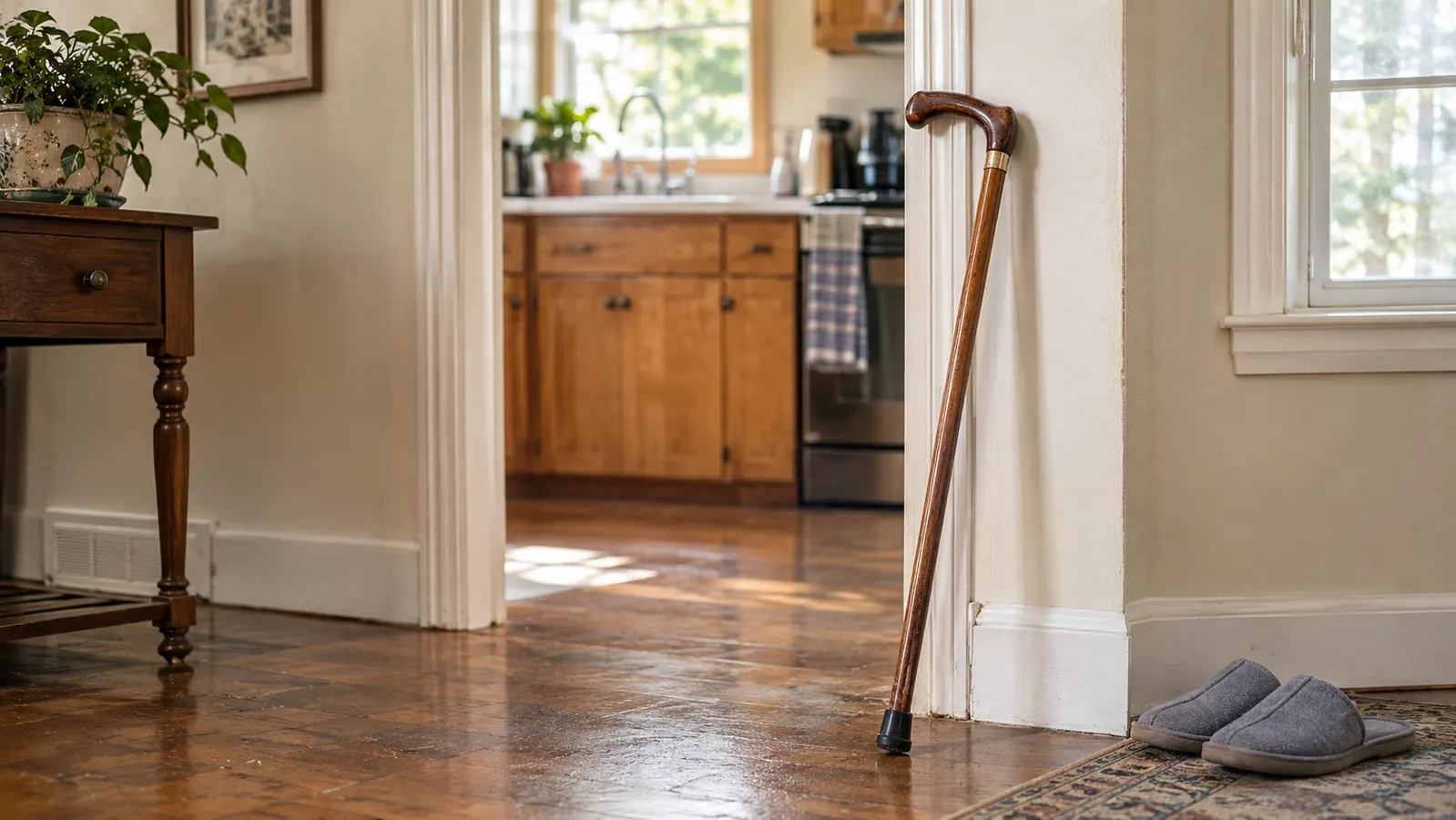
I bought the Vive folding cane in May, on the afternoon my physical therapist told me I could put the rollator away for short trips and walk to the mailbox like a normal person again. That was three months after my right knee replacement. I was 74, standing in my kitchen in Kettering, Ohio, with one hand on the counter and the other on the door frame, and a cane felt like a step backward and a step forward at the same time. Six months later it is the thing I reach for before my keys. I want to give you the honest version, including the parts I wish the listing had said plainly and the parts where a different tool is the better answer.
This is not a piece telling you that a cane will solve your balance. It will not. It is a piece about which cane, and about when a cane is the wrong tool for the job you are actually doing. Marge, my wife, has arthritis in both knees and has decided against a cane for herself entirely. A man at church asked me after service last month whether the Vive was worth his money. I told him yes, with two conditions attached. Those two conditions are most of what follows.
The Quick Verdict
Light, genuinely foldable, and it locks up rigid once the joints are seated. A solid steadiness aid for a person with a working grip. It is not a cane to lean your weight on, and it is not comfortable in a hand with arthritis in it.
Amazon Check Today's Price →The cane that has ridden in my car door pocket since May
Aluminum shaft, eight ounces, folds down to about twelve inches, adjusts from 33 to 37 inches in one-inch steps. Six months of daily use around the house, the yard and the church parking lot.
Amazon Check Today's Price on Amazon →What Nobody Tells You Before You Buy a Folding Cane
The first thing is the weight, because nobody believes it. The listing says eight ounces and I put it on the scale in my shop to check. Eight ounces, dead on, and that matters more than you would think. A cane you carry is a cane you use. A cane that feels like a piece of pipe stays in the closet. The shaft is aluminum, which is why it is that light, and it has held up to being dropped on the driveway, wedged under a pew and shut in the car door once. The finish has a scuff on it from that last one. Nothing bent.
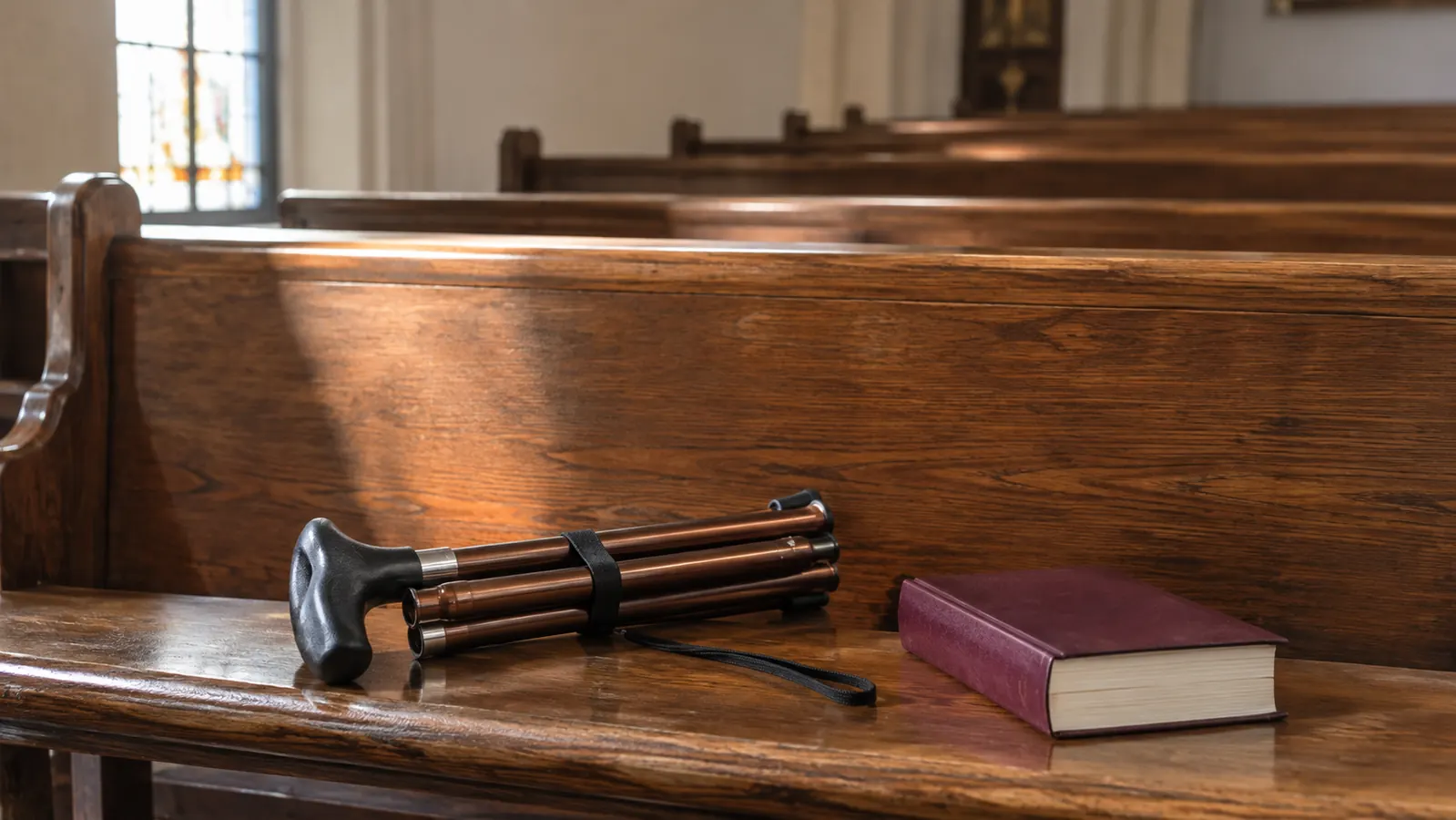
The second thing is the folded size, which is not the same as a small cane. The listing gives the folded dimensions as five by one by twelve inches. Twelve inches is the number that matters, because twelve inches is what fits in a car door pocket, a tote bag, or the gap between the pew and the hymnal rack on Sunday. It is not a pocket cane. It does not go in a shirt pocket and it is not something you forget you are carrying. But it disappears into a bag in a way a one-piece cane never will, and that is the whole reason to buy a folding one.
The third thing, and this is the one I would put in bold if I were writing the listing, is that a folding cane is a jointed tool and joints are the weak point. The Vive locks in place when you seat the sections and press them open. In six months mine has slipped once. It was my fault. I had pulled it out of the car in a hurry at the doctor's office, half-seated the joint, and put my weight on it crossing the lot. It folded about two inches and I caught myself on the car. Since then I seat it every time, deliberately, before I take a step. That is a habit you have to build. It is not a defect in the cane. It is how folding canes work, all of them.
How I've Used It for Six Months
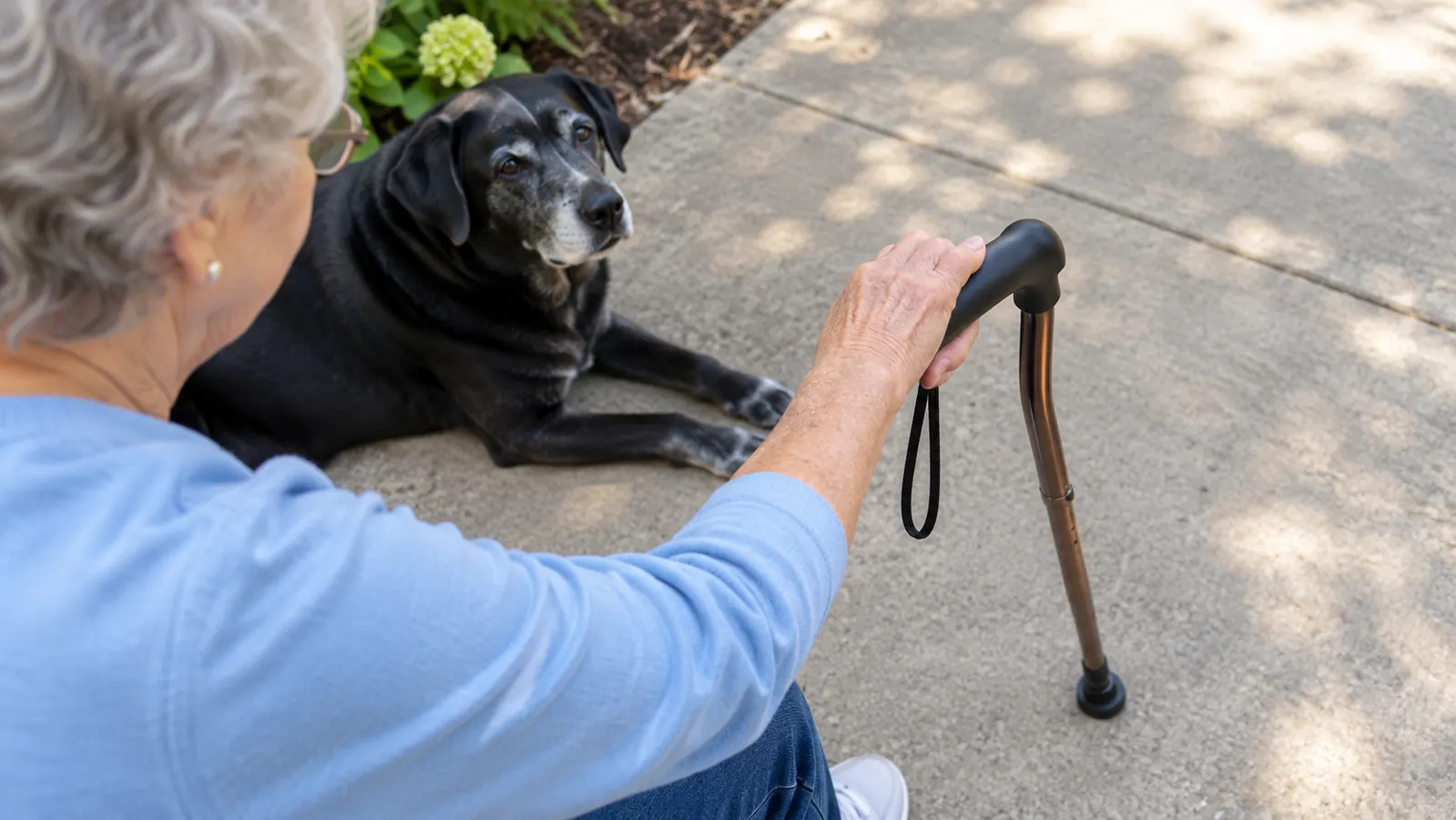
I set mine to 35 inches. The cane adjusts in one-inch increments from 33 inches at the bottom to 37 at the top, and 35 put the handle at the crease of my wrist when I stand up straight with my arm hanging, which is the fit my physical therapist showed me. Getting the height right is the single biggest thing you can do for your shoulder and your wrist. Set it too low and you are hunched. Set it too high and you are reaching. The one-inch steps are not fine adjustment, so if you land between two holes you will pick the closer one. For me 35 was the answer on the first try.
Where it goes: the house every day, the yard when I am checking the gutters or walking out to the shed, the church parking lot on Sunday, the grocery store when I am only running in for two things, and the driveway when I get the mail. Folded, it lives in the car door pocket. It sits under the pew on Sunday morning. It has been to the doctor's office more times than I care to count. That is a lot of small trips, and small trips are exactly the job this cane is built for.
What I do not use it for is pushing myself up out of a chair, and I want to be plain about that because I see people do it. A cane is for walking. The rubber base on a hardwood floor will skid if you load it sideways, and the shaft is aluminum, not steel. When I get up off the couch I push off the arm of the couch. When I get out of the car I use the door frame. The cane comes after, when I am upright and walking. Used that way it has never given me a moment's trouble.
Six months is long enough to know a thing. The joints have not loosened, the rubber base has not worn through, and the grip has not gone slick. I wipe the base off with a rag every couple of weeks and that is the entire maintenance routine. For an eight ounce tool that gets dropped on concrete and shoved under a pew, that is a fair record.
The Parts That Genuinely Work
The weight is the headline. Eight ounces of aluminum is light enough that I forget I am holding it, and that is the entire difference between a cane you use and a cane you leave by the door. My rollator does the heavy work on long outings. The cane does the light work the rest of the time, and it does it without me noticing.
The grip is contoured to the hand, and for my hand it works. The listing gives the handle material as brass and rubber, and the shape is not a plain straight rod. It fills the palm. On a two mile walk I might have something to say about it. On a walk to the mailbox and back, or around the church lot, it is comfortable and my hand does not cramp up.
The lock is the part I trust most. When the sections are seated and pressed open, the cane is rigid. I have leaned on it getting up the two steps from the garage into the kitchen a thousand times and it has not wobbled. The brand backs it with a lifetime guarantee, which I have not had to use, and I like that Vive puts that in writing on a folding cane where the joints are the obvious failure point.
Eight ounces on my shop scale, twelve inches folded, and it has ridden in the car door pocket since May without me once thinking about it.
The Parts Nobody Warns You About
The rubber base is fine on hardwood, fine on carpet, fine on dry concrete. On the wet concrete of the garage apron after a rain it is not what I would call planted. That is not a defect. It is a rubber tip on a smooth wet surface, and any cane with a rubber tip behaves the same way. I take those few feet slower and I put my hand on the door frame at the step, same as I did before I had the cane. If you live somewhere with more rain and ice than Ohio, plan for that.
The grip is not for everybody. Marge tried my cane once in the kitchen and handed it back inside of a minute. Her hands have arthritis in them and the contoured grip put pressure right across the sore knuckles. A thicker, softer grip would suit her better, and so would something she could lean on harder. She is not wrong about her own hands. If your grip is weak, try a cane in person before you order one online, or ask your therapist what they hand out at the clinic.
The last thing nobody says is that this cane will not hold you up. It is a steadiness aid. It gives you a third point of contact and something to look at while your feet catch up. It is not a walking frame and it is not a rollator. If your balance is bad enough that you are not sure which foot is going where, a cane is the wrong first tool, and I say that as a man who started on a rollator and was glad of it.
What I Liked
- Eight ounces on a shop scale, light enough to carry all day
- Folds to about twelve inches, so it fits a car door pocket or a tote bag
- Adjusts in one-inch steps from 33 inches to 37 inches
- Rigid and quiet once the sections are fully seated
- Lifetime guarantee from Vive, a family-owned brand
Where It Falls Short
- The rubber base is less planted on wet concrete
- The contoured grip is hard on a hand with arthritis in it
- It will not hold your weight, and it is not meant to
- Every joint has to be seated by hand before you lean on it
What a One-Piece Cane Would Do Differently
I have never owned a one-piece cane, so what follows comes from the listings and from what I saw at the clinic, not from my hall closet. A fixed cane is one shaft with a handle and a tip. No joints. That means nothing to seat and nothing to slip, which is the whole argument for it. It also means it does not fold, and a fixed cane is roughly three feet long no matter where you put it. It rides across the back seat and it leans in the corner at the diner and it does not go in a door pocket.
Simplicity favors the fixed cane. Load favors the fixed cane too, because a single shaft with no hinge takes weight in a way a jointed one does not. If I were putting my weight through the handle on every step, I would own a fixed cane. What I do is put a hand on it and walk. For that, the folder earns its hinge.
The honest way to decide is to ask where the cane sleeps. If it sleeps by the front door, buy the fixed one. If it sleeps in the car, the pew or a tote bag, buy the folder. That is the whole test, and it has nothing to do with which one is built better.
Who This Is For
This cane is for a person who can walk unaided in the house on a good day but does not quite trust the sidewalk, the church lot, or the two steps into the garage. Someone whose knee or hip is healing and whose therapist has cleared them off a walker or a rollator for short distances. Someone who wants a cane in the car without a full length cane rattling around in the back seat. Someone who can grip a handle and seat a joint, and who will actually build the habit of seating it.
It also suits a person who travels. Twelve inches folded goes in a carry bag. It goes under a pew, under a restaurant table, into a door pocket. If you have ever tried to park a full length cane in a booth at a diner, you know why that matters.
Who Should Skip It and Get Something Sturdier
Skip it if your grip is weak or painful. Get a cane with a larger, softer handle, and try it in your hand before you buy. The Vive grip is contoured and comfortable for a working hand and not comfortable for an arthritic one. That is not a knock on the cane. It is a fit question, and fit questions go to my physical therapist, not to me.
Skip it if you need to lean. If you are putting real weight through your arm to keep the pressure off a knee, an eight ounce aluminum folding cane is not the tool. A heavier one-piece cane takes load better and has no joints to seat. If you need to sit down and rest halfway, that is a rollator with a seat, which is what I use for the grocery store and the walk from the church lot to the door on Sunday. If your balance is genuinely poor, a walker is the conversation to have with our doctor, not a cane.
And skip the folding version specifically if the folding is not buying you anything. If the cane would live by the front door and never leave the house, a fixed cane is simpler, has no joints to seat, and costs less. The folding is worth it to me because mine rides in a car door pocket five days out of seven. If yours would not, you are paying for a hinge you do not need.
If your grip is good and your balance is fair, this is the cane I would buy again
Six months, one scuff on the finish, and one half-seated joint that was my own fault. Aluminum, eight ounces, 33 to 37 inches in one-inch steps, folds to about twelve inches.
Amazon Check Today's Price on Amazon →