
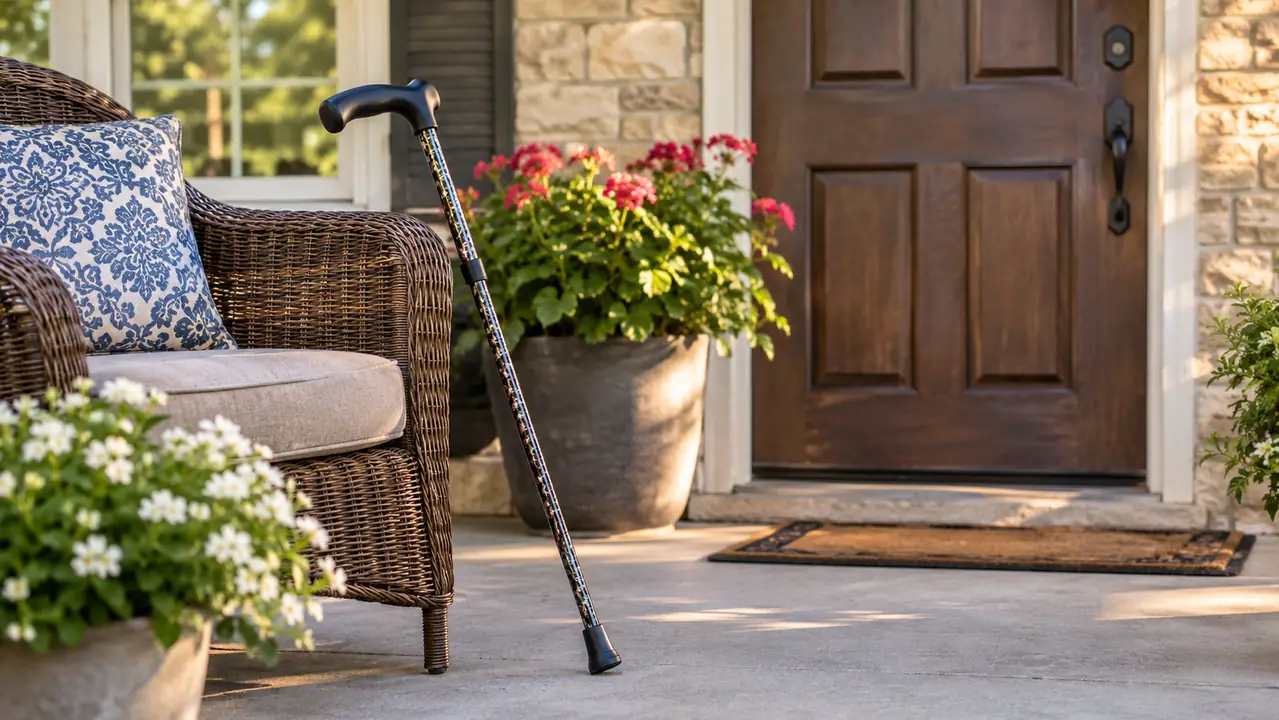
I bought the Vive folding cane in May, about three months after my right knee replacement, when my physical therapist told me I could put the rollator aside for short walks and start getting around the house on my own again. Before that I was holding furniture and door frames, which works right up until it does not. Six months later the cane is the thing I reach for every single day. Around the kitchen, out to the garage, down the hall to the bathroom at night, across the church parking lot on Sunday morning. And the question I get from friends my age is always the same one. Why not just carry a plain one-piece cane? It is a fair question, and I have handled a fixed cane enough times to answer it honestly.
Short answer: a fixed one-piece cane is the stiffer tool and the simpler one, and a folding cane is the one you will actually have with you. If you walk the same steady loop every day, mostly inside your own house and yard, and you can leave a cane leaning by the door where you need it, a fixed cane does the job with nothing to loosen and nothing to check. If your day moves, kitchen to garage to the sedan to the store to a pew and back again, a cane that folds down small and fits in the car door pocket stops being an errand of its own. That is what the Vive gives me. What it costs me is a little stiffness through the middle. I have decided that trade is worth it. Not everybody should, and I will tell you where the line falls.
| Vive Folding Cane | Fixed One-Piece Cane | |
|---|---|---|
| Rigidity under load | Aluminum shaft with a locking joint in the middle | One continuous shaft, nothing to seat or tighten |
| Folding for storage | Folds down to roughly 12 inches, rides in a car door pocket or under a pew | Full length all the time, leaning where you leave it |
| Height adjustment | One-inch increments from 33 to 37 inches | Most adjust with a pin too, or come cut to length |
| Handle and grip | Contoured ergonomic grip over brass and rubber | Usually a plain crook or a T-handle |
| Upkeep | A hinge to seat and look at now and then | Nothing to check, ever |
| Leaning it against a wall | Folded it slides down. Open it can pivot on the tip | Stays where you prop it |
| Getting in and out of a car | Fold it, stow it, close the door | Lay it across the seat or hold it the whole ride |
| Weight | Listed at 8 ounces | A plain aluminum cane lands in the same neighborhood |
| First week | You learn to seat the joint before you lean on it | You pick it up and walk |
What I Compared, and What I Did Not
I am not a physical therapist and I am not going to write like one. What I am is a retired HVAC service technician who spent thirty-eight years deciding whether a part would hold under load, and that is the question I brought to this. On the folding side I had my own cane in hand and the listing in front of me. Aluminum shaft, rubber tip and rubber base, brass and rubber handle, 8 ounces, adjustable from 33 to 37 inches in one-inch increments, folds to about 12 inches, and it locks when you open it. On the fixed side I had two things and no more. The plain one-piece cane a fellow from church carries, which I have picked up and leaned on half a dozen times in the parking lot, and what I saw this spring at the physical therapy clinic, where the clinic canes are one-piece and have been dropped on that floor for years.
I never owned a fixed cane, so I am not going to pretend I put a thousand miles on one and then switched. What I can tell you is how each one feels in the hand, how each one behaves when you are not using it, and where the honest difference sits. That last part is the whole article. The difference is one part.
The difference is the joint. A folding cane has a hinge at the middle. Unfold it and the sections seat against each other, and the lock takes hold. Mine has held through six months of hardwood, carpet, concrete, asphalt, and the gravel shoulder at the end of our driveway, and it has never folded up on me mid-step. But a joint is still a joint. It is a place where two pieces meet instead of one piece continuing, and anybody who has repaired anything knows that is where the trouble will start if trouble ever starts. A fixed cane does not have that place. The shaft runs from the grip to the tip in one piece, and there is nothing in the middle to think about. That is the trade in two sentences, and everything else you read is convenience.

Where the Vive Folding Cane Wins
It wins on being somewhere other than the hall closet. That sounds like a small thing until you have lived it. Folded, this cane sits in the door pocket of our sedan and stays there. It goes under the pew on Sunday and I do not have to lean it in the aisle where somebody will trip on it. At the doctor's office it goes beside me on the chair instead of standing out in the open where it gets knocked over. Six months in, I have never once left the house without it, and I have never once had to plan a trip around where a five-foot cane was going to sit at the other end. The fellow from church with the fixed cane lays his across the back seat, and he has driven off and left it sitting on a bench at least once that I know of.
It also wins on the grip and on the dialing in. The handle on mine is contoured, brass and rubber, and it does not slide in my palm even in July when my hands are damp from the garage. I set it at 35 inches in about ten seconds when it came out of the box, and the one-inch steps from 33 to 37 meant I could land exactly where my physical therapist told me to land instead of close to it. A fixed cane often adjusts with a pin too, so I am not claiming folding invented height adjustment. I am saying that on the folding cane, the adjustment comes with the folding, and I do not have to pick one feature or the other.
Where a Fixed One-Piece Cane Wins
It wins on certainty under weight, and I am not going to talk around that. If you put real load through a cane, if you are leaning hard because of a hip or a knee that is not ready to carry you, one continuous piece of aluminum will feel more solid in your hand than any hinge ever will. My knee is far better than it was in February. I use the cane for balance and for a little confidence, not to hold me up, and that is exactly why the joint has never been an issue for me. A man who needs to press down hard has a different set of requirements. If that is you, this is a question for your physical therapist, and it is one I asked mine before I ever opened the box.
It also wins on plain simplicity. There is nothing to seat, nothing to check, nothing to look at twice. You lean it against the wall by the door and it stays where you put it. You get up in the dark at two in the morning and it is exactly where it was, at full length, ready to grab. A folded cane that slid down behind the umbrella stand would be no help to anybody at two in the morning. And there is something to be said for a tool with no moving parts. I have spent my working life replacing moving parts. Fewer is better, right up until the fewer part is the one that lets you carry it with you.
The cane that goes with you instead of waiting in the car
The Vive folds to about 12 inches, adjusts from 33 to 37 inches in one-inch steps, and weighs 8 ounces on the listing. I have carried mine every day since May and the lock has never let go on me.
Amazon Check Today's Price on Amazon →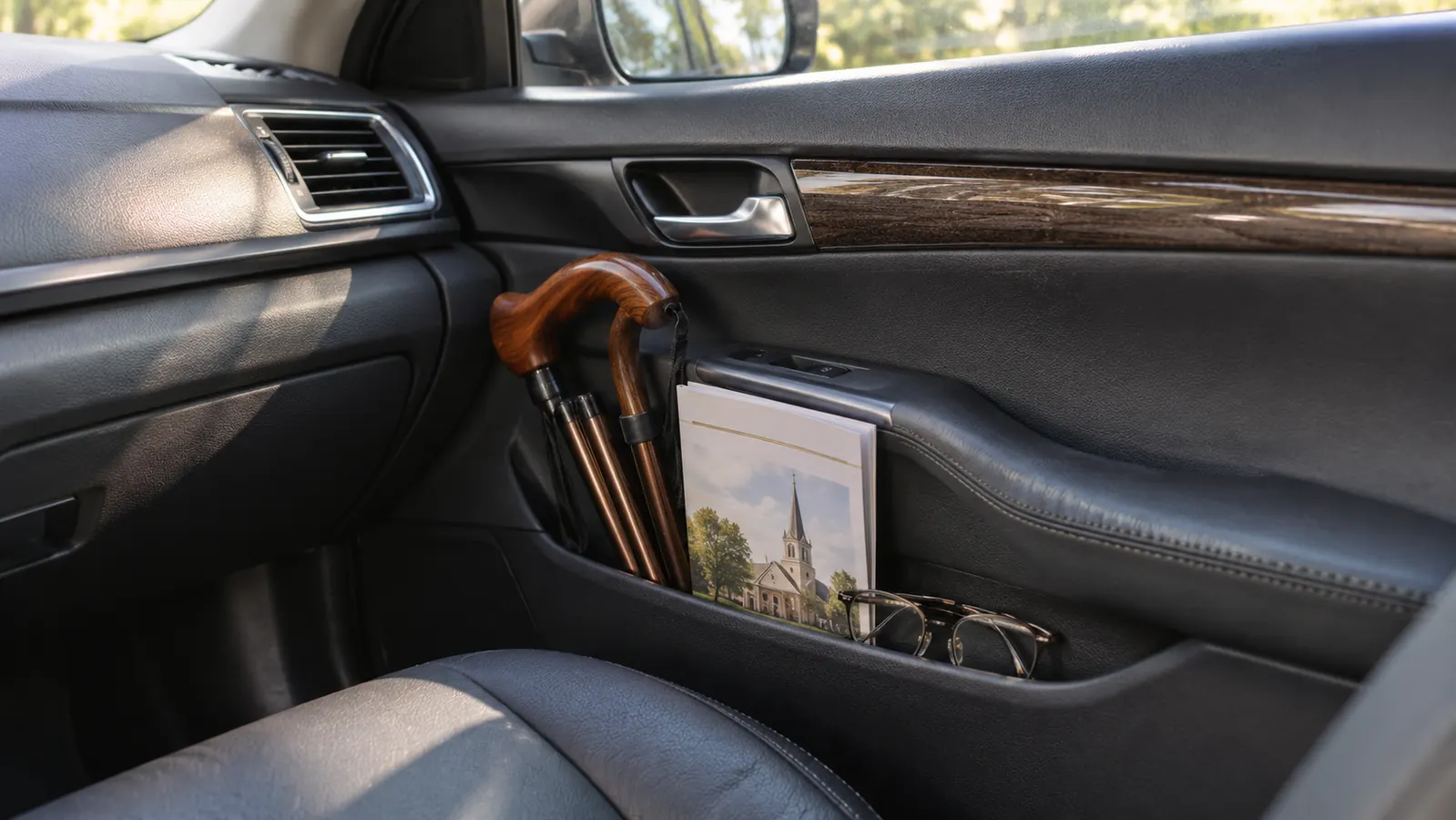
The Joint, and What I Actually Check
Here is my whole maintenance routine, and it takes about four seconds. When I open the cane, I open it until it stops, and then I give it one small push to make sure the sections have seated. That is it. Once a month, when I am already out in the garage checking the brake tension on the rollator, I look the cane over. I look at the tip for wear, I look at the joint, and I set it against the workbench and lean a little weight on it to hear whether anything has changed. Nothing has. The tip is the part that takes the abuse and it is rubber, replaceable, and the cheapest thing on the whole cane to worry about.
I asked my physical therapist about the joint before I bought it, because that was my one hesitation. The answer I got was the answer I expected from anybody who works with their hands. Seat it every time, and if it ever feels like it moves under you, stop and look at it instead of pushing through. I have followed that and had no trouble. The listing also carries a lifetime guarantee from Vive, which is not why I bought it, but it does tell you the company expects the hinge to hold. Sixteen thousand some odd reviews at 4.6 stars tells you most people are not writing in about a joint that failed in the first week either.
Six months, one cane, set at 35 inches, and it has never once stayed home because it was in the way.
Setting the Height and Holding On
Height is where people get this wrong, and it has nothing to do with which cane you buy. My physical therapist had me stand straight with my arms at my sides and set the top of the grip at the crease of my wrist. For me that came out at 35 inches, which sits nicely inside the 33 to 37 inch range. The one-inch increments are what makes that possible. If a cane only came in two or three lengths you would take what you got and spend the next year hunching. I checked it again in September after a summer of being on my feet more, and it was still right where I set it. I have not had to touch it.
The grip matters more than I expected. On a plain crook handle your hand rides in one spot and your fingers do the holding. The contoured grip on the Vive puts the weight across my palm instead, and after a long Sunday morning of standing and visiting, my hand is not the thing that is tired. That is my experience and not a medical claim. If you have grip trouble or a wrist that gives you grief, bring it up with your physical therapist, because handle shape is one of those things they can look at in about thirty seconds and tell you what to avoid.
Who Should Buy Which
Buy the folding Vive if your cane needs to travel with you and you are not leaning your body weight through it. That is a person who is getting steadier rather than less steady, who is out of the house several times a week, who goes to church or the store or the doctor and does not want a cane standing in the aisle or lying across the back seat. It is also the right pick for somebody who has put off buying a cane at all because a cane felt like a thing you carry awkwardly. A cane that folds is a cane you will bring. That was my situation exactly, and six months in I would make the same choice without hesitating.
Buy a fixed one-piece cane if the cane is going to carry weight, if your balance is the reason you are buying it rather than distance, or if you simply want a tool with no moving parts and you have a place by the door to leave it. Somebody who uses a cane mostly at home, moving room to room, is paying for folding they will never use. And if you are in the middle of a recovery where the cane is doing real work, talk to your physical therapist before you buy either one. I asked mine about the joint and I asked about the height, and both answers were better than anything I would have figured out on my own in the garage. Marge and I are both under every weight limit either cane lists, so that never entered into it for us, and it should not enter into it for you either.
If you are only going to own one cane, own the one you will carry
Aluminum shaft, rubber tip, brass and rubber grip, 8 ounces, 33 to 37 inches in one-inch steps, folds to about 12 inches. Mine rides in the car door pocket and sits under the pew, and that is the reason it comes with me.
Amazon Check Today's Price on Amazon →