
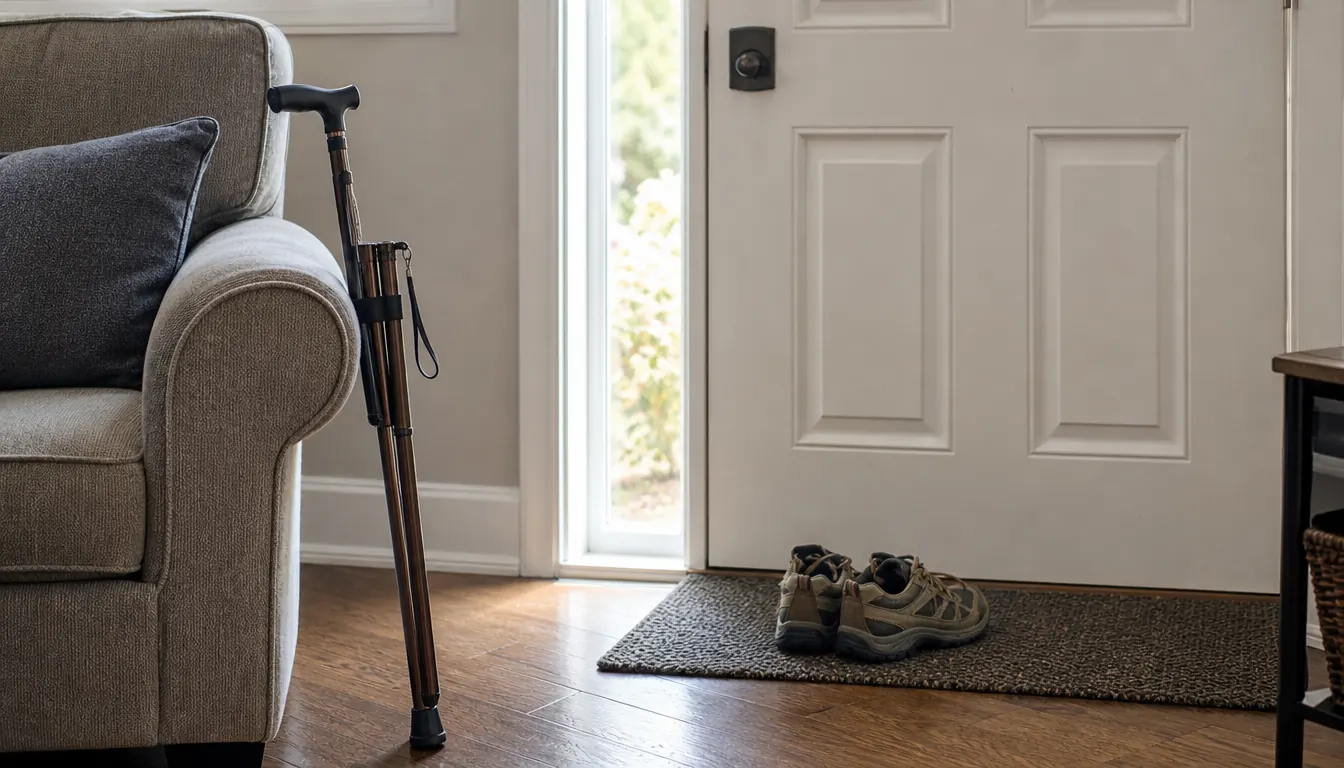
Almost nobody sets a cane to their own height. They take it out of the box, plant it on the floor, decide it feels about right, and walk off. I did exactly that for three days in May, and by the third afternoon my shoulder ached in a way that had nothing to do with my knee. The cane was not broken. It was set at 33 inches, which is where it starts, and I need 35.
The one measurement that matters is the height of your wrist crease, taken with your shoes on and your arm hanging loose. Get it wrong by two inches and you will spend the day either hunched over the handle or hiked up on your toes to reach it. Neither one is going to hurt you in the moment. They just wear you out, and worn out is when people get careless about where they put their feet.
I am 74, retired after 38 years as an HVAC service technician, and my right knee was replaced in February. When my physical therapist moved me off the rollator for short distances in May, I bought a Vive folding cane and set it to 35 inches. It has been at 35 inches since. It goes around the house, out to the yard, into the car, and under the pew on Sunday. Here is how I sized it, how I walk with it, and where I think this particular cane stops being the right tool.
Set it to the right number once, and stop walking with your hand on the wall
The Vive folding cane adjusts from 33 to 37 inches in one-inch steps and locks where you put it. Mine has sat at 35 inches since May.
Amazon Check Today's Price on Amazon →Step 1: Measure from the floor to the wrist crease, with your shoes on
Stand flat on the floor in the shoes you actually walk in. Let the arm on your weaker side hang at your side, loose, no reaching and no holding it out. Find the crease where your hand folds onto your forearm, the line that shows up when you tip your hand back. That crease is the top of the cane. Everything else follows from it.
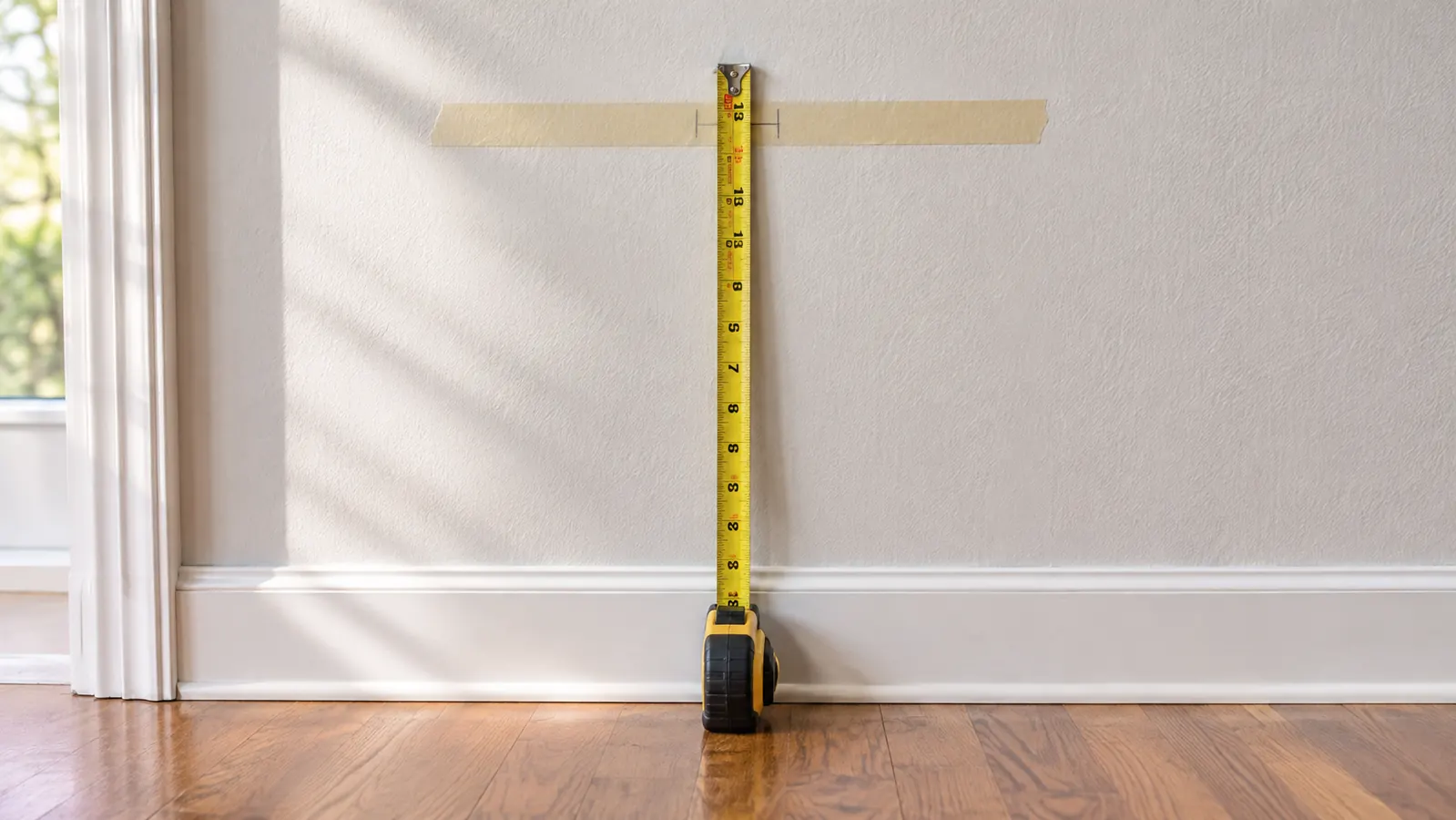
Measure straight up from the floor to that line. You can do it alone with a tape measure and a strip of masking tape on the wall, but it goes faster with a second person. Marge held the tape and read the number out and I marked it on the door frame in pencil, the way I used to mark pipe cutoffs on a joist. Mine came to 35 inches. Hers, if she ever needs one, comes to about 31.
Two things will hand you a bad reading. Slippers, because they sit lower than shoes, and a bent arm, because it shortens the measurement. Take it twice, once in the morning and once late in the day, and if the two numbers disagree, use the taller one. A cane a half inch too tall is a small nuisance. A cane a half inch short pulls you into a lean all day long.

Step 2: Set the height, then make sure the joints are locked
The Vive adjusts in one-inch steps between 33 and 37 inches, so you may not land exactly on your number. If you measure 34 and a half, set it at 35, not 34. Set it on the kitchen floor against the baseboard with a tape measure lying alongside, not by eye in the living room. I set mine on a Saturday morning with good light and I have not touched it since.
Before you put any weight on it, unfold it and seat every joint. The cane locks in place and it wants to be locked before the first step, not adjusted after you are already moving. I check the lock every morning at the foot of the bed and again when I lift it out of the car. It takes two seconds, and it is the same habit as pulling the garage door down and watching it go all the way.
The handle is a contoured grip, listed as rubber over brass, and it is meant to sit in your palm rather than hang off your fingers. If you catch yourself gripping it like a hammer handle, stop and check the height again. Most of the time the grip is fine and the cane is too short.
Step 3: Check the fit standing up, not sitting down
Put the tip on the floor about four to six inches in front of your foot and a little to the outside of it. Not way out front like a walking stick you are leaning on, and not straight down against your heel. With the tip in that spot and the height right, your elbow should carry a soft bend, somewhere around 15 to 20 degrees, and your shoulders should sit level with each other.
Check the shoulders first, because they tell you the truth before your back does. If the shoulder on the cane side is climbing toward your ear, the cane is too tall. If you are hinging forward at the waist to reach the handle, it is too short. Those two checks catch most of it, and you can run them in a church hallway without anyone noticing.
Then walk the length of your hallway and back, and walk it on every surface you have. Our hall is hardwood and the bedrooms are carpet, and a rubber tip behaves differently on each. If something still feels off, this is the point to bring the cane to a physical therapy session and have someone watch you walk with it. Mine looked at it in June and changed the tip position, not the height, and that was the right call.
Step 4: Hold it in the hand opposite your bad side
I had this backwards for a week. My right knee is the new one, so the cane goes in my left hand. The reason shows up the first time you do it right: the cane and the sore leg move together, so the cane takes load on the same beat the bad side lands. Hold it on the same side as the bad knee and the cane is out of step with your own body the whole way down the hall.
If you are not sure which side counts as your bad side, or if both sides feel unsteady, that is a question for my physical therapist or our doctor, not for me. I fix furnaces. My physical therapist watched me walk the length of the clinic and said left hand, and left hand it has been since May.
And one cane, not two, unless somebody who knows your situation tells you otherwise. Before May I walked short distances with a hand on the wall or on the back of a chair, and that worked right up until it did not. The cane replaced the wall. It did not replace the rollator. For the grocery store and the church parking lot I still take the rollator and sit down when I need to.
Step 5: Walk cane and opposite foot together, and take stairs the slow way
The rhythm feels wrong for about a day. Cane forward with the opposite foot. For me that means left hand cane and right foot landing at the same time, then the left foot swings through on its own. Say it under your breath if you need to: cane and bad leg together. It is the same four count as a march, and after an afternoon you will stop thinking about it.
Stairs. Going up, the good leg goes first and the cane comes along with the bad leg. Coming down, the cane and the bad leg go first together and the good leg comes down last. We have two steps from the garage into the kitchen and I take them the same way every single time, with my free hand on the door frame. Where there is a handrail, use the handrail and the cane both. There is no prize for doing it with one hand.
One last thing about a folding cane, and it is the part that earns the thing a place in the car. Fold it before you sit down, and unfold it before you stand up. When I get somewhere, I open the cane and seat the joints while I am still sitting in the seat with the door open. Standing first and then wrestling with a folded cane in a parking lot is how you end up off balance with a door swinging at your back.
What Else Helps
Check the rubber tip once a month, the way you would check a mower blade before the season starts. Lay the cane on its side in good light and look at the bottom. When the rubber has worn thin or gone shiny and slick, it is done, and a worn tip on a hardwood floor is worse than no tip at all. Mine still looks new after six months of daily use, but I look anyway, first of the month, the same day I check the smoke alarms.
Wear real shoes around the house. Marge and I both got into slippers because the carpet is soft, and a backless slipper is the wrong thing to be wearing while you learn a new rhythm. A pair of shoes with a sole you can feel the floor through does more for your steadiness than any gadget I have bought.
Keep the cane where you will actually reach for it. Mine lives by the front door when I am home, rides folded in the car door pocket, and sits under the pew on Sunday mornings. A cane in a closet is a cane you will not use, and then you are back to walking with your hand on the wall.
Tell your physical therapist what you bought. I brought mine to a session, they watched me walk, and they moved the tip position. That cost me twenty minutes and it was worth more than anything I read online, this page included.
And do not expect one aid to do every job. The cane is for short walks and steadiness around the house. The rollator is for longer outings and for standing in a line, and it has a seat for a reason. Keeping those two straight is the difference between me using both and me using neither.
Thirty-five inches, set on my kitchen floor on a Saturday in May. The number has not moved since. What changed is that I stopped walking with my hand on the wall.
Where This Cane Does Not Fit
The Vive stops at 33 inches at the bottom. If your wrist crease measures under that, the cane does not go low enough for you, and no amount of adjusting will fix it. Marge is 5 foot 4 and her number would come out around 31, so this is not her cane if she ever needs one. I would rather tell you that than have you buy it and spend your days hunched over the handle.
It is an aluminum shaft at 8 ounces, which is why it is easy to carry and why it will not feel like a heavy wooden stick planted in the floor. Some people want that heavier, more planted feel. If you do, this is a different tool than the one you are picturing.
And more joints means more to check. A folding cane comes apart into sections and goes back together, and every joint is a place to look before you lean on it. I do not mind that trade, because the folding is what lets the cane live in the car door pocket and under the pew instead of staying home in the hall closet. If you never leave the house with it, a one-piece cane is simpler. If you do leave the house, the folding is the whole point.
Measure once, set it once, and get on with your Sunday
Adjusts from 33 to 37 inches in one-inch steps. Aluminum shaft, 8 ounces, and it folds small enough for a car door pocket or under a pew. Mine has held at 35 inches since May.
Amazon Check Today's Price on Amazon →