
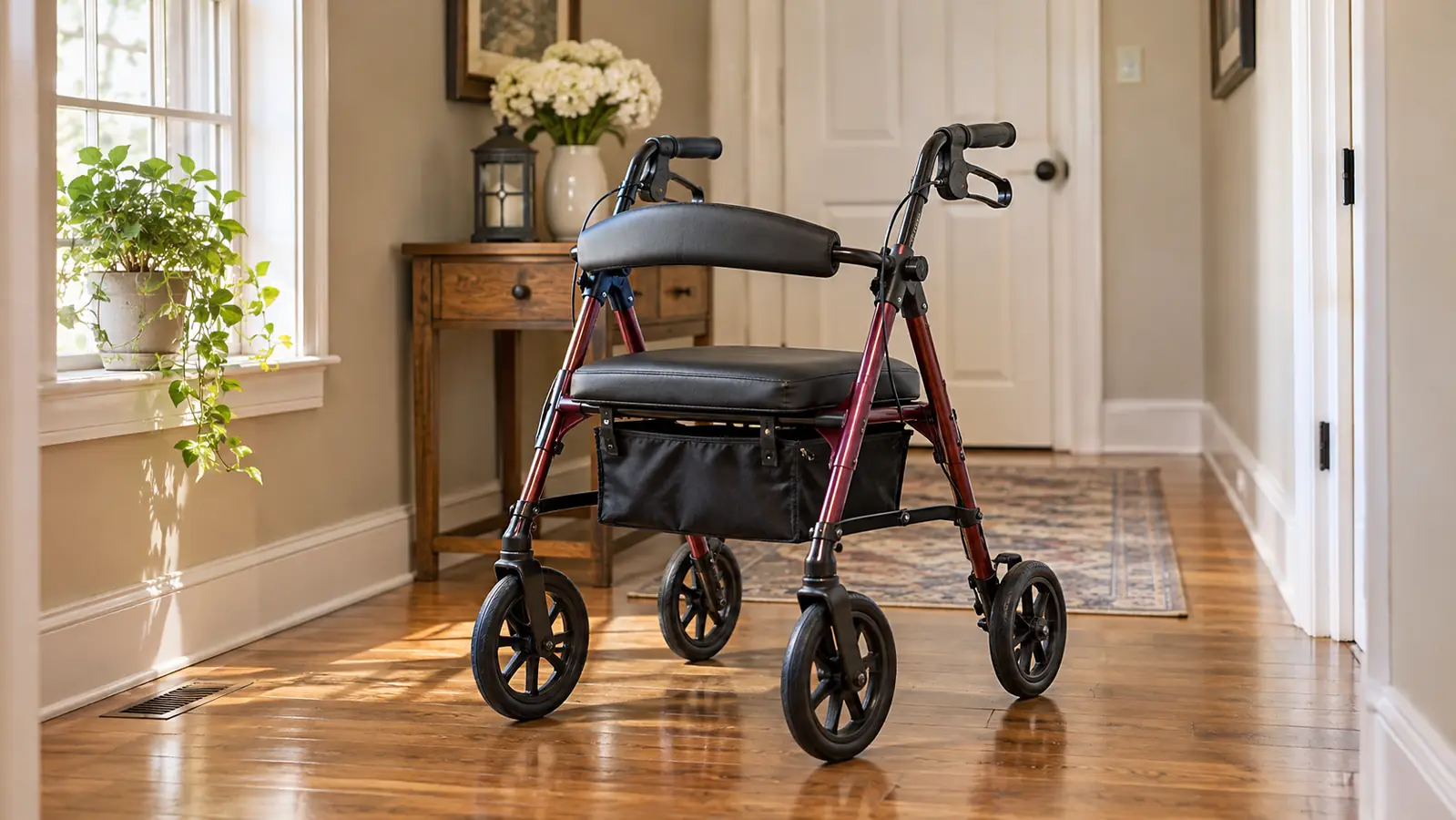
The rollator came out of the box on a Tuesday in late January, about two weeks before my right knee replacement, and I had it standing in the hallway in four minutes flat. Then I stood there looking at it, because the handles were set where the factory set them, and that was not where I needed them. I am 5 feet 11 and about 195 pounds. I pushed it down the hall to the kitchen and back, and by the time I reached the refrigerator my shoulders had crept up around my ears and I was leaning forward like a man pushing a cart with a bent wheel.
Here is what nine months with the Drive Medical rollator has taught me. A mobility aid is a tool, and a tool that is not fitted to the person holding it is worse than no tool at all. My physical therapist took one look at me standing behind the thing and said, "Your handles are low. You will hate that by Thursday." She was right, and I did. One afternoon with a tape measure, a pencil, and a five-minute brake check fixed it, and I have re-checked the whole setup on the first of every month since. This is the order I did it in, and it is the order I would do it in again.
One thing before we start. I am a retired HVAC technician, not a doctor and not a physical therapist. Anything about your own balance, your own surgery, or your own fall risk belongs with your doctor or your PT. What follows is how I set up a piece of equipment in my own hallway.
Set to Your Own Height, This Is the One That Carries Me Through a Grocery Store
Four wheels, a fold-up seat, a removable backrest and 7.5 inch wheels. Nine months in, the handles on mine still sit exactly where I set them.
Amazon Check Today's Price on Amazon →Step 1: Stand It Up and Lock the Frame Open
The first job takes four minutes and no tools. Pull the two sides apart until the frame locks open, fold the seat down flat, then swing the back support up until it stands vertical. On mine the back support lifts off entirely if you would rather have it gone. I left mine on. It is the difference between perching on a bench and sitting in a chair, and in a pharmacy line that difference is the whole reason I bought the thing.
Once it is open, get down on one knee and look at the wheels from the side. All four should touch the floor at the same time, and the frame should not rock when you press down on one corner. A rock means something is not locked, or that the floor is doing something you did not know about. My hallway is dead flat hardwood. My kitchen is not, and I found that out with my hands on the grips.
Set it in the room where you will use it most and stand behind it with both hands on the grips. Do not walk yet. Just stand there. If you feel like you are reaching down, the handles are too low. If you feel like you are shrugging, they are too high. That feeling is the entire job in one sentence, and everything in the next step is just how you get there.

Step 2: Put the Handles at Your Wrist Crease, Then Measure Both Sides
The rule my physical therapist gave me is this. Stand up straight with your arms hanging at your sides, and the top of the handle grip should line up with the crease on the inside of your wrist. Not your knuckles. Not your fingertips. The crease. Do that and your elbows carry a slight bend when you grip, which is where you have the most push and the least strain across your shoulders.
To change the height, press the adjustment lever under each grip and slide the handle up or down until it seats in a hole. The Drive Medical listing puts the top of the handle at 35 inches and says the rollator is built for someone 59 inches and taller. I am 5 feet 11, my wife Marge is 5 foot 4, and both of us are inside that range, which is exactly the point. The rollator does not care who you are. It cares where the handles sit.
Set one side, then set the other to match, and check it with a tape measure from the floor to the top of the grip instead of by eye. Mine came out of the box a half inch off from side to side, and I did not notice until the second day, when my right hip started complaining about a push that was not even. Write the number on a piece of masking tape and stick it to the shelf by the tape measure in the garage, because you will want it again.
Then walk. Ten steps down the hall and ten back, and pay attention to three things: your shoulders should be down, your elbows slightly bent, and the front wheels should feel like they are helping you along rather than pulling away from you. If your hands go numb or your grip aches, the height is still wrong. Mine took two tries to get right, and the second try was a half inch lower than the height I thought I wanted.
Step 3: Set the Brakes So They Stop the Wheel and Let It Go
The brakes on the Drive Medical are the part people skip and the part I check most often. Squeeze both handles toward the grips and the wheels should slow and stop while you are still moving. Push down on both handles until they set and you have a parking brake. Test that honestly: set it, then push the rollator forward with both hands. It should not move. A brake that creeps will find the one slope on the church sidewalk on a Sunday morning with everybody watching.
Then test the release. Let the handles go and spin each front wheel by hand. They should turn free and coast to a stop. A wheel that drags means the tension is too tight, and a rollator that pulls to one side will wear you out in a store aisle faster than the walking ever did.
If one side grabs before the other, or a handle feels spongy before it bites, that is a tension problem, and it is the one adjustment on this rig I would rather you not guess at. Make one small change, test it, and repeat. If the two sides will not match after two or three tries, stop and let the shop or your physical therapist look at it. A brake you are not sure of is a brake you will not use, and an unused brake is not a brake.
While you are down there, look at the axles. The wheels are seven and a half inches and they pick up everything. I pull a wad of dog hair out of mine about every three weeks, and Pepper is a calm nine-year-old Labrador who mostly lies in doorways. If there is a shedding animal or a long-haired person in your house, check the axles more often than you think you need to.

Step 4: Check It Against Your House, Not the Showroom Floor
A rollator that fits you can still be wrong for your house. Measure the narrowest doorway you actually go through. The frame measures 21.5 inches across, and the door into our one bathroom is the tight one. I walked it through every doorway in the house before I trusted it, and I learned two things: the bathroom door needs to be pushed all the way open, and the carpet edge between the hall and the bedroom catches a front wheel if I come at it sideways.
Then check the seat, and check it the way you will actually use it. Sit down on it the way you would in a pharmacy line: both hands on the grips on the way down, feet flat, knees roughly level with your hips. If it feels low, it is low, and getting up off it is the same motion as getting up out of a kitchen chair that has gone soft. I sit on mine two or three times per outing and I am not embarrassed about it.
Last, pick the thing up. It weighs 20 pounds. I lift mine into the trunk of the sedan with one hand on the frame and one under the seat edge, and I bend my knees to do it, which is a habit I picked up from thirty-eight years of carrying tools in and out of other people's houses. Folded, it takes up a good chunk of a trunk. And be honest about steps, because a rollator does not climb the two steps from our garage into the kitchen. I carry it up and Marge holds the door, or I leave it in the trunk on days I do not need it.
Step 5: Take It Out Once, Then Re-Check It Once a Month
The first real trip out is the test that matters. Mine was the grocery store, because a store is nothing but smooth floor, tight aisles, and a lot of standing still. I sat on the seat twice in the checkout line that first time, which is a thing I would not have done in December. The second trip was the church parking lot to the door on a Sunday morning, which is a longer walk than it looks and slightly uphill.
After that first trip, put a reminder in your phone for once a month and do five things. Squeeze both brakes and set the parking brake. Spin both front wheels and pull the hair out of the axles. Press the adjustment lever under each grip to make sure it is still seated in its hole. Unfold and refold the frame to confirm it locks open. Then stand behind it and check that your elbows still bend the way they did the day you set it.
The handle height will move on you. Not because the rollator is bad, but because a lever under a grip gets bumped when the thing goes into a trunk, or when somebody leans on it, or when you carry it up two steps. Mine was a half inch low in June and I spent a week blaming my shoulder before I thought to check. Now it is the first of the month, along with the brake tension, and I have not had to touch it since.
And this one matters more than the other four steps. Ask your physical therapist to watch you walk with it once, after you have set it up yourself. I had mine a half inch too low and I was sure it was right. She caught it in ten seconds from across the room. That is not a thing you can see in your own hallway mirror.
What Else Helps
Use a tape measure and use a pencil. Mark the number inside the door of the shelf where you keep your tools, so that the next time you fold the thing into a trunk and something shifts, you have a reference that is not your memory.
Wear the same shoes every time you set the height. A work boot and a slipper are not the same half inch, and neither is a stiff new pair. Keep the manual in the same drawer as the warranty card, because the Drive Medical frame is alloy steel and carries a limited lifetime warranty, and you will want the paperwork if a weld ever lets go.
And do not try to fit one rollator to two people. Marge is 5 foot 4, and when she tried mine at my setting her shoulders came up and she handed it right back. My physical therapist predicted exactly that. What is right for me is wrong for her, and that is not a defect in either of us. For short trips around the house I am on a cane now anyway, and the rollator stays set where I set it for the longer walks: the store, the church lot, the doctor.
Set at my wrist crease, I can walk a grocery store end to end without stopping. Set the way it came out of the box, I was looking for a seat by the second aisle.
Nine Months In, the Handles Are Still Where I Set Them
This is the one piece of equipment I would buy again tomorrow. Set the height at your wrist crease, set the brakes so they hold, then check both on the first of the month.
Amazon Check Today's Price on Amazon →