
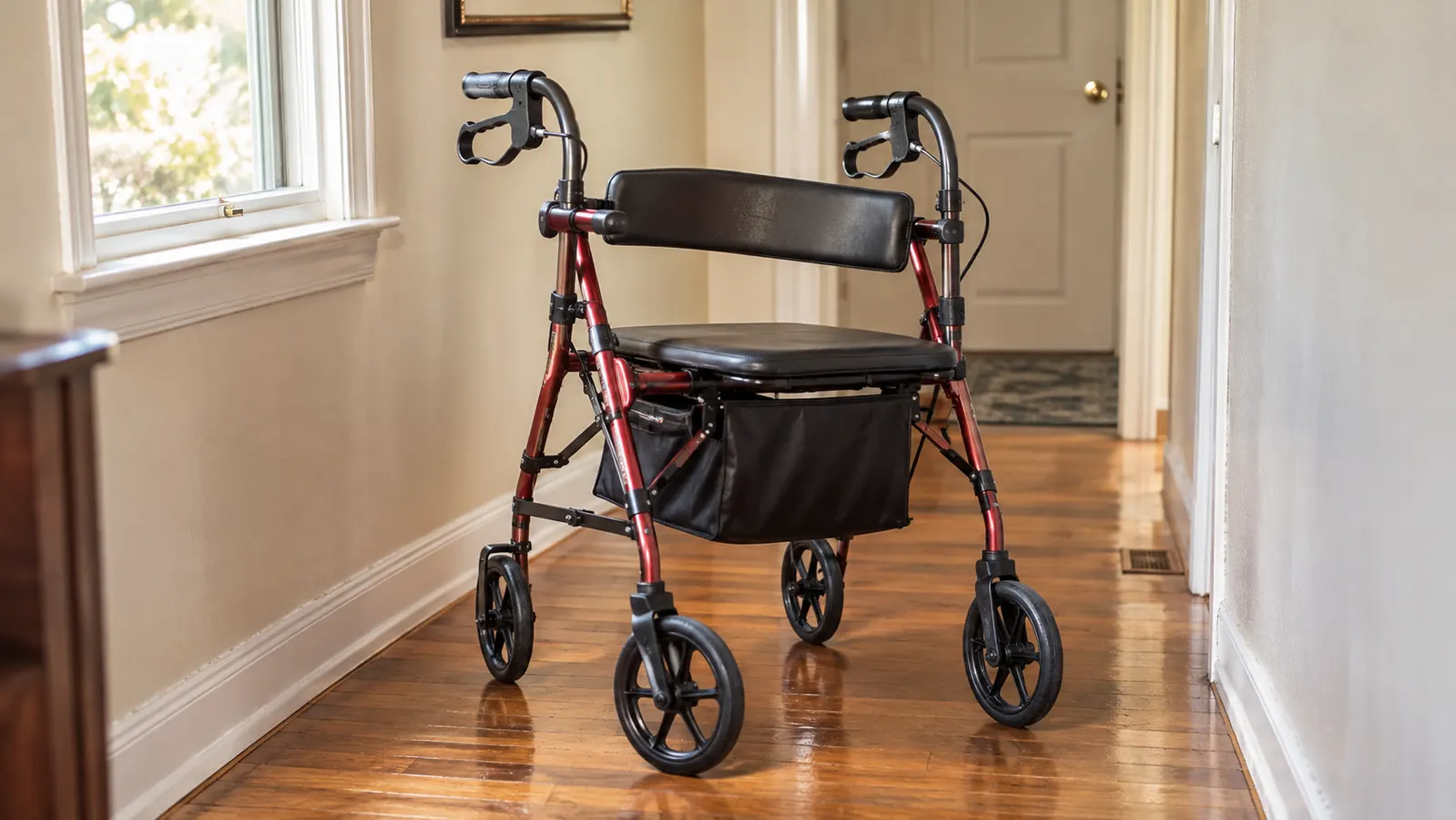
Short answer first, because that is what you came for. If the halls are the whole story and you never leave the house, a standard two-wheel walker is the easier thing to live with. It is shorter front to back, it pivots where it stands, and you never have to find floor space to swing it around. But halls were not the whole story at our house. I bought a Drive Medical rollator with a seat about two weeks before my right knee replacement in February, and it did two things the clinic walker could not do for me. It rolled, so I did not have to lift it with a leg that had just been cut open, and it gave me somewhere to sit down. Nine months later it is still the thing that gets me to church and the grocery store.
One thing to get straight before we go further. I never owned a standard walker. I used one at the physical therapy clinic during sessions, and I have seen plenty of them folded in the corners of other people's houses. So this compares a listing, a clinic loaner and nine months of getting a 20 pound cart around a 1988 ranch house with hardwood in the hall, carpet in the bedrooms and a bathroom door at the end of it. Marge and I measured it, adjusted it and complained about it. Here is the honest breakdown.
| Drive Medical Rollator | Standard Two-Wheel Walker | |
|---|---|---|
| Footprint in a tight hall | 25.5 inches deep and 21.5 inches wide, and it has to be rolled through and turned | Shorter front to back, and you can lift it and pivot it in place |
| Moving without lifting | Four 7.5 inch wheels, so it rolls along with you | You pick it up and set it down every step |
| Sitting down to rest | Built-in seat with a fold-up back support | No seat. You find a chair or keep standing |
| Slowing down on a ramp | Brakes at the handles | No brakes. Your legs do the stopping |
| Two steps up from the garage | 20 pounds, and the wheels turn while you lift | Folds and is lighter in the hand |
| Loading into the trunk | Folds, then 20 pounds of alloy steel up and over the lip | Folds flat and is easier to swing in |
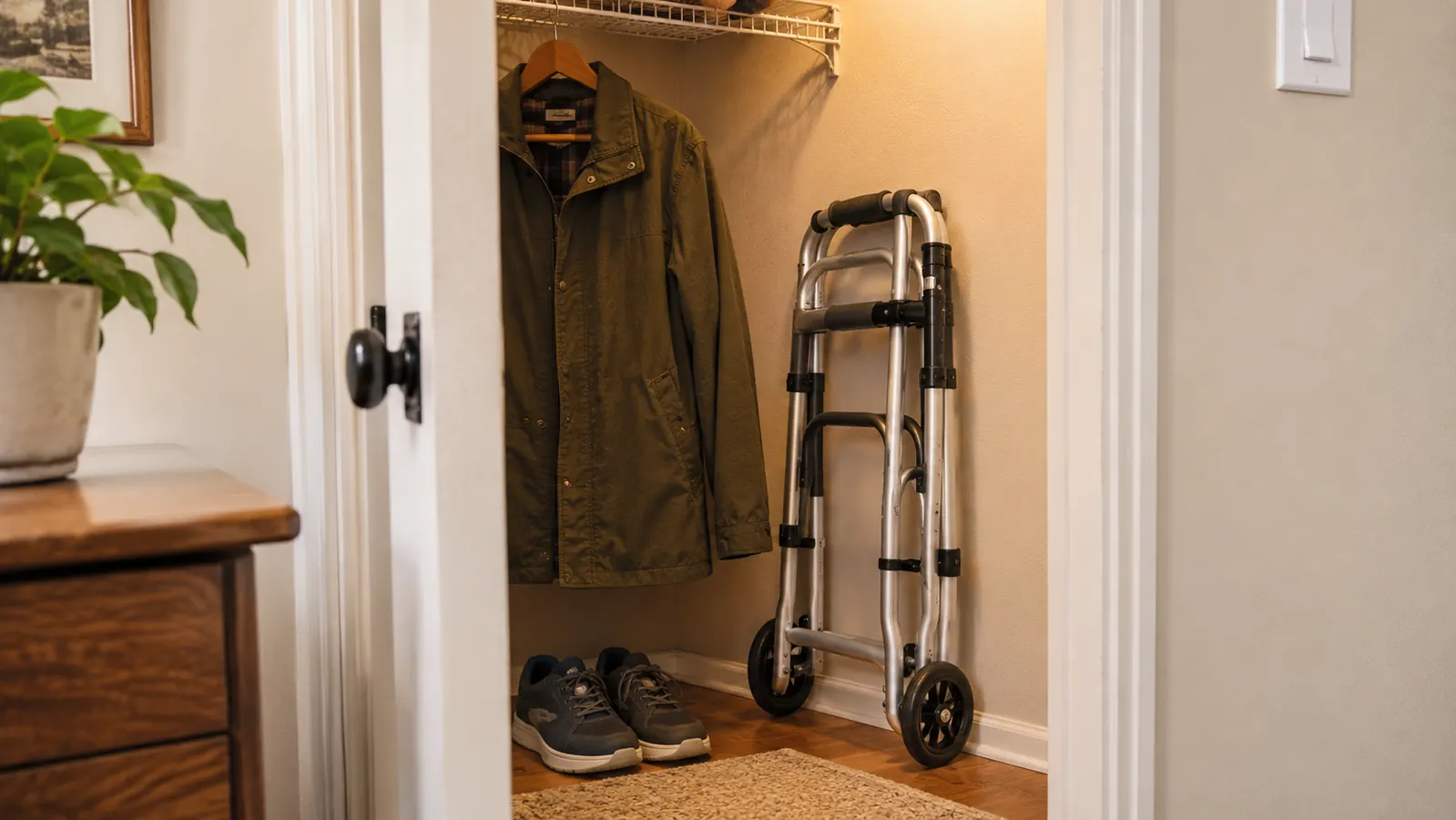
| Where it lives when not in use | Folds, but the seat and the depth take closet room | Folds thin and leans in the coat closet |
| Handle height | Adjusts with a lever, up to 35 inches, for someone 59 inches and taller | Adjusts too, on most models |
Where the Drive Medical Rollator Wins
The first thing a rollator does that a walker cannot is move without being picked up. After surgery that mattered more than I expected. With a plain walker you lift, set down, shift your weight, lift again, and every lift goes through your arms and your good leg. The Drive Medical has four wheels, 7.5 inches of them, and it rolls ahead of you. The lip between the hardwood in the hall and the carpet in the bedroom is about half an inch, and a walker's front tips have to be lifted over that lip every single time. This rolls over it. The strip at the bathroom door is the same story. If your hands are arthritic, that difference is not a small one, and Marge spotted it before I did.
The second thing is the seat, and it is the reason the cart lives by the back door instead of out in the garage. It has a seat and a fold-up back support, and I use both. At church on Sunday I get there early and sit on it in the narthex while Marge works the room. At the doctor's office I sit on it in line at the desk, and I am not hunting for a chair that is the right height. At the grocery store, when the line backs up to the frozen food, I sit. The brakes are the other half of it. Coming down the ramp out of the church lot I can hold the handles and let it ease down at my pace. A plain walker has nothing to hold on to. Your legs are the brakes. The handles adjust with a lever and I set mine at my wrist crease the week it arrived, which is exactly what my physical therapist told me to do.

Where a Standard Two-Wheel Walker Wins
Now the honest half, and it is the half the title of this piece is about. Our hall is not wide, and yours probably is not either if your house went up in the fifties or sixties. The Drive Medical rollator measures 25.5 inches deep and 21.5 inches wide. That is not a monster, but depth is what gets you in a hall. To turn it around at the bathroom door you need a pocket of floor to swing it in, and in our house that pocket is the doorway itself. A standard two-wheel walker is shorter front to back, and because you lift it, you can pivot it where it stands. Pick it up, turn it, set it down. No turning radius, no backing out. If the entire job is bedroom to bathroom and back, twice a night, the walker is the easier tool, and I would not pretend otherwise.
The other places a plain walker wins are the ones nobody thinks about until both hands are full. Two steps up from the garage into the kitchen. I can get the rollator up them, but it is 20 pounds of alloy steel and the wheels want to go their own direction while I am lifting. A basic walker folds and is lighter in the hand, and there is nothing on it to keep adjusted. Same story at the trunk of the car. Mine folds and I can roll it out to the bumper on its own wheels, which is a real help, but then it is still 20 pounds going up and over the lip. And when it is not in use, a walker folds flat and leans in the coat closet by the door. Mine folds too, but the seat and the depth take closet room, so it stays open by the back door with the brakes set.
The one I bought before surgery and would buy again tomorrow
Four wheels, a seat with a fold-up back, and handles that adjust to your height. It carried me through the first six weeks after my knee replacement and it still rides in the trunk of the car.
Amazon Check Today's Price on Amazon →The Tight Hall Test, In Practice
For the first six weeks after surgery I used the rollator indoors every day, so I had to solve the hall rather than argue with it. What worked was this. I rolled it to the bathroom door, set the brakes, and stepped past it holding the wall and the door frame for the last three feet. The cart did not need to go into the bathroom. It needed to be waiting when I came out, which it was. When I did have to reverse direction, I backed it out into the bedroom instead of trying to swing it around in the doorway. Backing up is easier than turning when the walls are close, and it took me about a week to stop fighting that.
Take a tape measure to your own hall before you buy anything. Measure the width at its narrowest point, which in our house is between the linen closet and the door frame. The cart is 21.5 inches wide, so whatever is left over is what you have for your own feet and hips. Then look at the floor space at the end of the hall, because turning is where a rollator runs out of room and a walker does not. Five minutes with a tape saves you a return label and a trip to the post office.
What we settled on looks like this. The rollator handles the long runs: church, the grocery store, the doctor, the mailbox on a cold morning when I want something to hold. The short runs indoors belong to a cane now, and my physical therapist moved me to that in May. If you are not ready for a cane and you are deciding between these two, the walker is the better indoor tool and the rollator is the better everything-else tool. Very few people I know regret buying the one that lets them leave the house.
Depth is what gets you in a hall. The Drive Medical is 25.5 inches deep, and at the bathroom door that is the whole argument.
What I'd Check Before You Decide
Height first. The listing puts the handle height at a maximum of 35 inches and says the minimum user height is 59 inches, which is just shy of five feet. I am 5 foot 11 and I run the handles well below the top of that range. If you are under 59 inches, this particular cart is not sized for you, and no amount of adjusting will fix it. Set the handles at your wrist crease with your arms hanging down, the way my physical therapist had me do it, and check that you are not stooping to reach them. A stoop will put you in your lower back by the end of a grocery run.
Weight second. It is 20 pounds. That is fine to roll and awkward to lift into a trunk, and if you cannot lift 20 pounds safely, plan around it rather than hoping. Park where the trunk is low, or slide it into the back seat footwell, or accept that someone else loads it. The warranty is a limited lifetime one, which tells you the maker expects the frame to hold up, and the frame is alloy steel. Mine has been through nine months of church parking lots and the wheels still turn true.
I will also say the obvious. There are more than fifty-one thousand reviews on this listing and it sits at 4.6 stars, so you are not buying something untested. Read the low reviews for the complaints that would actually bother you, not the ones that would not. Seat height and folding are the two things that matter to me, and they are the two things I looked at hardest before I clicked buy.
Who Should Buy Which
Buy the Drive Medical rollator if you need to sit down partway through an errand, if you have had a knee or a hip done and cannot lift a walker, if your grip is going, or if you leave the house more than twice a week. Buy it if there is a ramp, a parking lot or a long checkout line anywhere in your life. That is the job it was built for, and it does that job well. Marge uses it too, on the long walk from the car into church, even though the cart is set for my height and not hers.
Buy a standard walker if you are in a small house, you mostly move at night, and you can lift a light frame without thinking about it. It will turn in places the cart will not, it will lean in the closet, and it has nothing to maintain. What I would not do is buy a walker expecting it to be the outdoor answer too, because it will not be, and you will be back shopping inside a year. Marge and I ended up with one cart, one cane, a rail on the toilet and a bench in the tub, and the hall is still narrow. We just stopped asking one piece of equipment to do every job in the house.
Still by the back door, nine months on
Four wheels, a seat, a fold-up back and handles that adjust. If your house has tight halls and your calendar still has church and the grocery store on it, this is the one that does both.
Amazon Check Today's Price on Amazon →