
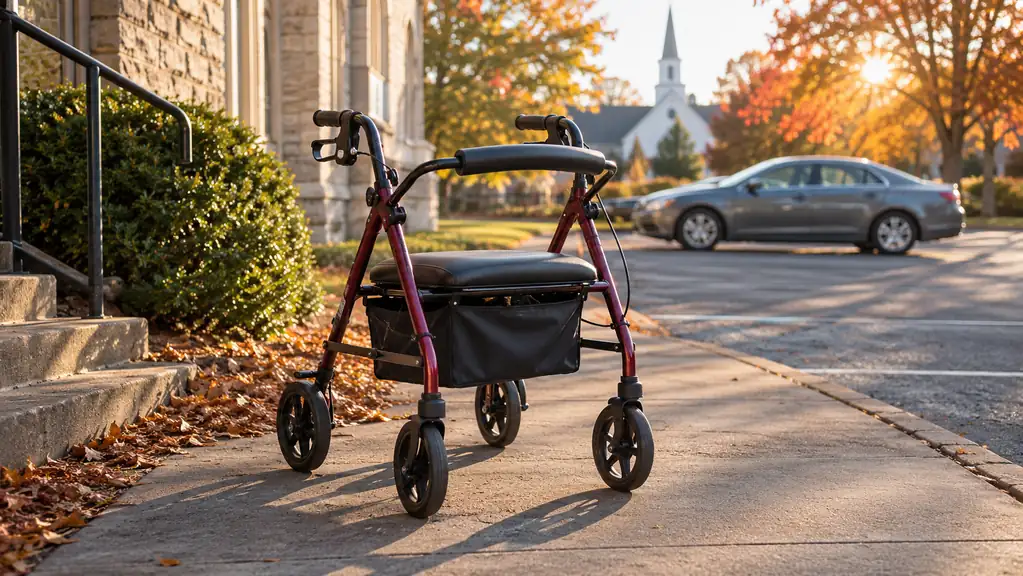
I bought the Drive Medical rollator two weeks before my right knee got replaced, which sounds like getting ahead of myself. It was not. My physical therapist watched me come down the clinic hallway with one hand on the wall and told me a four-wheel rollator with a seat would serve me better than the two-wheel walker I had been leaning on. So I ordered this one in late January, set the handles in my garage the week it arrived, and had it parked by the front door when Marge brought me home in February. It is November now. That is about nine months of real use, and I have opinions.
Here is what I am not going to do. I am not going to tell you it changed my life. A rollator is a tool, the same as a pipe wrench or a torque stick, and tools do not change lives. They make a job easier or they do not, and you find out in the first week. I am also not going to pretend there is nothing wrong with it. Three things about this thing irritate me on a regular basis and you will hear about all three before I am done. What I will say up front is this. If you or your husband or your mother cannot walk more than fifty feet without looking around for somewhere to sit, this is the one I would buy again.
The Quick Verdict
Nine months on a replaced knee. The seat is the whole point and it holds up. The wheels and the width are the two things to check before you order.
Amazon Check Today's Price →The seat is the reason to buy it, so check the specs on that seat
Seat with fold-up, removable back support. Seven and a half inch wheels. Folds flat into a sedan trunk. Confirm the current listing details and today's price before you order.
Amazon Check Today's Price on Amazon →How Nine Months With It Actually Went
For the first six weeks after surgery, that rollator lived in our hallway. Ours is a one-story ranch and the hall runs from the kitchen back to the bedrooms on hardwood, and I walked it maybe a dozen times a day, every day, with Pepper lying in the doorway the way she always does. I sat down on that seat more in those six weeks than in the eight months since, and I do not say that as a complaint. That is what the seat is for. It is a place to stop, not a place to spend the afternoon. Anybody who tells you a rollator seat is comfortable enough to nap in has not sat in one.
Since spring the knee is good enough that I do not need it inside the house. Now the Drive Medical goes in the car. Church on Sunday morning, because we park in the far lot and the walk in is longer than it looks from behind the windshield. The grocery store. Doctor visits, which is where it earns the most. I have sat on that seat in a waiting room line, in a pharmacy line, and once, memorably, at the license bureau, and every one of those times I was glad the thing has a seat and the man in front of me did not.
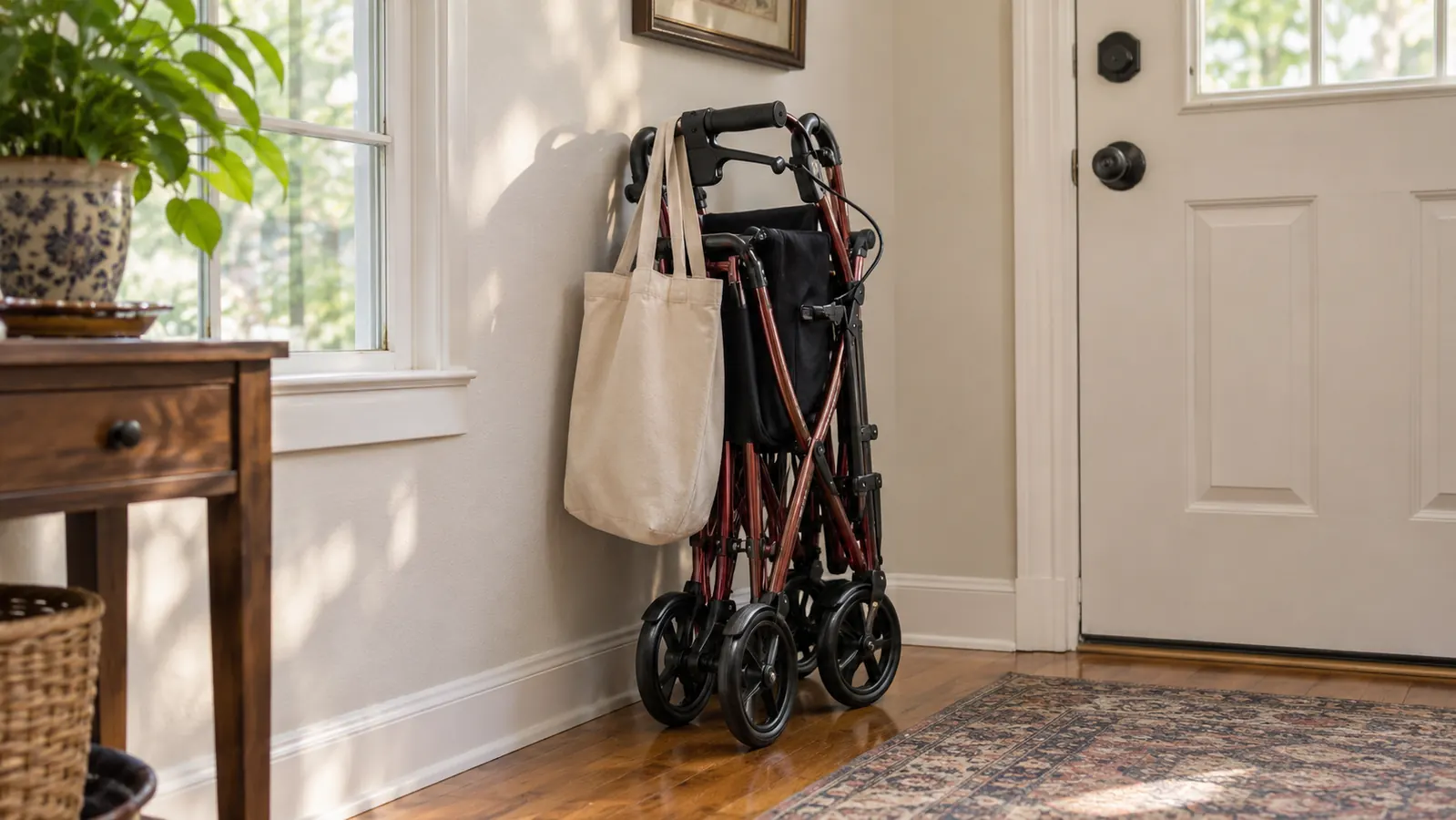
It folds. That matters more than the listing copy lets on. It folds flat enough to go in the trunk of our sedan with room left for groceries, and it weighs 20 pounds according to the listing, which is close to what my bathroom scale says. I lift it in with one hand and I set it down with one hand. I have done it in the rain. I have done it with a bag of groceries already in the other hand. That is not nothing at 74 years old, and it is the difference between an aid that goes places with you and an aid that leans against the wall by the door.

What Nobody Tells You Before You Buy One
The seat is lower than you are picturing. It sits you down with your knees up a little, like a folding chair at a family reunion, not like the armchair in the living room. For the first week that bothered me. Then I understood it is the reason I can stand back up out of it, and standing up is the whole point of sitting down in the first place. If you are expecting a chair, you will be disappointed. If you are expecting a bench at a bus stop, you will be fine, and you will use it more than you expect.
The back support folds up and it comes off entirely. I kept mine up for the first month, then folded it down and left it that way, because folded down you can slide onto the seat from the side instead of backing into it, which is what I do in a tight aisle at the store. When it is up, you sit back and stay put. My physical therapist preferred it up. My back preferred it down. I do not think either of us is wrong, and it is nice that the thing gives you the choice without tools.
It measures 21.5 inches wide per the product dimensions. That sounds like nothing until you try to take it through a narrow bathroom door with a laundry basket in your other hand. Our hall bathroom door is 30 inches and it goes through fine. A house with older, narrower doors would be a different story, and I would measure the tightest one in your house before you order rather than after. It is also 25.5 inches deep, which is what makes it feel bigger in a hallway than you expect from a photograph.
The wheels are 7.5 inches. On hardwood, tile and store linoleum they roll like a shopping cart, smooth and quiet. On carpet they take a little push. On the gravel strip between my garage and the alley they do not like it at all, and I do not blame them. The two steps up from our garage into the kitchen are the reason this thing never leaves the main floor. It is not a four-wheeler and it does not climb. If your regular route involves unpaved ground, a thick doormat, or a single step, plan on lifting it every time.
The Three Things That Genuinely Work
First, the seat. I have said it twice and I will say it a third time because it is the entire reason to buy a four-wheel rollator instead of a plain walker. Not the wheels. Not the folding. The seat. If there is a line, if there is a long hallway, if there is a wait you did not plan for, you sit. That is it. That is the product. Everything else on this thing is in service of getting a seat to the place where you need to sit down, and it does that job without complaint.
Second, the height adjustment. There is a lever on the handle, the handles go up to 35 inches per the listing, and the minimum recommended user height is 59 inches. I am 5 feet 11 and I had room to spare. I set mine the week it arrived, standing straight with my arms at my sides, so the grip landed right at the crease of my wrist. I have not touched it since and I have not wanted to. My physical therapist showed me that trick on the clinic's rollator and it is the single most useful thing anybody has told me about walking aids.
Third, the frame. Drive builds it out of alloy steel, it is rated for a good deal more weight than I will ever put on it, and it does not flex or creak when I drop onto the seat harder than I mean to. Nine months in, I have tightened the folding hardware once. The listing carries a limited lifetime warranty, which I have not had to use and hope not to. A cheap frame announces itself in the first month with a rattle. This one has been quiet, and quiet is what you want under a 74-year-old man on hardwood.
What I Liked
- The seat is a real place to stop, and that is the point of the whole purchase
- Handles adjust up to 35 inches, so a taller user is not hunched over
- Folds flat and lifts into a sedan trunk with one hand at 20 pounds
- Alloy steel frame, no rattle or flex after nine months of daily use
- Rolls smooth and quiet on hardwood, tile and store floors
Where It Falls Short
- 7.5 inch wheels do not handle gravel, grass or a thick mat
- 21.5 inches wide, so a narrow doorway is a genuine problem
- The seat sits low, with your knees up a little
- It will not go up or down a step, so it stays on one floor of the house
- Folded back support and monthly hardware checks are not for everybody
I have sat on that seat in a waiting room line, a pharmacy line, and once at the license bureau. That is the whole case for this thing, and it holds up.
The Honest Gripes
Gripe one, the wheels. I said it above and it belongs on the list by itself. Seven and a half inches is a good size for a store floor and a poor size for a gravel lot. I have learned which door to use at church so I do not have to cross the loose stone by the side entrance, and I have learned to take the long way around the alley instead of cutting through it. Those are small things. They are also things I did not know to think about before I bought, and you should know them before you do.
Gripe two, and this one caught me off guard. The brake handles need attention. I check the tension once a month with my fingers, the way I used to check belts on a furnace, and once in nine months they needed a turn. That is not a defect in the product. That is a machine with moving parts, and machines with moving parts need somebody in the house who will look at them. If nobody is going to look at them, buy something with fewer parts or make friends with a neighbor who owns a screwdriver.
Gripe three, it is furniture now. The Drive Medical lives folded against the hallway wall near the front door, and in a house we have owned since 1988, a new piece of furniture in the hallway is a topic of conversation. Marge has opinions about it. I have moved it twice and it came back twice. It will stay there until it is not needed, and then it goes to somebody at church who does need it, which has been the plan since the day I ordered it.
Setup, and the One Thing I Would Do Differently
Assembly out of the box took me about twenty minutes in the garage with a cup of coffee, and most of that was reading the sheet twice to be sure I had it right. The handles went in, the back support clicked on, and I set the height at my wrist crease before I ever sat on it. That last part is the piece I would do differently. I would have had my physical therapist look at the height that same week instead of two weeks later, because two weeks of walking at the wrong height is two weeks of your shoulders riding up around your ears.
The other habit I would hand to anybody is a monthly look at the hardware. Not because anything has failed on mine. Because it is a folding steel frame that gets lifted in and out of a trunk, and a bolt that is tight in January can be a bolt that is loose by July. It takes ninety seconds. I do it the first Saturday of the month when I change the furnace filter, and then I forget about it until the next first Saturday. That is the whole maintenance schedule and it has kept the thing solid.
Would I buy it again? Yes. I would buy it earlier, in the fall instead of late January, so I had a few weeks of practice on it before the surgery instead of two. I would measure the bathroom door first. And I would not let anybody talk me back into the two-wheel walker I was leaning on at the clinic, because that thing has nowhere to sit down and sitting down turned out to be the part I needed most.
Who This Is For
This is for somebody who needs to cover a distance and needs to sit down partway through it. Church, the grocery store, the doctor, a grandchild's ball game, an airport. It is for a person tall enough to fit the handles, steady enough to work the brakes, and living somewhere with a hallway wide enough to park it. It is also for the spouse or the son or the daughter doing the buying, because this is one of the few things you can order for an older parent that will actually get used instead of gathering dust in the garage next to the exercise bike. If that is your situation, the Drive Medical rollator is the one I have used for nine months, and it is the one I would point you to.
Who Should Skip It
Skip it if most of your walking happens on gravel, grass or a rutted alley. The wheels are 7.5 inches and they will tell you so within the first ten feet. Skip it if there is a step between the rooms you use every day, because this will not go over a step and you will end up lifting it, which defeats the purpose of the thing. Skip it if the tightest doorway in your house is much under two feet. And skip it if nobody in the house will spend ninety seconds a month checking bolts and brake tension, because a folding machine left alone for a year is a folding machine that will surprise you at the worst moment.
One more, and this is the one people get wrong. If what you actually need is help getting up off the couch or out of a chair, this is not that. I use a folding cane around the house and in the yard now, and it is a different tool for a different job. The rollator is for distance and for sitting. Buy it expecting it to do the cane's job and you will be disappointed, and the rollator will take the blame for a job it was never asked to do. Ask your physical therapist which one fits your week before you buy either one.
Buy the one with the seat, then set the handles before you walk on it
Nine months, one knee replacement, one tightened bolt. Check the current Drive Medical listing for the seat, the fold-up back support, the 7.5 inch wheels and today's price.
Amazon Check Today's Price on Amazon →